
Define Medical Transcriptionist: A Complete Career Guide
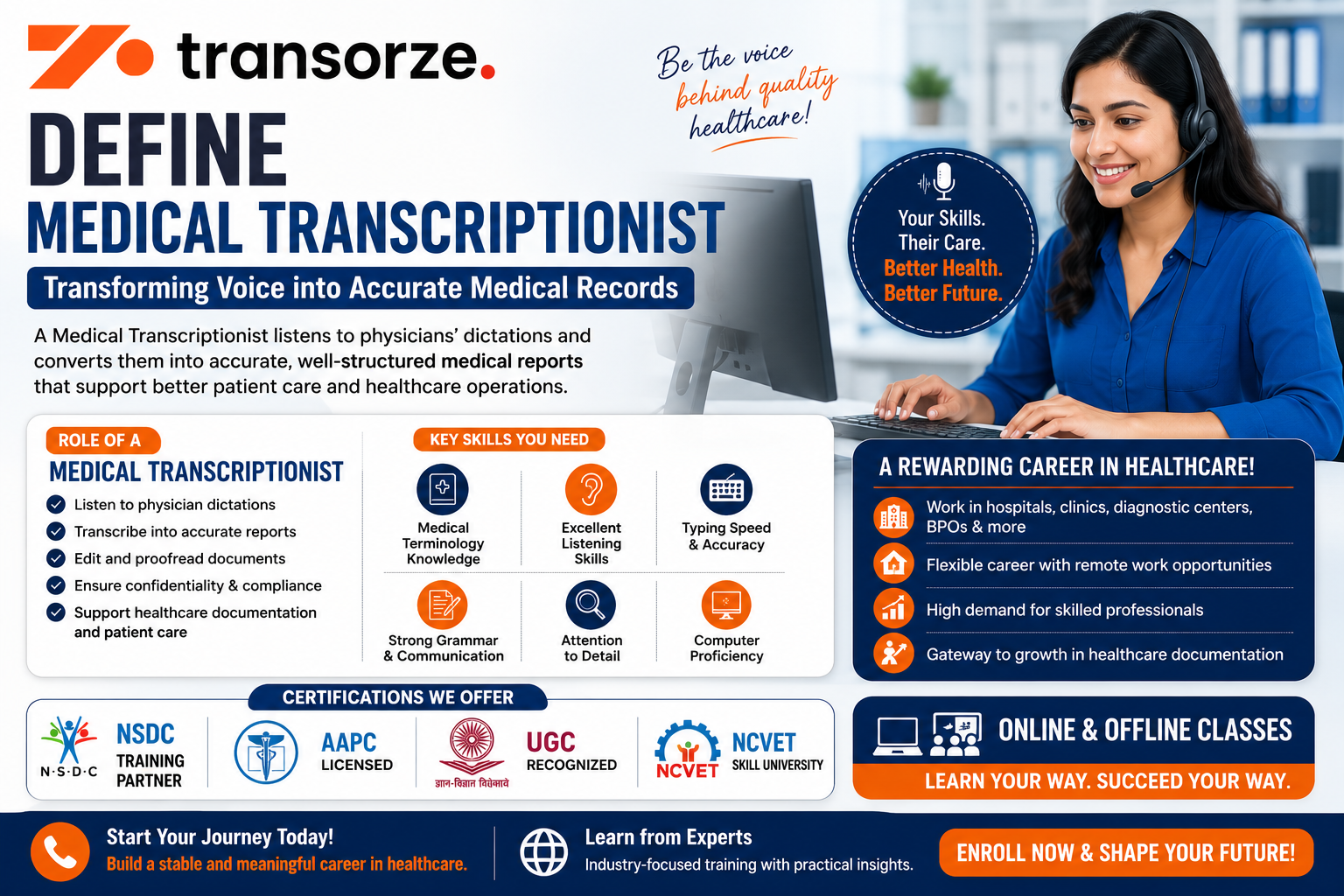
Healthcare organizations generate enormous amounts of medical information every day. Doctors, nurses, specialists, and healthcare providers document patient histories, diagnoses, treatment plans, and clinical observations. Ensuring this information is accurately recorded and maintained is critical for quality patient care.
If you’ve searched for “define medical transcriptionist,” you’re likely interested in understanding what this profession involves, how it fits into the healthcare system, and whether it offers a promising career path.
This comprehensive guide explains the role of a medical transcriptionist, their responsibilities, required skills, qualifications, career opportunities, and future prospects in today’s healthcare industry.
Define Medical Transcriptionist
A medical transcriptionist is a healthcare documentation professional who listens to voice recordings made by physicians and other healthcare providers and converts them into accurate written reports.
These reports become part of a patient’s permanent medical record and may include:
- Medical histories
- Physical examination reports
- Discharge summaries
- Operative reports
- Consultation notes
- Diagnostic test results
- Referral letters
In simple terms, when asked to define medical transcriptionist, the answer is:
A medical transcriptionist is a trained healthcare professional responsible for converting physician dictations into accurate, organized, and legally compliant medical documents.
Why Are Medical Transcriptionists Important?
Medical records are among the most critical documents in healthcare.
Accurate documentation helps:
- Improve patient care
- Support clinical decision-making
- Facilitate communication among healthcare providers
- Ensure proper insurance reimbursement
- Maintain legal compliance
- Preserve patient history
Medical transcriptionists play an essential role in ensuring that healthcare documentation is complete, accurate, and accessible.
Without proper documentation, healthcare organizations could face operational inefficiencies, billing challenges, and patient safety concerns.
What Does a Medical Transcriptionist Do?
A medical transcriptionist performs several specialized tasks that require both healthcare knowledge and language skills.
Listening to Physician Dictation
Doctors often record patient encounters using digital voice-recording systems.
Medical transcriptionists carefully listen to these recordings and convert them into written reports.
Creating Accurate Medical Documents
The transcriptionist ensures that reports are:
- Grammatically correct
- Properly formatted
- Accurate and complete
- Consistent with medical terminology
Reviewing Medical Information
Professionals verify information such as:
- Diagnoses
- Procedures
- Medications
- Laboratory results
- Clinical observations
Editing Speech Recognition Output
Many healthcare organizations now use speech recognition technology.
Medical transcriptionists frequently review and edit machine-generated reports to ensure accuracy.
Maintaining Confidentiality
Patient information is highly sensitive.
Medical transcriptionists must comply with privacy regulations and maintain strict confidentiality standards.
Key Responsibilities of a Medical Transcriptionist
The daily responsibilities of a medical transcriptionist may include:
Documentation Preparation
- Transcribing physician notes
- Preparing discharge summaries
- Creating consultation reports
- Formatting healthcare documents
Quality Assurance
- Checking spelling and grammar
- Verifying medical terminology
- Ensuring report accuracy
- Reviewing documentation standards
Record Management
- Updating patient records
- Organizing documentation
- Maintaining electronic health records
Communication
- Clarifying unclear dictations
- Coordinating with healthcare providers
- Supporting documentation workflows
These responsibilities require strong attention to detail and a solid understanding of healthcare terminology.
Skills Required to Become a Medical Transcriptionist
Successful medical transcriptionists possess a combination of technical and professional skills.
Medical Terminology Knowledge
Understanding medical language is essential.
Professionals must recognize:
- Diseases
- Treatments
- Surgical procedures
- Anatomy
- Physiology
- Pharmacology terms
Excellent Listening Skills
Accurately interpreting physician dictation requires focused listening and concentration.
Strong English Language Skills
Medical transcriptionists need excellent:
- Grammar
- Spelling
- Punctuation
- Sentence structure
Typing Speed and Accuracy
Fast and accurate typing improves productivity and efficiency.
Attention to Detail
Even minor documentation errors can affect patient care and reimbursement processes.
Computer Skills
Professionals work with:
- Word processing software
- Electronic health record systems
- Medical transcription platforms
- Speech recognition tools
Educational Requirements
Many employers prefer candidates with formal healthcare documentation training.
Medical transcription courses typically cover:
- Medical terminology
- Anatomy and physiology
- Pharmacology basics
- Healthcare documentation
- Medical transcription practices
- Editing and proofreading
- Healthcare compliance
Structured training helps students build confidence and develop job-ready skills.
For learners seeking professional training, Transorze provides Online & Offline classes and supports industry-focused education through credentials including NSDC Training Partner, AAPC Licensed, UGC Recognized, and NCVET Skill University.
These qualifications help learners gain healthcare documentation knowledge aligned with industry expectations.
Medical Transcriptionist Work Environment
Medical transcriptionists may work in a variety of healthcare settings.
Common employers include:
- Hospitals
- Multispecialty clinics
- Diagnostic centers
- Healthcare BPOs
- Medical documentation companies
- Telehealth providers
Many professionals also work remotely, making medical transcription an attractive option for those seeking flexible work arrangements.
Medical Transcriptionist vs Medical Scribe
Many people confuse these two healthcare roles.
| Medical Transcriptionist | Medical Scribe |
|---|---|
| Converts recorded dictation into written reports | Documents patient encounters in real time |
| Works after patient visits | Works during patient visits |
| Focuses on transcription and editing | Assists physicians directly |
| Often works remotely | Usually works on-site or virtually with physicians |
Both careers support healthcare documentation but differ significantly in workflow and responsibilities.
Career Opportunities in Medical Transcription
Medical transcription skills can lead to several healthcare documentation careers.
Common roles include:
Medical Transcriptionist
Creates and edits medical reports from physician dictation.
Medical Documentation Specialist
Ensures documentation quality and compliance.
Medical Editor
Reviews and improves healthcare documentation.
Healthcare Documentation Analyst
Evaluates documentation accuracy and workflow efficiency.
Quality Assurance Specialist
Monitors documentation standards and performance.
As healthcare organizations continue digitizing records, professionals with strong documentation skills remain valuable.
Is Medical Transcription Still a Good Career?
This is one of the most frequently asked questions by aspiring healthcare professionals.
The answer is yes—but the role has evolved.
Modern medical transcriptionists increasingly perform:
- Documentation review
- Speech recognition editing
- Quality assurance
- Clinical documentation support
Healthcare providers still require trained professionals to ensure medical records remain accurate and compliant.
As technology advances, the demand is shifting from pure transcription to documentation quality and editing expertise.
Advantages of Becoming a Medical Transcriptionist
There are several reasons people choose this profession.
Healthcare Industry Exposure
Professionals gain valuable healthcare knowledge without direct patient care responsibilities.
Flexible Work Opportunities
Remote and hybrid work arrangements are increasingly available.
Career Growth
Experience can lead to advanced documentation and healthcare administration roles.
Skill Development
The profession strengthens:
- Medical knowledge
- Communication skills
- Attention to detail
- Technical proficiency
Stable Demand
Accurate healthcare documentation remains essential regardless of technological advancements.
Future Scope of Medical Transcription
Healthcare documentation continues to evolve with digital transformation.
Emerging trends include:
- Speech recognition technology
- Electronic health records
- Clinical documentation improvement
- Remote healthcare services
- AI-assisted documentation tools
Rather than replacing professionals, these technologies often increase the need for skilled reviewers and documentation specialists who can ensure accuracy and compliance.
Professionals who combine transcription expertise with healthcare knowledge will continue to find opportunities in the industry.
Frequently Asked Questions
A medical transcriptionist is a healthcare professional who converts doctors’ voice recordings into written medical reports that become part of a patient’s permanent medical record.
They listen to physician dictations, prepare medical reports, edit documentation, verify medical terminology, and ensure healthcare records are accurate and complete.
Most employers prefer candidates with training in medical terminology, anatomy, healthcare documentation, and medical transcription practices.
Yes. Medical transcription offers healthcare industry exposure, flexible work opportunities, specialized skills, and pathways into broader healthcare documentation careers.
Yes. Many medical transcriptionists work remotely using secure healthcare documentation systems and digital transcription platforms.
Key skills include medical terminology knowledge, listening ability, typing accuracy, grammar proficiency, attention to detail, and computer literacy.
Final Thought
o define medical transcriptionist, it is best described as a healthcare documentation professional responsible for transforming physician dictation into accurate medical records. Their work supports patient care, healthcare communication, insurance processing, and regulatory compliance.
Medical transcription remains an important healthcare profession, especially for individuals who enjoy language, healthcare terminology, attention to detail, and technology. With the right training program and skills, it can provide a rewarding pathway into the growing healthcare documentation field. At Transorze, aspiring medical transcriptionists can build industry-relevant skills through structured training, practical learning, and flexible online and offline classes designed to prepare them for healthcare documentation careers.
