
10 Things Every Medical Coding Fresher Should Do Before Applying for Jobs
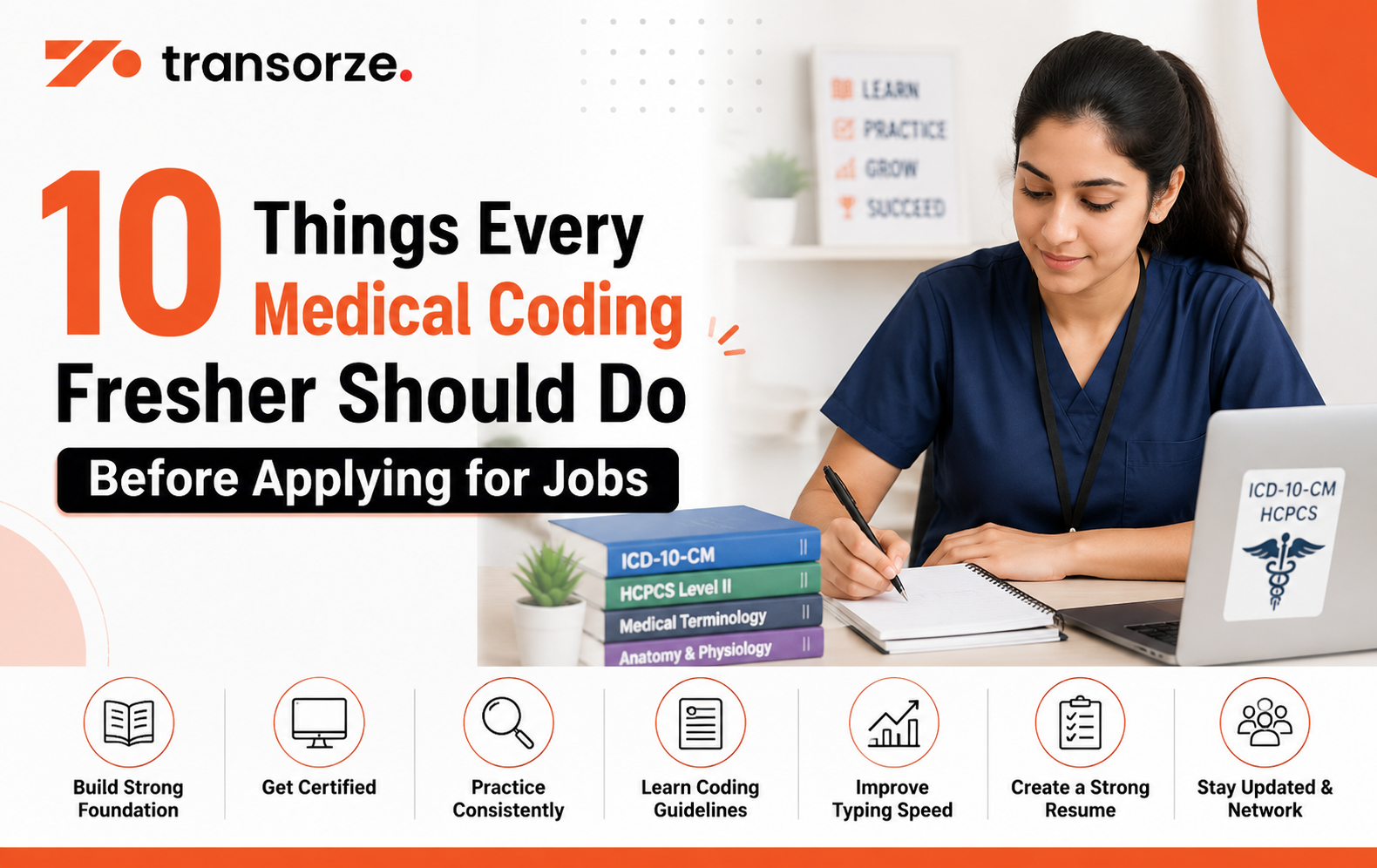
If you’re new to medical coding, there’s a good chance you already know the theory, but theory alone won’t get you hired. Recruiters and hiring managers in this field aren’t just looking for someone who memorized the ICD-10-CM index. They’re looking for someone who can actually code a real chart, communicate clearly, and hold their own in an interview.
So before you start firing off applications, it’s worth pausing and asking: am I actually job-ready, or do I just feel ready? Here are the 10 things every fresher should genuinely work on before applying for medical coding jobs.
1. Learn Medical Terminology Thoroughly
This is non-negotiable. Every code you’ll ever assign starts with understanding what the physician actually wrote. Build a strong foundation in medical terms, prefixes, suffixes, and word roots, because most clinical documentation is built from combinations of these.
If you can break down a word like “hepatosplenomegaly” into hepato (liver) + spleno (spleen) + megaly (enlargement) without blinking, you’re already ahead of most freshers walking into interviews.
2. Understand Anatomy and Physiology
Coding without understanding anatomy is like reading a map without knowing what a road looks like. Learn the structure and function of the human body, since it helps you understand conditions better and catch documentation inconsistencies before they become coding errors.c
For example, knowing that the kidneys sit retroperitoneally, or how the cardiac conduction system works, isn’t trivia. It’s what lets you sanity-check a diagnosis against the procedure being billed.
3. Practice ICD-10-CM Until It Feels Natural
Reading the guidelines once isn’t enough. Get comfortable with ICD-10-CM guidelines and code as many diagnoses as you can, across as many specialties as you can get your hands on. Cardiology charts read differently from orthopedic charts, and the only way to build that instinct is repetition.
Try setting yourself a small daily goal, even if it’s just 10-15 practice diagnoses a day, and track how your speed and accuracy improve over a few weeks.
4. Practice CPT Coding With Guidelines
CPT coding rewards precision. Practice CPT coding with guidelines to improve accuracy and speed, paying close attention to bundling rules, modifiers, and code descriptions that sound similar but aren’t interchangeable.
A lot of freshers rush this step because CPT feels more “mechanical” than ICD-10-CM. That’s exactly why it trips people up in real jobs, where speed and accuracy are both being measured from day one.
5. Learn HCPCS Level II Codes
HCPCS often gets overlooked in fresher prep, but understand Level II HCPCS codes properly, because they’re important for many specialties and claims, especially anything involving durable medical equipment, supplies, or drugs administered outside a typical office visit.
Skipping this is one of the more common gaps recruiters notice when reviewing fresher resumes.
6. Improve Your Communication Skills
Coding isn’t a solo desk job the way people imagine it. Strong communication helps in clarification, teamwork, and interview success. You’ll need to query physicians, coordinate with billing teams, and explain your reasoning when a claim gets questioned.
If you’re naturally a quieter person, this is worth actively practicing, not just hoping it improves on the job. Mock scenarios, group study sessions, and even simple habit like explaining a code choice out loud can help.
7. Build Genuine Confidence
Keep learning, keep practicing, and believe in your skills. This sounds like a throwaway line, but confidence is genuinely one of the biggest differentiators in interviews. Two candidates with similar knowledge often get very different offers based on how sure they sound explaining their reasoning.
Confidence here isn’t about bravado. It comes from having actually coded enough real scenarios that you’re not guessing anymore.
8. Attend Mock Interviews
Practice mock interviews to get comfortable and confident for real interviews. This step gets skipped constantly, usually because it feels uncomfortable or unnecessary. But the questions in a real coding interview (like walking through a chart live, or explaining why you sequenced a code a certain way) are very different from studying alone at home.
Even doing two or three mock interviews with a mentor or peer can dramatically reduce nerves on the actual interview day.
9. Practice Real Case Studies
Work on real-time coding scenarios to improve your analytical and coding skills. Textbook examples are clean and tidy. Real charts are messy, incomplete, and sometimes contradictory. Practicing with real or realistic case studies is what actually prepares you for that gap.
This is also where you start noticing patterns, like which specialties tend to have vague documentation, or which conditions commonly get miscoded.
10. Create a Professional LinkedIn Profile
Highlight your skills, courses, and achievements. A strong profile creates opportunities, sometimes before you even apply anywhere. Recruiters in the medical coding and healthcare BPO space actively search LinkedIn for candidates, and a profile that clearly lists your certifications, coding specialties, and any case study experience makes you far easier to find and shortlist.
Don’t just list “Medical Coder” as a headline. Be specific about what you know: ICD-10-CM, CPT, HCPCS, your certification status, and any specialty focus you’re building toward.
Why These 10 Steps Matter More Than They Seem
Notice that only three of these ten points are purely technical (ICD-10-CM, CPT, HCPCS). The rest are about anatomy fundamentals, communication, confidence, and how you present yourself. That’s not an accident. Employers in medical coding are hiring for accuracy and judgment, not just code lookup speed, and that combination is exactly what separates a fresher who gets hired quickly from one who sends out fifty applications with no response.
STUDENTS SUCCESS STORIES
Recommended Reads
Frequently Asked Questions
Medical terminology and anatomy should come first, since every ICD-10-CM and CPT code is built on understanding what the documentation actually describes clinically.
Yes. HCPCS Level II codes cover durable medical equipment, supplies, and certain drugs, and many claims across specialties require them, so skipping this creates a real gap in job readiness.
There’s no fixed number, but consistent daily practice with real or realistic case studies for several weeks is generally what it takes to code confidently and quickly enough for entry-level roles.
Very much so. Coders regularly query physicians for clarification and coordinate with billing and compliance teams, so weak communication can slow down claims and create friction with a team.
Yes. Mock interviews prepare you for live chart walkthroughs and code-sequencing questions that are very different from studying alone, and they significantly reduce first-interview nerves.
Recruiters in healthcare and coding actively search LinkedIn for candidates, so a clear, specific profile listing your certifications and coding focus areas can generate opportunities before you even apply.
Getting the Structured Practice Freshers Actually Need
Reading a list like this is easy. Actually building each of these ten skills, especially the case study practice, mock interviews, and specialty-specific coding speed, takes structured guidance and real feedback, not just self-study.
This is exactly the gap Transorze helps freshers close, with online classes that combine ICD-10-CM, CPT, and HCPCS practice with real case studies, mock interview sessions, and career guidance, so you walk into your first interview already coding like someone with experience.
