
AI Coding vs Human Coding Accuracy: Which Is More Reliable for Medical Coding in Kerala?
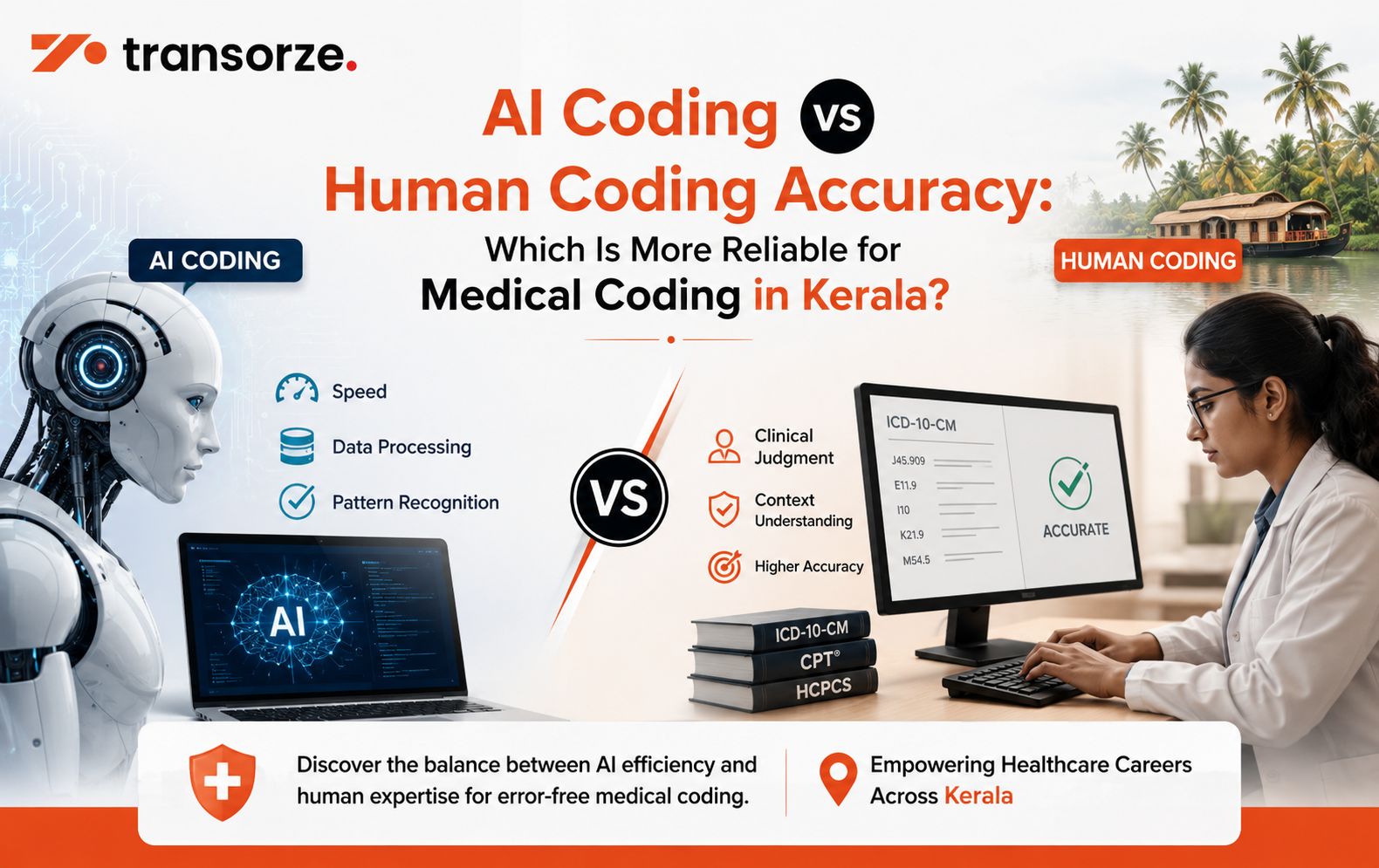
Medical coding is becoming increasingly technology-driven. Artificial intelligence (AI), natural language processing, and computer-assisted coding tools can now analyse clinical documentation and suggest diagnosis and procedure codes within seconds.
But an important question remains: Is AI coding more accurate than human coding?
For hospitals, diagnostic centres, healthcare BPOs, and medical coding professionals in Kerala, this is not simply a technology question. Coding accuracy can affect claims, reimbursement, documentation quality, compliance, audits, and the reliability of healthcare data.
The answer is not that AI is always more accurate than humans—or that human coders are always better. AI and human coders have different strengths, and the most reliable approach is often a combination of both.
Kerala’s healthcare sector includes large multispecialty hospitals, medical colleges, diagnostic centres, specialty hospitals, and a growing healthcare services and outsourcing ecosystem. As these organisations handle increasing volumes of digital medical records, the ability to code accurately and efficiently is becoming even more important.
This makes understanding AI Coding vs human coding accuracy especially relevant for healthcare professionals and aspiring medical coders in Kerala.
What Does Accuracy Mean in Medical Coding?
Before comparing AI with human coders, it is important to understand what “accuracy” actually means.
Medical coding accuracy is not simply about choosing a code that looks appropriate. A good coding process must consider documentation, specificity, sequencing, guidelines, completeness, and compliance.
1. Correct Code Selection
The first question is straightforward:
Does the selected ICD-10-CM, CPT, HCPCS, or other applicable code accurately represent the provider’s documentation?
For example, if a physician documents a specific type of diabetes with a documented complication, selecting only an unspecified diabetes code may fail to capture the full information available in the medical record.
2. Specificity
Accurate coding also means selecting the most specific code supported by the documentation.
Details such as:
- Laterality
- Acute versus chronic conditions
- Anatomical site
- Complications
- Encounter type
- Disease stage
- Procedure details
can influence code selection.
An AI system can systematically scan documentation for these details. However, a human coder must still determine whether the documentation actually supports the suggested code.
3. Completeness
A coder should identify all reportable conditions and procedures supported by the medical record.
A patient may be admitted primarily for one condition while also having documented hypertension, diabetes, chronic kidney disease, or another clinically relevant condition.
Missing important secondary diagnoses can reduce the completeness of the coded record.
4. Sequencing
In many coding environments, the order in which diagnoses and procedures are reported matters.
Human coders use coding guidelines and clinical documentation to determine appropriate sequencing. AI can assist with this process, but complex cases may still require experienced human judgement.
5. Compliance
Accuracy also means following applicable coding rules rather than simply selecting the code that appears to produce the highest reimbursement.
For organisations serving international healthcare markets, coders may need to work with systems such as ICD-10-CM and CPT according to the requirements of the relevant client, payer, and jurisdiction. The official FY 2026 ICD-10-CM guidelines emphasise that complete documentation and review of the entire medical record are essential for accurate coding.
Where AI Coding Excels
AI has several significant advantages when processing large volumes of medical documentation.
Consistency
One of AI’s biggest advantages is consistency.
An AI system does not become tired after coding hundreds of charts. It does not lose concentration at the end of a long shift and does not naturally change its approach because of workload pressure.
If the same documentation is processed under the same rules, an AI system can produce consistent recommendations.
For high-volume healthcare operations in cities such as Kochi, Thiruvananthapuram, Kozhikode, and Kottayam, this consistency can be valuable.
Speed
AI can analyse large volumes of documentation much faster than manual coding.
Instead of manually searching through every section of a medical record, an AI-assisted system can identify potentially relevant diagnoses, procedures, terminology, and coding opportunities.
This can help reduce turnaround time and allow human coders to spend more time on complex cases.
Identifying Specificity
AI can scan large amounts of clinical text and identify details that may support a more specific code.
For example, a clinical note may contain information about:
- Chronicity
- Disease severity
- Anatomical location
- Complications
- Laterality
- Associated conditions
An AI tool can highlight these details for the coder instead of requiring the coder to locate every relevant phrase manually.
Completeness Checks
AI can review the documentation systematically and flag potential diagnoses or procedures that may have been overlooked.
This can be particularly useful in lengthy hospital records containing physician notes, operative reports, discharge summaries, laboratory information, and other documentation.
Handling High Volumes
Kerala has a strong healthcare ecosystem, and many hospitals and healthcare service providers handle substantial patient volumes.
During periods of increased workload, AI can help process routine cases without increasing the workload proportionally for human coding teams.
Supporting Coding Quality
AI-assisted coding can also help identify potential inconsistencies, missing information, or cases that require further review.
However, the effectiveness of these systems depends heavily on the quality of the technology, the underlying coding rules, the training data, and the quality of the medical documentation.
Where Human Coders Remain More Accurate
Despite rapid advances in AI, human expertise remains essential.
The reason is simple:
Medical coding is not only code lookup. It requires interpretation, judgement, and understanding of documentation.
Clinical Judgement
Human coders can recognise situations where the documentation does not tell a simple, straightforward story. Consider a hypothetical case from a multispecialty hospital in Kochi. A physician’s documentation may contain several diagnoses, symptoms, previous conditions, and treatment details. The coder needs to determine which conditions are actually supported and reportable—not simply select every diagnosis mentioned in the record. An experienced coder can recognise relationships and inconsistencies that an automated system may misunderstand.
Handling Ambiguous Documentation
Suppose a medical record contains conflicting information. One section describes a condition as acute, while another section suggests a chronic condition. The AI system may flag both pieces of information, but deciding what should ultimately be coded may require clarification from the healthcare provider. A human coder can identify the issue and initiate an appropriate coding query.
Understanding Context
Medical records are not always written in perfectly structured language. Doctors may use abbreviations, specialty-specific terminology, shorthand, or clinical descriptions that require contextual understanding. A human coder with strong knowledge of anatomy, physiology, medical terminology, and disease processes can interpret documentation more effectively.
Complex and Unusual Cases
Routine cases are easier for AI. Rare diseases, unusual procedures, complex surgical cases, multiple comorbidities, and unusual combinations of diagnoses can be more challenging. Experienced coders can research guidelines, review the complete record, and determine the appropriate approach when an automated system is uncertain.
Audit and Compliance Reasoning
A human coder can explain why a particular code was selected and refer to the applicable coding guideline or documentation. This reasoning becomes especially important when a claim or coded record is reviewed during an audit.
AI Coding vs Human Coding Accuracy: A Practical Comparison
Coding Factor | AI Coding | Human Coding |
Routine documentation | Excellent | Excellent |
Speed | Very high | Moderate |
Consistency | Very high | Can vary |
High-volume processing | Excellent | Limited by workload |
Specificity detection | Strong | Strong with experience |
Complete record interpretation | Good | Excellent |
Ambiguous documentation | Limited | Strong |
Clinical judgement | Limited | Excellent |
Rare conditions | Variable | Strong with expertise |
Complex procedures | Variable | Strong |
Documentation queries | Cannot independently replace human judgement | Excellent |
Audit explanation | Limited | Strong |
Repetitive coding | Excellent | Can lead to fatigue |
Final judgement | Requires oversight | Human responsibility |
The comparison shows why there is no universal answer to whether AI or humans are “more accurate.”
AI is highly effective at consistency, speed, pattern recognition, and repetitive analysis. Human coders are stronger at interpretation, judgement, ambiguity, and complex decision-making.
What Does This Mean for Healthcare in Kerala?
Kerala’s healthcare environment makes this distinction particularly important.
The state has a diverse healthcare network spanning government hospitals, private multispecialty hospitals, medical colleges, diagnostic centres, specialty institutions, and AYUSH establishments.
The Kerala Clinical Establishments (Registration and Regulation) Act, 2018 establishes a framework for registration and regulation of clinical establishments in the state and includes requirements relating to standards, records, information, and reporting. That means accurate healthcare documentation is not merely an administrative task.
It contributes to:
- Better healthcare records
- Reliable reporting
- Claims and reimbursement processes
- Audit readiness
- Healthcare analytics
- Operational decision-making
- Public health data
- Compliance
The Kerala Health Department also maintains health-related datasets covering areas such as non-communicable diseases, child health, maternal and child health, disease statistics, and other programmes. Reliable healthcare data depends on accurate documentation and coding processes.
For Kerala’s growing healthcare and health-information workforce, this creates an important opportunity: medical coders need to learn how to work with AI rather than simply compete against it.
A Realistic Example: AI + Human Coding
Imagine a hospital in Thiruvananthapuram processing hundreds of outpatient encounters every day. A large proportion of the records contain straightforward documentation.
For example:
- Clearly documented hypertension
- Routine diabetes follow-up
- Simple respiratory infections
- Routine laboratory-related encounters
- Clearly documented follow-up visits
AI can review these records, identify relevant terminology, and generate coding suggestions. A human coder can then verify the suggestions according to the documentation and applicable coding guidelines.
Now consider a more complicated case.
A patient has multiple chronic conditions, an acute complication, conflicting documentation, and a complex procedure.
In this situation, the AI system can still be useful by:
- Highlighting potential diagnoses
- Identifying relevant documentation
- Suggesting possible codes
- Flagging inconsistencies
- Providing a starting point for the coder
But the experienced coder remains responsible for reviewing the record, applying coding knowledge, resolving ambiguity, and determining whether the suggested codes are actually supported. This is where the combination becomes powerful.
The Best Approach: AI + Human Expertise
The future of medical coding is unlikely to be a simple battle between AI and human coders. Instead, the strongest model is likely to be AI-assisted human coding.
Level 1: AI Handles Routine Cases
AI can process straightforward, well-documented cases where the coding logic is relatively clear. Human coders can perform targeted quality checks rather than manually processing every routine chart from the beginning.
Level 2: Human Review for Moderate Cases
When the AI system has lower confidence or identifies potential documentation issues, the case can be routed to a human coder. The coder reviews the suggestions and makes corrections where necessary.
Level 3: Human-Led Complex Coding
Highly complex, unusual, ambiguous, or high-risk cases should receive deeper human review. Here, AI functions as an assistant rather than the final decision-maker.
Why This Combined Model Works
AI can help humans:
- Work faster
- Find information more efficiently
- Reduce repetitive work
- Identify potential missed codes
- Maintain consistency
- Prioritise complex cases
Human coders can help AI by:
- Validating suggestions
- Correcting errors
- Resolving ambiguity
- Interpreting clinical context
- Applying coding judgement
- Handling unusual cases
The result is not “AI replacing humans.”
It is AI making skilled coders more productive and skilled coders making AI safer and more reliable.
Does AI Coding Mean Medical Coders Will Lose Their Jobs?
This is one of the biggest concerns among students considering medical coding as a career. The more realistic change is that the role of the medical coder is evolving.
As AI becomes better at routine coding tasks, employers may increasingly value coders who can:
- Review AI-generated codes
- Identify AI errors
- Understand medical documentation
- Perform quality audits
- Handle complex coding
- Resolve documentation issues
- Apply coding guidelines
- Understand compliance
- Work with computer-assisted coding systems
- Perform critical analysis
Professional coding organisations are already highlighting the growing importance of critical thinking and the ability to validate, accept, reject, or override AI-generated coding suggestions.
This is particularly important for students and professionals in Kerala who want to build long-term careers in healthcare BPO, medical coding, revenue cycle management, hospital documentation, and related fields.
What Should Kerala Medical Coding Students Learn?
If you are a student from Kochi, Thiruvananthapuram, Kollam, Kottayam, Kozhikode, Kannur, or another part of Kerala, learning traditional medical coding fundamentals remains essential. AI should not replace the fundamentals. Instead, your learning path should include both.
Medical Coding Fundamentals
Build a strong foundation in:
- Anatomy and physiology
- Medical terminology
- Pathophysiology
- ICD coding
- CPT concepts
- HCPCS concepts
- Coding guidelines
- Diagnosis and procedure documentation
- Compliance
- Medical records
AI-Assisted Coding Skills
Then develop an understanding of:
- Computer-assisted coding
- Natural language processing
- AI-generated coding suggestions
- Confidence scoring
- AI validation
- Error identification
- Documentation analysis
- Human-in-the-loop workflows
- Coding quality audits
Critical Thinking
Most importantly, learn to ask:
“Does the documentation actually support this code?”
That question will remain valuable regardless of how advanced AI becomes.
How Transorze Approaches Medical Coding in the AI Era
At Transorze, we believe medical coding education should prepare learners for the healthcare industry they are entering—not only the industry that existed a few years ago. That means students need more than memorisation of code sets. They need to understand why a code is selected, how documentation supports it, how coding guidelines are applied, and how technology is changing the workflow.
AI-assisted coding does not eliminate the need for medical coders. Instead, it increases the value of professionals who understand both coding principles and technology.
For students in Kerala, this creates an opportunity to build a future-ready healthcare career by combining medical coding knowledge with digital and AI-enabled skills.
How Should Hospitals Measure AI Coding Accuracy?
Hospitals and healthcare organisations should not judge an AI system using a single accuracy percentage.
Instead, they should monitor several indicators.
Code Accuracy: How often does the AI recommendation match expert-reviewed coding?
Modification Rate: How frequently do human coders need to change AI-generated suggestions?
Completeness: Does AI identify all relevant, documentation-supported conditions and procedures?
Specificity: Does it consistently identify the most specific code supported by the record?
Compliance: Does the system follow current coding guidelines and organisational requirements?
Productivity: How much time does AI-assisted coding save without compromising quality?
Audit Results: Do independent audits identify systematic AI errors?
These measurements provide a much clearer picture than simply asking whether “AI is accurate.”
The Biggest Factor Behind Coding Accuracy: Documentation
There is one factor that neither AI nor human coders can completely overcome:
Poor documentation.
If a healthcare provider’s documentation is incomplete, vague, contradictory, or missing important clinical details, the coder may not have enough information to assign the most appropriate code. AI cannot magically create documentation that does not exist.
Human coders cannot legitimately code unsupported information either. This is why accurate documentation by healthcare providers and accurate interpretation by coders must work together.
The FY 2026 ICD-10-CM guidelines emphasise the importance of reviewing the complete medical record and note that accurate coding depends on complete and consistent documentation.
AI Coding vs Human Coding Accuracy: Who Wins?
The answer depends on the type of case.
For routine, high-volume, well-documented cases: AI can be extremely fast and consistent.
For complex and ambiguous cases: experienced human coders remain essential.
For the highest overall workflow efficiency and reliability: AI-assisted human coding is often the strongest approach.
The future is therefore not simply:
AI vs Human
It is:
AI + Human Expertise.
AI can process information at machine speed. Human coders bring clinical understanding, critical thinking, judgement, and accountability.
When these strengths are combined correctly, healthcare organisations can improve productivity without treating accuracy as an afterthought.
The Future of Medical Coding in Kerala
Kerala’s healthcare sector will continue to generate increasing amounts of digital clinical information. As hospitals and healthcare service providers adopt more technology, medical coding workflows are likely to become increasingly automated and data-driven.
This does not make medical coders irrelevant. It changes what makes a coder valuable.
The future medical coder will increasingly be someone who can understand the medical record, apply coding guidelines, evaluate AI suggestions, identify errors, and make defensible decisions. For students and healthcare professionals in Kerala, this is an opportunity rather than a threat. Medical coding training and placements can help learners develop the practical knowledge required for this changing healthcare environment.
AI may change how medical coding is performed, but human expertise will continue to determine whether the final coding decision is accurate, appropriate, and supported by documentation.
Students who want to build these fundamentals can explore a Medical Coding Course in Kerala designed around coding systems, guidelines and industry requirements.
Recommended Reads
Frequently Asked Questions
Not in every situation. AI can be highly accurate for routine, well-documented cases and offers strong consistency and speed. Human coders remain better equipped to handle ambiguity, complex documentation, unusual cases, and clinical judgement.
AI is more likely to automate parts of the coding workflow than eliminate the need for skilled coders completely. Human expertise remains important for validation, complex cases, documentation issues, audits, and quality control.
Yes. AI-assisted coding can help healthcare organisations manage large volumes of documentation, improve workflow efficiency, and support coding consistency. However, implementation should include appropriate human review and quality monitoring.
Yes. Students should first develop strong medical coding fundamentals and then learn how AI and computer-assisted coding tools are used to support the coding process.
AI can assist with complex coding by identifying relevant documentation and suggesting possible codes. However, complex, ambiguous, or unusual cases should receive experienced human review.
The future is likely to involve greater automation combined with human oversight. Medical coders who develop strong coding knowledge, analytical thinking, documentation skills, and AI-assisted coding capabilities will be better positioned for the changing healthcare industry.
Final Takeaway
The debate around AI Coding vs human coding accuracy should not be about choosing one and eliminating the other.
AI brings speed, consistency, scalability, and powerful documentation analysis. Human coders bring clinical understanding, judgement, contextual interpretation, and the ability to deal with situations that do not fit neatly into predefined patterns. For Kerala’s evolving healthcare ecosystem, the strongest approach is to bring these capabilities together.
AI can assist the coder. Technology can accelerate the workflow. But skilled human expertise remains at the centre of accurate medical coding. For aspiring medical coders in Kerala, the message is clear: don’t prepare to compete with AI—prepare to become the coder who knows how to work with it.
Transorze focuses on building industry-oriented healthcare skills that help learners understand the fundamentals of medical coding while preparing for the technology-driven future of healthcare documentation.
