
Medical Coding Classes: Online and Classroom Training That Actually Gets You Job-Ready

OUR BRANCH ADDRESS

Phone:+91 949 583 3319

Website:www.transorze.com 

SEND A MESSAGE

If you’ve started looking into medical coding classes online, you’ve probably noticed the same problem everyone runs into: a hundred institutes claim to be “the best,” but very few explain what you’re actually signing up for. This page is meant to fix that — what medical coding is, what a good class should include, how online and offline formats compare, and how to tell a training program that leads to a job from one that just leads to a certificate.

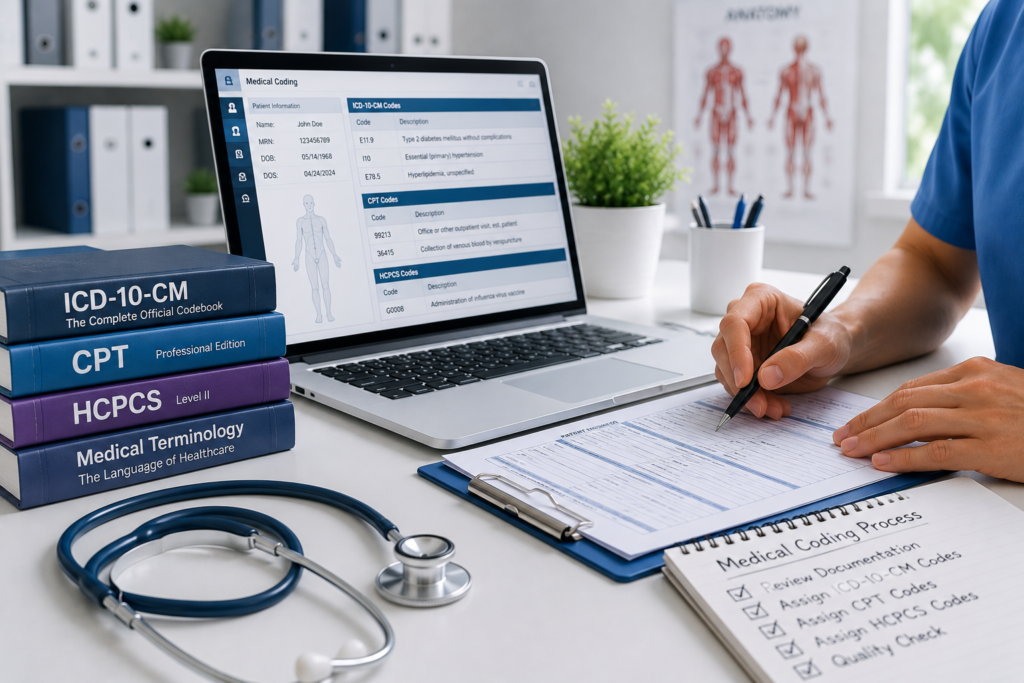
Medical coding is the process of translating a doctor’s diagnosis, procedure, and treatment notes into standardized alphanumeric codes (ICD-10-CM, CPT, and HCPCS Level II) that insurance companies and healthcare systems use for billing, records, and compliance. It’s one of the few healthcare-adjacent careers you can enter without a medical degree, which is exactly why demand for structured, well-taught medical coding classes has grown so quickly — in hospitals, insurance companies, billing firms, and remote/work-from-home roles.

What You Should Expect From a Good Medical Coding Class

Not all “medical coding classes” are built the same. Before you enroll anywhere, check whether the program actually covers these fundamentals:

  • Anatomy and medical terminology — you can’t code a diagnosis you don’t understand
  • ICD-10-CM diagnosis coding — the current U.S. and international coding standard
  • CPT and HCPCS Level II procedure coding — for outpatient and physician billing
  • Medical record documentation review — reading real (de-identified) clinical charts, not just textbook examples
  • Insurance and reimbursement basics — how coding connects to claims and revenue cycle management
  • Hands-on practice coding — case studies, not just multiple-choice theory
  • Certification exam preparation — for CPC (Certified Professional Coder) or equivalent industry-recognized credentials
  • Placement support — resume building, mock interviews, and employer connections after course completion

If a program skips the hands-on practice and certification prep, you’ll finish “informed” but not actually employable — and that gap is where most disappointed students get stuck.

Online vs. Offline Medical Coding Classes: Which Should You Choose?

This is the single most common question we hear, and honestly, the right answer depends on how you learn — not on which format is “better.”

Choose online medical coding classes if:

  • You’re balancing the course with a job, family, or other commitments
  • You live outside a city with an in-person training center
  • You’re comfortable learning through recorded/live virtual sessions and want to revisit lessons at your own pace
  • You want to start sooner rather than waiting for a classroom batch to fill

Choose offline (classroom) classes if:

  • You learn better with in-person accountability and face-to-face doubt-clearing
  • You want direct access to trainers for hands-on chart-reading practice
  • You value the structure of fixed class timings
  • You’re located near a physical training campus

The honest answer: both formats can get you certified and placed, provided the curriculum, trainers, and practice material are equally rigorous. What actually matters more than the delivery mode is whether the institute gives you real case studies, doubt-resolution access, and placement support — ask about all three before comparing online vs. offline.

Transorze runs both tracks side by side, so students choose the format that fits their life rather than being forced into whichever one the institute finds easier to run — with campuses across Kerala and Tamil Nadu for those who prefer classroom learning, and a fully supported online track for everyone else, regardless of location.

Who Should Take Medical Coding Classes?

Medical coding attracts a wider range of students than most people expect:

  • Life science and paramedical graduates (BSc Nursing, Pharmacy, Zoology, Microbiology, Biotechnology, Physiotherapy) looking for a healthcare career that doesn’t require a clinical license
  • Career switchers from unrelated fields who want stable, process-driven work with clear certification pathways
  • Homemakers and remote-work seekers drawn to the work-from-home flexibility many coding roles offer once certified
  • Fresh graduates who want a shorter, skill-focused alternative to a multi-year degree before entering the workforce
  • Working professionals in hospital administration or billing who want to formalize their coding knowledge with a recognized certification

There’s no strict eligibility ceiling, but a background in life sciences, nursing, or a related field does make the anatomy and terminology sections easier to pick up.

What Happens After the Course: Certification and Career Paths

Completing a medical coding class is the training step — certification is what employers actually screen for. Most reputable programs prepare students for a nationally or internationally recognized coding certification exam (such as CPC), because certified coders are simply preferred over uncertified ones in almost every hiring pipeline, from hospitals to third-party billing companies to insurance providers.

Once certified, coders typically move into roles like:

  • Medical Coder / Coding Specialist
  • Medical Records Analyst
  • Claims Processing Associate
  • Coding Auditor (with experience)
  • Coding Trainer/QA (with experience)

Compensation varies by employer, geography, specialty coding certifications, and experience — an admissions counsellor can walk you through realistic entry-level and growth expectations based on the specific role you’re targeting, rather than relying on generic national averages that may not reflect your local market.

How to Choose the Right Medical Coding Institute

A few practical filters that matter more than marketing claims:

  1. Ask what percentage of class time is hands-on coding practice, not lecture-only theory.
  2. Ask to see sample study material or a demo class before paying full fees.
  3. Check whether certification exam prep is built into the curriculum or sold as a separate add-on.
  4. Ask specifically what placement support looks like — is it a vague promise, or an actual process (resume review, mock interviews, employer referrals)?
  5. Confirm trainer background — are they practicing/experienced coders, or generic instructors reading slides?
  6. Compare online and offline batch options at the same institute, so you’re not choosing your institute and your format at the same time under pressure.

Why Many Students Choose Transorze

Many aspiring healthcare professionals choose Transorze because it combines quality education with industry-focused training. Students can choose Online & Offline classes based on their learning preferences while benefiting from programs supported by NSDC Training Partner, AAPC Licensed, UGC Recognized, and NCVET Skill University affiliations. This combination helps learners build practical skills, gain recognized credentials, and prepare confidently for careers in medical coding and billing.

NSDC, NCVET, UGC LOGO

STUDENT SUCCESS STORIES

Frequently Asked Questions

Medical coding is the process of converting a doctor’s diagnosis, treatment, and procedure notes into standardized codes (ICD-10-CM, CPT, and HCPCS) so that insurance companies and healthcare systems can process billing, records, and compliance accurately.

Yes. Medical coding classes online cover the same core curriculum as classroom training — anatomy, terminology, ICD-10-CM, CPT, HCPCS, and certification exam preparation — through live or recorded sessions, with the added flexibility of studying around your existing schedule.

Most structured medical coding classes run for a few months, depending on whether you’re studying full-time or part-time and whether the program includes certification exam preparation. Ask any institute for their exact batch duration before enrolling, since this varies by curriculum depth.

No formal medical degree is required. However, a background in life sciences, nursing, pharmacy, or a related paramedical field makes the anatomy and medical terminology portions of the course noticeably easier to grasp.

The CPC (Certified Professional Coder) credential is one of the most widely recognized certifications in the medical coding industry. A good training program builds exam preparation directly into the coursework rather than leaving you to prepare separately.

Yes, medical coding is one of the more remote-friendly healthcare-adjacent careers, since the work involves reviewing documentation and assigning codes — tasks that don’t require physical presence at a facility. Many certified coders work fully remote or hybrid roles after gaining some initial experience.

Medical coding is about assigning the correct diagnosis and procedure codes to a patient encounter. Medical billing uses those codes to generate and submit insurance claims for payment. The two are closely related, and many training programs — including combined coding and billing tracks — teach both together.

They can be, provided the online program includes live interaction with trainers, real case-study practice, and structured certification prep — not just pre-recorded videos. The learning format matters less than the quality of the curriculum and the amount of hands-on practice included.

popup banner image

Start Your Dream Career with Industry-Recognized Training

Get your FREE Course Brochure