
Copyright © Transorze. All rights reserved.
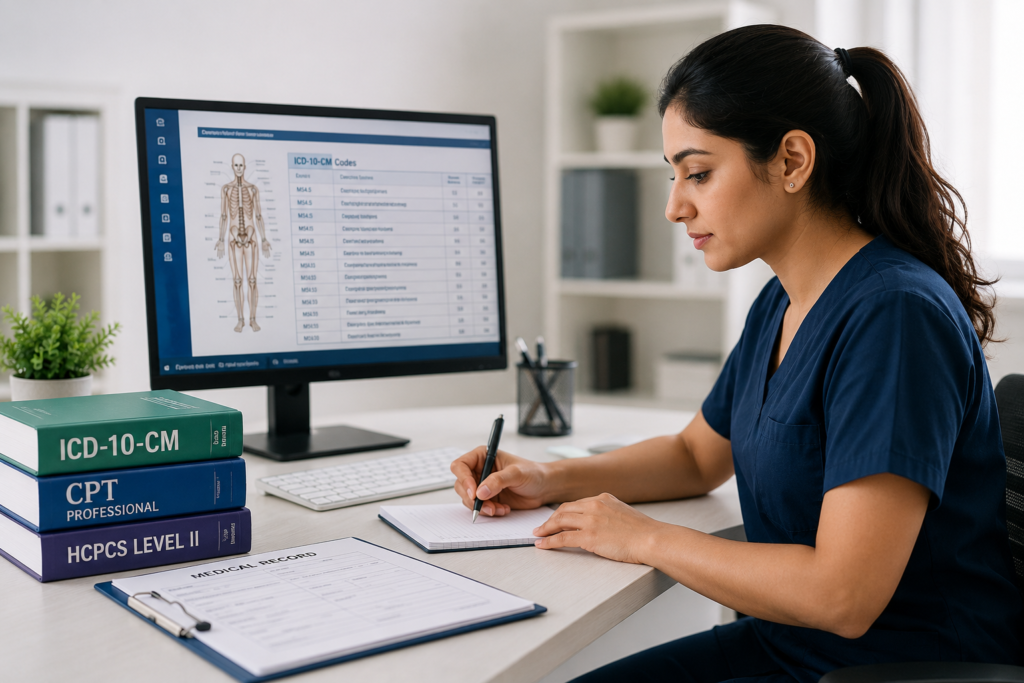
If you are in Perinthalmanna and looking into medical coding as a career, the good news is that geography is no longer a barrier. Medical coding training today is delivered online, which means students across Malappuram district — including those in and around Perinthalmanna — can access the same quality of live instruction that was previously available only to those willing to travel to Kochi or Thiruvananthapuram.
This page walks you through what medical coding actually involves, what a credible training programme should cover, what the job market looks like for coders from this region, and what to ask before you enrol anywhere.
Medical coding is the process of translating clinical documentation — a physician’s notes about a diagnosis, a surgical report, a radiology finding — into standardised alphanumeric codes. These codes are submitted to insurance companies for reimbursement and are also used for healthcare data analysis and compliance.
The three main coding systems in use are ICD-10-CM (International Classification of Diseases, 10th Revision) for diagnoses, CPT (Current Procedural Terminology) for procedures, and HCPCS Level II for outpatient services, supplies, and pharmaceuticals. A trained medical coder works with all three, matching the clinical language in patient records to the correct codes from these systems.
It is a desk job, largely computer-based, and increasingly done remotely. You do not provide clinical care — you translate the record of care into a standardised format that the healthcare billing system can process. That distinction is important: a clinical background helps, but it is not required to become a skilled and employed medical coder.
Medical coding training is open to a fairly wide range of educational backgrounds. Most training providers accept candidates with the following:
BSc Biology, Zoology, Biochemistry, Microbiology, and related graduates are well-positioned for medical coding. The anatomy and physiology component of the course, which typically takes two to three weeks, is covered faster when students already have a biology foundation. That said, the coding curriculum teaches everything from scratch — prior clinical knowledge accelerates the learning curve, it does not replace the training itself.
GNM and BSc Nursing graduates, physiotherapists, pharmacists, and lab technicians are among the most employable candidates after medical coding training. Employers hiring for inpatient and surgical coding roles value clinical exposure, and nurses in particular tend to have strong anatomy knowledge and familiarity with medical terminology that translates directly into faster certification.
Commerce and arts graduates can also enter the field, though they will need to invest more time in the anatomy and terminology modules. The CPC (Certified Professional Coder) exam from AAPC does not require a science degree — it tests coding knowledge and application, which is teachable regardless of prior educational stream.
If you are unsure whether your background qualifies, the most useful step is to speak with a trainer directly rather than second-guessing eligibility on your own.
A well-structured medical coding program for CPC certification typically covers the following, delivered over three to five months of live instruction plus exam preparation:
The course opens with a systems-level review of human anatomy — musculoskeletal, cardiovascular, respiratory, digestive, neurological, genitourinary, and integumentary systems. Alongside this, medical terminology is taught in depth: Greek and Latin root words, prefixes, suffixes, and combining forms that appear repeatedly in physician documentation. This section typically takes three to four weeks and sets the foundation for everything that follows.
ICD-10-CM is the diagnosis coding system used in the United States. The curriculum covers the official coding guidelines — including how to sequence primary and secondary diagnoses, how to use combination codes, when to apply placeholder characters, and how to navigate chapter-specific instructions for areas like neoplasms, injuries, and obstetric coding. Students work with the ICD-10-CM codebook directly, not just a simplified summary.
CPT (Current Procedural Terminology) is the largest and most complex component of the CPC exam. The curriculum covers all major sections: Evaluation and Management (E/M), Anesthesia, Surgery (by body system), Radiology, Pathology and Laboratory, and Medicine. The Surgery section alone spans multiple weeks given its scope. Students practice selecting codes from operative reports and procedure notes, not just from abstract descriptions.
HCPCS codes are used for services and supplies not covered in CPT — durable medical equipment, ambulance services, specific drug codes, and outpatient procedures. This section is shorter but appears on the CPC exam and is essential for real-world billing in outpatient settings.
Many programmes integrate a billing overview alongside coding — covering how coded claims are submitted, what insurance adjudication looks like, common denial reasons, and how revenue cycle management (RCM) works. This context helps students understand why accurate coding matters and prepares them for workplaces where coding and billing functions overlap.
The CPC exam, administered by the AAPC, is five hours and forty minutes long and consists of 100 multiple-choice questions across 40 medical specialties. It is open-book: candidates bring tabbed CPT, ICD-10-CM, and HCPCS codebooks. Knowing where to find codes quickly under time pressure is a skill the exam prep phase focuses on directly. Good training programmes include timed mock exams, performance analysis by section, and targeted revision for weak areas.
Transorze delivers medical coding training as live online classes — not pre-recorded videos you watch at your own pace, but scheduled sessions with a trainer in real time. This distinction matters more than it might initially seem.
Live instruction means you can ask questions during the session, get immediate clarification on coding scenarios, and receive feedback on practice submissions. It also means you are accountable to a batch schedule, which most students find keeps their preparation on track. Sessions are held on weekday schedules, with batch timings that typically accommodate working students or those who have other daytime commitments.
For students in Perinthalmanna and the wider Malappuram district, this model removes a barrier that used to be significant: you do not need to relocate, rent accommodation in a city, or spend hours commuting. A stable internet connection and a laptop or desktop computer are the main prerequisites. The training environment — live, instructor-led, with shared case studies and mock exams — mirrors the remote work environment you will eventually work in as a certified coder.
The primary employers for Kerala-based medical coders are US-focused healthcare organisations operating through Indian delivery centres. These include revenue cycle management (RCM) companies, third-party billing firms, health information management companies, and healthcare BPOs. Many of these organisations hire remotely, which works in favour of coders in smaller towns — your location is not a disadvantage once you have your credential and some experience.
Entry-level coders with a CPC-A credential typically earn between ₹15,000 and ₹22,000 per month in their first role. Within two to three years, coders who develop specialty experience — particularly in high-demand areas like cardiology, orthopaedics, oncology, or interventional radiology — commonly earn ₹30,000–₹50,000 per month. Coders with additional credentials (like the CCS or specialty-specific AAPC certificates) and experience working directly with US clients tend to earn above this range, especially in freelance or remote-contract arrangements.
Medical coding is one of the more genuinely remote-friendly professions in the healthcare services sector. Once a coder has verified experience and an active CPC credential, work-from-home arrangements are common — both with Indian-based employers and with international clients. For students in Perinthalmanna who are weighing this as a career, the ability to work from home permanently is a concrete and realistic outcome, not a vague aspiration.
Not every training provider offers the same quality of instruction, and the differences are worth understanding before you pay a fee.
Trainer credentials: Ask whether the trainers hold active CPC or CCS certifications from AAPC or AHIMA. A trainer who certified a decade ago and has not coded since is not the same as one who stays current with annual codebook updates and coding guidelines.
Live vs. recorded sessions: Live classes allow doubt-clearance and real-time interaction. Pre-recorded modules have their place as supplementary material, but they should not be the primary instructional format for a skills-based programme like medical coding.
Codebook access: The CPC exam requires the official CPT Professional Edition, ICD-10-CM, and HCPCS Level II codebooks. Confirm whether the programme includes these or whether you need to purchase them separately — they add to the cost of preparation.
Exam registration support: AAPC exam registration, scheduling, and the two-year apprentice period (for CPC-A to full CPC upgrade) can be confusing for first-time candidates. A good training provider walks students through this process rather than leaving it to individual research.
Post-course access: Doubts do not stop the day your batch ends. Ask whether you can reach trainers during your individual exam preparation window and whether LMS access continues after the course.
Placement process: Ask directly what the placement support involves — resume review, mock interviews, employer connections, or all three. Vague answers about “placement assistance” without specifics are a signal to probe further.

Yes. Medical coding classes for Perinthalmanna students are available online, with live instructor-led sessions that do not require travel or relocation. Students across Malappuram district — including Perinthalmanna, Manjeri, and surrounding areas — can join scheduled batches and receive the same quality of training as students in larger cities.
Most medical coding programmes accept candidates with a minimum of 10+2 (Plus Two) qualification. Science backgrounds — particularly Biology — are an advantage, but not a requirement. Nursing graduates, paramedical professionals, and science degree holders are especially well-suited for the course. Non-science graduates are also eligible and can complete the programme with focused effort on the anatomy and terminology modules.
A standard medical coding training programme takes three to five months, depending on the depth of the curriculum and whether it includes CPC exam preparation. After completing the course, students typically spend an additional four to eight weeks in self-directed exam prep. From enrolment to certification, the realistic timeline for a focused student is five to eight months.
Most medical coding programmes in Kerala prepare students for the CPC (Certified Professional Coder) examination conducted by the AAPC (American Academy of Professional Coders). Candidates who pass the exam without the required two years of work experience receive the CPC-A (Apprentice) designation, which is recognised by most employers and can be upgraded to full CPC status after the experience requirement is met.
Yes — online delivery is the standard format for medical coding training today. Live classes are held over video platforms, with scheduled sessions, real-time interaction with trainers, and access to practice materials through an online learning portal. Students in Perinthalmanna and throughout Malappuram district regularly complete medical coding training online without needing to travel.
Entry-level medical coders in Kerala typically earn between ₹15,000 and ₹22,000 per month at the start of their career. With two to three years of experience and specialty-level coding skills, monthly earnings commonly reach ₹30,000–₹50,000. Coders working remotely for US-based clients or on freelance contracts often earn above this range. Salary growth in this field is driven primarily by coding specialty, active certifications, and years of verified experience.
Medical coding is one of the strongest career pivots available to nursing graduates. Clinical knowledge of anatomy, medical terminology, and disease processes gives nurses a significant head start in the training, and employers specifically value nursing backgrounds for inpatient and surgical coding roles. For nurses in Perinthalmanna who want to transition to a desk-based, work-from-home-compatible career, medical coding is worth serious consideration.
Copyright © Transorze. All rights reserved.
