
Copyright © Transorze. All rights reserved.
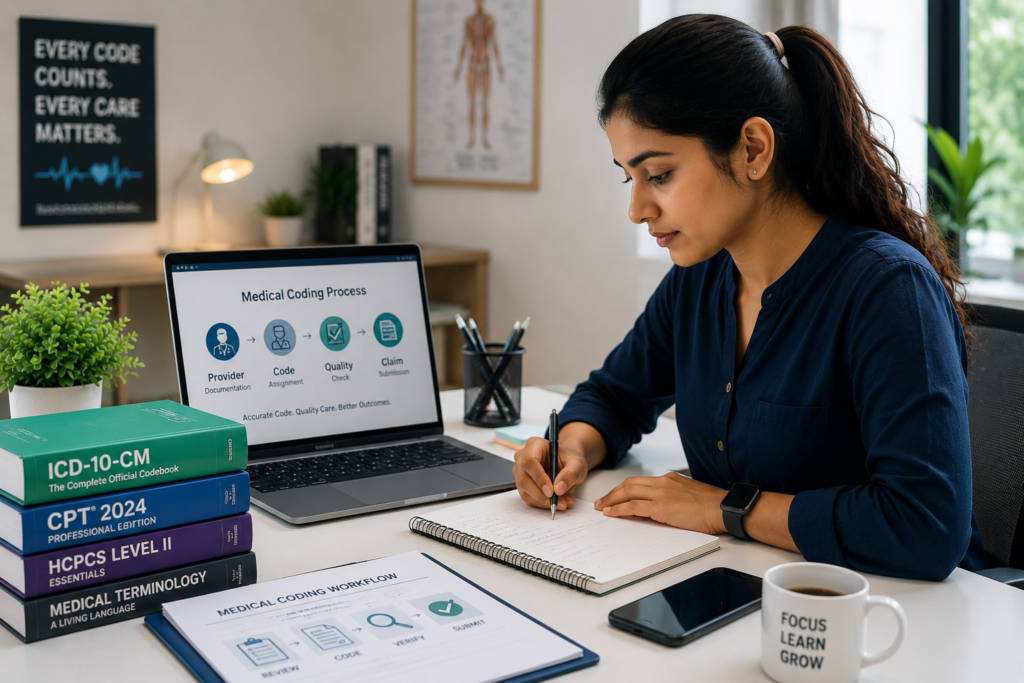
Thrissur has always had a strong culture of professional education, and medical coding has become one of the more in-demand training paths in the city over the last several years. The appeal is practical: it is a skill-based course that leads directly to employment, the certification is internationally recognised, and the work itself is increasingly done remotely — making it well-suited for graduates who want a serious career without being tied to a specific city or office.
If you are in Thrissur and exploring medical coding as a next step, this page covers what the training actually involves, what certifications matter for employment, what you can expect to earn, and what to look for in a programme before enrolling.
Medical coding is the translation of clinical documentation into standardised alphanumeric codes used for insurance billing, healthcare data reporting, and compliance. When a patient visits a physician, undergoes surgery, or receives a prescription, the details are documented by the treating clinician. A medical coder then reviews that documentation and assigns the appropriate codes from established classification systems.
The three systems in daily use are ICD-10-CM for diagnoses, CPT (Current Procedural Terminology) for procedures and services, and HCPCS Level II for outpatient items like medical equipment, ambulance transport, and specific pharmaceuticals. Together, these systems form the language of healthcare billing in the United States, which is the primary market that employs Kerala-based coders.
The job does not require clinical training or a medical degree. What it requires is a thorough knowledge of these coding systems, a working understanding of anatomy and medical terminology, and the certification that signals to employers that your knowledge has been independently verified.
The short answer is yes — and it is worth understanding why rather than just taking that at face value.
Thrissur district has a significant number of nursing and paramedical graduates entering the job market each year. Many find that clinical roles have high competition and irregular hours; medical coding offers a desk-based, regular-hours alternative that still draws on healthcare knowledge. For science graduates who are not pursuing clinical careers, it is one of the more direct paths to stable employment in the healthcare industry without requiring a postgraduate degree.
The remote work dimension is particularly relevant for Thrissur. Most medical coding work for Kerala-based coders is done for US-based clients — revenue cycle management companies, third-party billing firms, and healthcare BPOs. These employers hire remotely, which means a certified coder in Thrissur is competing for the same jobs as a coder in Kochi or Bengaluru. Location is not a disadvantage.
Medical coding training does not have a narrow eligibility filter, but some backgrounds are better positioned than others.
Nursing and Paramedical Graduates
GNM and BSc Nursing graduates, physiotherapists, pharmacists, lab technicians, and radiology technologists are among the strongest candidates for medical coding training. The clinical exposure, anatomy knowledge, and familiarity with medical terminology that these professionals already have translate directly into faster progress through the training curriculum. Employers hiring for inpatient surgical coding and cardiology or orthopaedic specialties actively seek candidates with clinical backgrounds.
Life Sciences Graduates
BSc graduates in Biology, Biochemistry, Zoology, Microbiology, and allied science streams pick up the anatomy and medical terminology modules efficiently. The transition from science education to medical coding is more straightforward than it might initially appear — the conceptual groundwork is already in place, and the coding systems themselves are what training adds.
Non-Science and Commerce Graduates
BA, BCom, and BBA graduates can absolutely complete medical coding training and pass the CPC exam. The anatomy and medical terminology section takes more time for non-science backgrounds, but it is teachable. If you are a commerce graduate who is disciplined and willing to invest seriously in the foundational modules, the path is open.
Working Professionals and Career Changers
Online delivery makes medical coding training accessible to people who are currently employed. Many students complete the programme while working part-time or managing other commitments. If you are in a healthcare-adjacent role — billing, reception, insurance, transcription — medical coding is a natural and relatively short upskilling path.
A complete medical coding course preparing students for the CPC (Certified Professional Coder) examination typically runs three to five months of structured instruction. Here is what that curriculum looks like in practice.
Human Anatomy and Physiology
The course begins with a systems-level review of the human body: skeletal, muscular, cardiovascular, respiratory, digestive, genitourinary, endocrine, nervous, and integumentary systems. This is not a clinical anatomy course — the goal is functional understanding sufficient to interpret physician documentation and select accurate codes. For candidates with a prior biology background, this section moves quickly. For others, it takes two to four weeks of focused attention.
Medical Terminology
Medical terminology is taught alongside anatomy as a parallel skill. Greek and Latin root words, prefixes, and suffixes appear constantly in clinical documentation, and a coder who cannot parse them quickly becomes dependent on dictionaries in a way that slows their work and reduces accuracy. Terminology training focuses on recognition and decoding speed — you will encounter most of these terms repeatedly across different coding scenarios.
ICD-10-CM Diagnosis Coding
ICD-10-CM is a hierarchical classification system containing tens of thousands of diagnosis codes. The curriculum covers the Official Guidelines for Coding and Reporting — a detailed document that governs how codes are selected, sequenced, and combined. Students work through chapter-specific guidelines covering areas like neoplasms, diabetes and other endocrine conditions, injuries and external causes, obstetric coding, and mental health. Practical exercises involve coding directly from clinical notes, not just from simplified case descriptions.
CPT Procedure Coding
CPT is the most extensive section of the CPC curriculum. It covers all of the following: Evaluation and Management (E/M) — the most commonly coded set of services in outpatient medicine; Anesthesia; Surgery (divided by body system — integumentary, musculoskeletal, respiratory, cardiovascular, digestive, urinary, reproductive, and so on); Radiology; Pathology and Laboratory; and Medicine. The Surgery section alone typically occupies several weeks of instruction given its scope. Students practice assigning codes from operative reports, procedure notes, and specialist encounter documentation.
HCPCS Level II
HCPCS Level II codes cover services and supplies not addressed in CPT — ambulance transport, durable medical equipment, specific chemotherapy drugs, and outpatient facility items. This section is shorter but appears on the CPC exam and is relevant to real-world billing in outpatient and home health settings.
CPC Exam Preparation
The CPC examination is conducted by the AAPC and consists of 100 multiple-choice questions across 40 sections of medicine, with a time limit of five hours and forty minutes. It is open-book — candidates bring tabbed copies of their CPT Professional, ICD-10-CM, and HCPCS codebooks. Navigating those books accurately under time pressure is itself a trainable skill, and exam preparation covers this directly. Mock exams under timed conditions, section-by-section analysis, and targeted revision form the final phase of the training program.
Transorze delivers its medical coding programme as live, instructor-led online classes — not self-paced video content you watch on your own schedule. This distinction shapes the learning experience significantly.
Live sessions mean you can raise doubts during the class, ask for a concept to be explained differently, and get feedback on your coding practice in real time. They also mean there is a batch schedule — which most students find useful because it creates structure and keeps preparation on track over the four to five months of the programme.
For students in Thrissur, the online format removes a practical barrier that used to be significant: you do not need to travel to Thiruvananthapuram or Kochi to access quality medical coding instruction. A laptop and a reliable internet connection are the prerequisites. Everything else — the curriculum, the practice cases, the mock exams, the trainer interaction — is delivered through the online platform. And because the job itself is done remotely in most cases, training online also familiarises students with the work environment they will eventually enter.
Entry-Level Roles and Starting Pay
Most medical coding graduates begin their careers as medical coders or coding associates with RCM companies, billing firms, or healthcare BPOs. Starting salaries for CPC-A certified coders in Kerala typically range from ₹15,000 to ₹22,000 per month. The CPC-A designation is awarded to candidates who pass the CPC exam before completing the two years of verified coding experience required for full CPC status — most employers recognise it and hire on that basis.
Mid-Career Growth
With two to three years of experience and specialty coding skills — cardiology, orthopaedic surgery, oncology, and interventional radiology coding command higher pay — monthly earnings frequently reach ₹30,000 to ₹50,000. Coders who add a second credential, such as the CCS (Certified Coding Specialist) from AHIMA, or who develop expertise in a high-demand specialty, tend to see faster salary growth.
Remote and Freelance Opportunities
Once a coder has an active CPC and documented work experience, remote work arrangements become widely accessible. Some coders work full-time from home for a single employer on a US time zone schedule; others take on multiple remote clients on a contractual basis. For Thrissur-based professionals, this means the earnings ceiling is not constrained by local market rates — it is set by what international clients are willing to pay for verified coding expertise.
With several options available in Kerala — including online programmes — a few questions separate credible providers from those that are not worth your time and money.
Does the trainer hold an active certification? Ask whether the instructor is a current CPC or CCS holder. Certifications from AAPC and AHIMA require continuing education units to maintain — a trainer who has not stayed current with codebook changes is teaching an outdated version of the subject.
Are sessions live or pre-recorded? For a practical, skills-based course like medical coding, live sessions are significantly more effective than pre-recorded content. The ability to ask questions during class and receive immediate feedback on coding exercises is difficult to replicate through videos alone.
What are the codebook arrangements? The CPC exam requires the CPT Professional Edition, ICD-10-CM, and HCPCS Level II codebooks. Confirm whether these are included in the course fee or whether you need to purchase them separately, and whether the training uses the current edition.
Can you speak with past students? Any training provider with genuine placement outcomes should be able to facilitate a conversation with a past student or point you to verifiable alumni. Testimonials on a provider’s own website are a starting point, but independent verification is more useful.
What support is available after the course ends? Exam preparation after the training concludes can raise questions that need trainer input. Confirm whether you retain access to the LMS and whether there is a mechanism for doubt-clearance during your post-course preparation window.
Thrissur is home to several major hospitals, medical colleges, and specialist clinics — including institutions affiliated with both government and private healthcare systems. This matters for medical coding students in two ways.
First, it means there is local industry awareness of what medical coding is and what certified coders do. Thrissur-based healthcare employers are increasingly familiar with US healthcare documentation standards, which creates local networking and employment opportunities alongside remote options.
Second, the city’s concentration of nurses and paramedical professionals — many of whom are graduates of institutions like the Government Medical College Thrissur or private nursing colleges — means there is a relevant peer community for anyone entering the field. If you are already in healthcare and considering a pivot to coding, you are likely not making this decision in isolation.

Yes. Medical coding classes for Thrissur students are available online, with live instructor-led sessions that do not require travel or relocation. Students across Thrissur district can join scheduled batches and receive the same quality of training previously available only to those willing to travel to larger cities.
Most medical coding programmes accept candidates with a minimum 10+2 qualification. Science graduates, nursing professionals, and paramedical graduates are particularly well-suited, though non-science graduates can also complete the programme and pass the CPC exam with focused effort. A clinical background helps but is not required.
A complete medical coding training programme — including CPC exam preparation — typically takes three to five months of structured instruction followed by four to eight weeks of self-directed exam preparation. Most students achieve certification within five to eight months of starting the course.
The CPC (Certified Professional Coder) from the AAPC is the most widely recognised credential for outpatient and physician-side coding roles. Freshers who pass the exam without two years of verified work experience receive the CPC-A (Apprentice) designation, which most employers accept for entry-level hiring. The CCS (Certified Coding Specialist) from AHIMA is the preferred credential for inpatient hospital coding roles.
Yes. Medical coding is one of the most genuinely remote-friendly healthcare services careers. Once a coder has an active CPC credential and one to two years of verified experience, work-from-home arrangements with US-based RCM companies, billing firms, and healthcare BPOs are widely available. Location within Kerala is not a barrier to remote employment.
Entry-level medical coders with a CPC-A credential typically earn ₹15,000–₹22,000 per month at the start of their career. With two to three years of experience and specialty coding skills, monthly earnings commonly reach ₹30,000–₹50,000. Coders working directly with international clients on a remote or freelance basis often earn above this range. Salary growth is closely tied to specialty expertise and active certifications.
Yes — medical coding training covers all three systems. ICD-10-CM is used for coding diagnoses. CPT (Current Procedural Terminology) is used for coding medical procedures and services. HCPCS Level II covers outpatient supplies, equipment, and services not addressed in CPT. The CPC exam tests knowledge of all three, and all three are used in everyday coding work.
Copyright © Transorze. All rights reserved.
