
Copyright © Transorze. All rights reserved.
Head Office : Transorze, T.C 48/48(2), Rahath Towers, Bypass Road, Ambalathara, Trivandrum – 695026.
Phone:+91 949 583 3319
Website:www.transorze.com
Medical coding has become one of the most sought-after career options in the healthcare sector, offering opportunities for graduates who want to work in a professional healthcare environment. As hospitals, clinics, and insurance providers continue to rely on accurate clinical documentation, the need for skilled medical coding professionals continues to grow. Their work helps ensure that patient records, diagnoses, and medical procedures are documented using standardized coding systems.
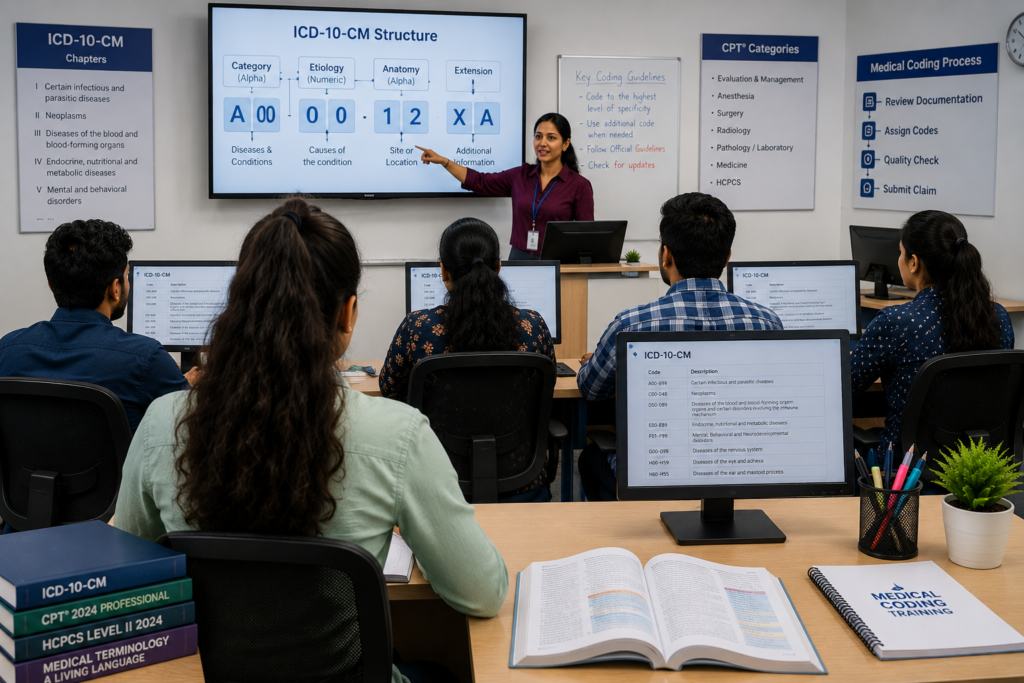
Enrolling in a well-structured medical coding course helps learners build a solid foundation in medical terminology, anatomy, coding guidelines, and healthcare documentation. Along with theoretical knowledge, students gain practical experience through coding exercises and real-world scenarios, preparing them for the responsibilities of healthcare documentation.
Whether you’re a life science graduate, a healthcare professional looking to enhance your skills, or someone exploring a new career path, a medical coding course provides the knowledge and practical exposure needed to pursue opportunities in the healthcare industry. With both online and offline learning options, you can choose a study mode that fits your schedule while developing industry-relevant skills.
Medical coding is the process of translating medical diagnoses, treatments, laboratory reports, and healthcare procedures into standardized alphanumeric codes. These codes are essential for maintaining accurate patient records, supporting insurance reimbursement, ensuring regulatory compliance, and improving communication between healthcare providers.
A medical coding course introduces learners to the principles of healthcare documentation and teaches them how standardized coding systems are applied in real clinical settings. Rather than focusing only on theory, students gain practical knowledge that helps them understand how healthcare records are reviewed and coded accurately.
Throughout the course, learners become familiar with coding systems such as ICD, CPT, and HCPCS while developing an understanding of clinical documentation and healthcare workflows.
The healthcare sector generates a large volume of patient records every day. Every consultation, diagnostic test, surgical procedure, and follow-up visit requires proper documentation to ensure continuity of care and efficient administrative processes.
As hospitals and healthcare organizations continue to adopt electronic health records, the need for professionals with medical coding expertise remains steady. Skilled coders contribute to accurate documentation, streamlined insurance processing, and healthcare data management, making them an important part of modern healthcare operations.
For graduates seeking a professional role in the healthcare industry, medical coding offers opportunities to develop specialized knowledge in a structured and evolving field.
A quality medical coding course goes beyond classroom instruction by combining structured learning with practical application. Instead of simply learning coding guidelines, students understand how healthcare documentation is interpreted and how coding decisions are made based on clinical information.
An effective training program typically includes:
This approach helps learners gradually build confidence while improving both technical knowledge and coding accuracy.
Learning should be convenient without compromising quality. Online medical coding classes allow students to attend live sessions, interact with instructors, complete practical assignments, and review recorded lectures from any location.
This flexible approach is particularly beneficial for learners who have academic, professional, or personal commitments. By studying online, students can learn at their own pace while continuing to receive guidance and feedback throughout the program.
Online learning is suitable for:
Medical coding is suitable for individuals who enjoy analytical work, attention to detail, and healthcare-related careers. The course welcomes learners from various educational backgrounds and provides a structured path for developing industry-relevant skills.
It is commonly chosen by:
No prior coding experience is required, making the course accessible to beginners who are willing to learn.
A medical coding course helps learners build a combination of healthcare knowledge and professional competencies that are valuable in medical documentation roles.
By the end of the training, students are expected to develop skills in:
Learn how to review physician notes, discharge summaries, laboratory reports, and operative records to identify relevant coding information.
Gain hands-on experience using ICD, CPT, and HCPCS coding systems while following accepted coding guidelines.
Develop a clear understanding of medical terminology, body systems, diseases, and procedures to improve coding accuracy.
Strengthen the ability to interpret complex healthcare documentation and make accurate coding decisions based on clinical evidence.
Build attention to detail and consistency, two essential qualities for maintaining reliable healthcare documentation.
Online learning offers greater flexibility while maintaining the same structured curriculum and instructor guidance. Students can participate in live classes, revisit recorded sessions, complete assignments, and interact with trainers without the need for daily travel.
Many learners find online classes helpful because they allow them to balance education with work, higher studies, or family responsibilities. With regular practice and active participation, students can develop practical coding skills in a convenient learning environment.
A medical coding course is designed to build both healthcare knowledge and coding expertise through a structured learning approach. Students gradually progress from understanding basic medical concepts to applying standardized coding systems used in healthcare organizations. The curriculum combines theoretical instruction with practical exercises to help learners confidently interpret clinical documentation.
Medical terminology forms the language of healthcare. Students learn commonly used medical words, abbreviations, prefixes, suffixes, and disease-related terminology, enabling them to understand physician documentation more effectively.
Knowledge of the human body is essential for assigning accurate medical codes. Learners study body systems, organ functions, common diseases, and medical procedures to better understand healthcare records.
Students are introduced to internationally accepted coding systems used for diagnosis and procedures. Through guided practice, they learn how coding guidelines are applied to different clinical situations.
Medical coders work with a variety of healthcare documents every day. The course helps students understand how to interpret physician notes, operative reports, discharge summaries, laboratory findings, and diagnostic records before assigning codes.
Beyond technical knowledge, medical coding training helps learners develop workplace skills that are valuable across the healthcare industry.
During the course, students improve their ability to:
These competencies help learners become more confident and prepared for professional healthcare environments.
Medical coding knowledge is useful in a wide range of healthcare settings where clinical documentation and standardized coding play an important role.
Professionals with coding expertise may find opportunities in:
As healthcare continues to adopt digital systems, coding professionals remain an essential part of healthcare administration.
Success in medical coding depends on more than technical knowledge. Employers value professionals who demonstrate accuracy, consistency, and a commitment to maintaining high documentation standards.
Some important qualities include:
Developing these qualities alongside technical knowledge supports long-term professional growth.
Choosing a training program requires careful evaluation of several factors beyond course duration or cost. A well-designed course should provide learners with both academic knowledge and opportunities to practice real coding scenarios.
When comparing programs, consider whether they include:
Taking the time to compare these features can help you make an informed learning decision.
Medical coding is a profession that combines healthcare knowledge with analytical thinking and professional accuracy. By building a strong understanding of coding systems, clinical documentation, and healthcare processes, learners can prepare themselves for a variety of opportunities within the healthcare sector.
Whether you are starting your career or enhancing your existing skills, a structured medical coding course provides the foundation needed to grow professionally. Consistent learning, practical experience, and a commitment to accuracy can help you build confidence and adapt to the evolving needs of the healthcare industry.
Many aspiring healthcare professionals choose Transorze because it combines quality education with industry-focused training. Students can choose Online & Offline classes based on their learning preferences while benefiting from programs supported by NSDC Training Partner, AAPC Licensed, UGC Recognized, and NCVET Skill University affiliations. This combination helps learners build practical skills, gain recognized credentials, and prepare confidently for careers in medical coding and billing.
Every successful career starts with the right guidance. Hear directly from our students as they share their learning experience, the practical skills they gained, and how the course helped them prepare for rewarding careers in medical coding and billing. Their journeys offer valuable insights for anyone considering this profession.
A medical coding course teaches you how to convert medical diagnoses, procedures, and treatments into standardized codes used by healthcare providers and insurance companies. The curriculum typically covers medical terminology, anatomy and physiology, ICD coding, CPT coding, HCPCS coding, healthcare documentation, and practical coding exercises. By the end of the course, students gain the knowledge needed to interpret medical records and apply coding guidelines accurately.
Yes. Most medical coding courses are designed for beginners and start with the fundamentals of healthcare terminology and anatomy before progressing to advanced coding concepts. Graduates from life science, pharmacy, nursing, biotechnology, microbiology, biochemistry, and allied healthcare backgrounds often find the transition easier, but beginners with an interest in healthcare can also learn successfully through structured training.
Yes. Most medical coding courses are designed for beginners and start with the fundamentals of healthcare terminology and anatomy before progressing to advanced coding concepts. Graduates from life science, pharmacy, nursing, biotechnology, microbiology, biochemistry, and allied healthcare backgrounds often find the transition easier, but beginners with an interest in healthcare can also learn successfully through structured training.
The duration depends on the course structure and learning schedule. Most programs are completed within a few months and include theoretical learning, practical coding sessions, assessments, and revision. Consistent practice and active participation help students build confidence and improve coding accuracy throughout the training.
Medical coding professionals can pursue opportunities in hospitals, specialty clinics, healthcare BPOs, insurance companies, medical billing organizations, and health information management firms. Common job roles include Medical Coder, Medical Billing Executive, Healthcare Documentation Specialist, Coding Associate, Revenue Cycle Executive, and Coding Quality Analyst.
Yes. Practical training is an important part of medical coding education. Students work with sample medical records, clinical case studies, physician documentation, and coding scenarios to improve their understanding of coding guidelines. Regular practice helps learners develop confidence before entering professional healthcare environments.
When comparing medical coding courses, consider factors such as curriculum quality, trainer experience, practical assignments, flexible learning options, updated course content, career guidance, and placement assistance. A comprehensive course should combine theoretical knowledge with practical learning to prepare students for real-world healthcare documentation.
Copyright © Transorze. All rights reserved.
