
Medical Coding Qualification: Eligibility, Skills, Certifications & Career Guide
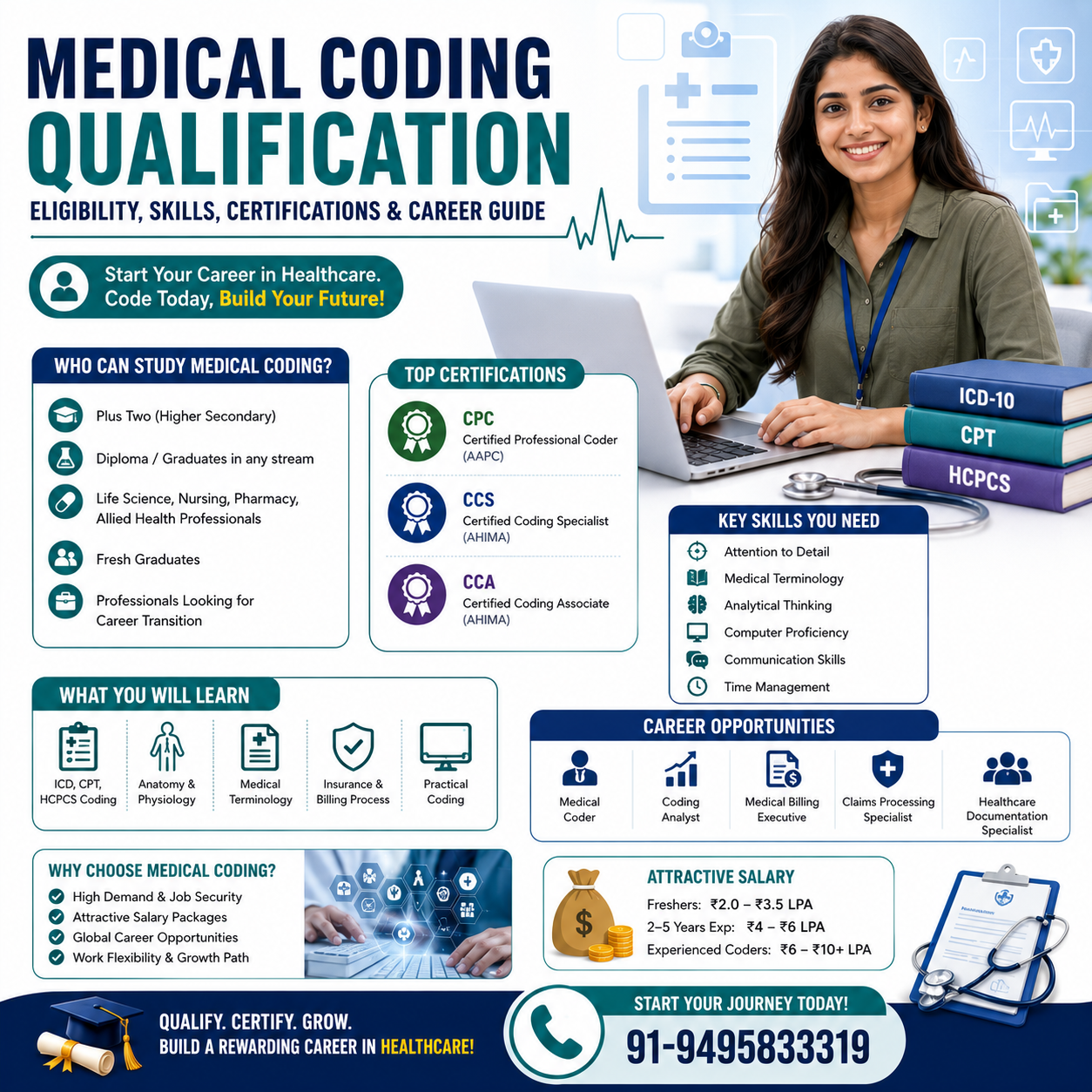
The healthcare industry is evolving rapidly, and medical coding has become one of the most in-demand career options in the healthcare administration sector. If you are searching for the right medical coding qualification, you are likely exploring a stable, rewarding, and growth-oriented career path.
Medical coding professionals play a crucial role in converting medical diagnoses, procedures, and treatments into standardized alphanumeric codes used for insurance claims, billing, and healthcare documentation. With hospitals, insurance companies, and healthcare outsourcing firms increasingly relying on accurate coding systems, the demand for trained medical coders continues to rise across India and globally.
This guide explains everything you need to know about medical coding qualifications, eligibility criteria, certifications, required skills, salary expectations, and career opportunities.
What Is Medical Coding?
Medical coding is the process of translating healthcare records into standardized codes using systems such as:
- ICD (International Classification of Diseases)
- CPT (Current Procedural Terminology)
- HCPCS (Healthcare Common Procedure Coding System)
These codes are used by hospitals, clinics, insurance providers, and healthcare organizations for billing, reimbursement, and maintaining patient records.
Medical coders work closely with healthcare documentation while ensuring compliance with healthcare regulations and insurance standards.
What Is the Required Medical Coding Qualification?
One of the biggest advantages of medical coding is that students from various educational backgrounds can enter the field.
Basic Medical Coding Qualification
The minimum educational qualification generally includes:
- Plus Two (Higher Secondary Education)
- Diploma holders
- Graduates in any stream
- Life science graduates
- Nursing and pharmacy students
- Allied health professionals
Although candidates from science or healthcare backgrounds may find it easier to understand medical terminology and anatomy, non-science graduates can also pursue medical coding with proper training.
For a detailed understanding of eligibility requirements, read this guide on medical coding eligibility criteria.
Who Can Study Medical Coding?
Medical coding courses are suitable for:
- BSc Nursing graduates
- B.Pharm and D.Pharm students
- Life science graduates
- Biotechnology students
- Physiotherapy graduates
- Ayurveda and Homeopathy graduates
- Fresh graduates seeking healthcare careers
- Professionals looking for career transitions
Even candidates without prior healthcare experience can build a successful career through structured training programs.
Educational Background Preferred for Medical Coding
While there is no strict requirement for advanced medical degrees, employers often prefer candidates with knowledge in:
- Human anatomy
- Physiology
- Medical terminology
- Pathology
- Pharmacology
This is why graduates from healthcare and life science backgrounds often adapt quickly to coding concepts.
However, dedicated training institutes bridge the knowledge gap for students from non-medical backgrounds through practical-oriented programs.
Important Skills Required for Medical Coding
Apart from academic qualifications, successful medical coders need specific technical and soft skills.
1. Attention to Detail
Even small coding errors can affect insurance claims and reimbursement processes. Accuracy is essential.
2. Analytical Thinking
Medical coders must interpret patient records carefully and assign appropriate codes.
3. Knowledge of Medical Terminology
Understanding medical terms, procedures, and diagnoses is critical.
4. Computer Skills
Medical coders work with healthcare software and electronic health record systems.
5. Communication Skills
Coders often coordinate with healthcare providers and billing teams.
6. Time Management
Meeting deadlines while maintaining accuracy is an important part of the role.
Do You Need Certification for Medical Coding?
Certification is not always mandatory for entry-level roles, but it significantly improves career opportunities and salary potential.
Employers often prefer certified medical coders because certifications validate professional competency and coding expertise.
Popular Medical Coding Certifications
CPC (Certified Professional Coder)
Offered by AAPC, CPC is one of the most recognized certifications worldwide.
CCS (Certified Coding Specialist)
Provided by AHIMA, CCS certification is ideal for advanced hospital coding roles.
CCA (Certified Coding Associate)
Suitable for beginners entering the medical coding field.
These certifications increase employability in hospitals, insurance companies, and healthcare BPOs.
You can also explore healthcare coding certification programs to understand how professional training supports certification preparation.
Is Medical Coding a Good Career?
Yes. Medical coding continues to be a strong career choice due to the expansion of healthcare services, insurance systems, and medical documentation requirements.
Benefits of a Medical Coding Career
High Demand
Healthcare organizations require skilled coders to manage patient documentation and insurance claims.
Stable Career Path
Medical coding remains essential even during economic fluctuations because healthcare services are always needed.
Global Opportunities
Certified coders can work with international healthcare systems, especially US healthcare processes.
Work Flexibility
Many experienced coders eventually work remotely or in hybrid roles.
Career Growth
Medical coders can advance into:
- Medical auditing
- Coding quality analysis
- Revenue cycle management
- Healthcare administration
- Team leadership roles
To learn more about industry scope, check out medical coding career opportunities.
Medical Coding Course Duration
Medical coding training programs vary depending on the institute and course structure.
Typical durations include:
| Course Type | Duration |
|---|---|
| Certificate Course | 3–6 Months |
| Advanced Diploma | 6–12 Months |
| Certification Preparation | 2–4 Months |
Many institutes combine theory, practical coding exercises, mock tests, and placement assistance.
What Is Taught in a Medical Coding Course?
A standard medical coding course usually covers:
- Human anatomy and physiology
- Medical terminology
- ICD coding
- CPT coding
- HCPCS coding
- Healthcare documentation
- Insurance claim processing
- Medical billing basics
- Coding compliance
- Practical case studies
Some institutes also provide:
- Interview preparation
- Resume building
- Soft skills training
- Certification exam support
Students can review medical coding course syllabus and fees for a better understanding of program structure and training modules.
Career Opportunities After Medical Coding
After completing medical coding training, candidates can apply for roles such as:
- Medical Coder
- Coding Specialist
- Coding Analyst
- Medical Billing Executive
- Revenue Cycle Executive
- Claims Processing Associate
- Healthcare Documentation Specialist
Employment opportunities exist in:
- Hospitals
- Multispecialty clinics
- Healthcare BPOs
- Insurance companies
- Medical coding companies
- Healthcare IT firms
Medical Coding Salary in India
Medical coding salary depends on factors such as:
- Qualification
- Certification
- Experience
- Employer type
- Location
Average Salary Range
| Experience Level | Approximate Salary |
|---|---|
| Freshers | ₹2.0 – ₹3.5 LPA |
| 2–5 Years Experience | ₹4 – ₹6 LPA |
| Certified Senior Coders | ₹6 – ₹10 LPA+ |
Candidates with international certifications and specialized coding expertise often receive higher salary packages.
Why Choose Professional Training for Medical Coding?
Self-learning can provide basic theoretical understanding, but structured training offers:
- Expert guidance
- Real-time coding practice
- Updated coding standards
- Certification preparation
- Placement support
- Industry exposure
Institutes like Transorze provide industry-oriented training programs designed to prepare students for real healthcare coding environments.
Students also benefit from medical coding placement assistance programs that help connect trained candidates with recruiters.
How to Start a Career in Medical Coding
Step 1: Check Eligibility
Ensure you meet the basic educational qualification requirements.
Step 2: Join a Medical Coding Course
Select a reputed training institute with experienced trainers and practical exposure.
Step 3: Learn Coding Systems
Develop strong knowledge in ICD, CPT, and HCPCS coding standards.
Step 4: Prepare for Certification
Practice mock exams and coding case studies.
Step 5: Apply for Jobs
Build a professional resume and attend healthcare recruitment interviews.
Why Medical Coding Is Growing in India
India has become a major hub for healthcare outsourcing and revenue cycle management services.
Factors driving demand include:
- Expansion of healthcare infrastructure
- Growth of insurance services
- Increased healthcare digitization
- Rising demand for accurate medical documentation
- US healthcare outsourcing growth
This creates excellent employment opportunities for qualified medical coders across cities like Kochi, Bangalore, Chennai, Hyderabad, and Pune.
Why Students Choose Transorze for Medical Coding Training
Many students prefer Transorze because of its practical-oriented training approach, experienced faculty, certification-focused curriculum, and placement-oriented programs.
Key advantages include:
- Industry-relevant syllabus
- Practical coding sessions
- Certification guidance
- Experienced trainers
- Placement support
- Flexible learning options
For students looking to build a strong healthcare career foundation, choosing the right training institute can make a significant difference.
Frequently Asked Questions
Candidates with Plus Two, diploma qualifications, or graduation can pursue medical coding. Life science and healthcare backgrounds are often preferred but not mandatory.
Yes. Non-science students can learn medical coding through professional training programs that include medical terminology and anatomy basics.
Certification is not always mandatory for entry-level jobs, but certifications like CPC improve job opportunities and salary potential.
Most medical coding courses last between 3 and 12 months depending on the course type and certification level.
Yes. Medical coding offers stable career growth, increasing demand, competitive salaries, and international job opportunities.
Yes. Many healthcare companies hire freshers who complete professional training and demonstrate coding knowledge.
Attention to detail, medical terminology knowledge, analytical skills, computer proficiency, and accuracy are essential.
Final Thoughts
Understanding the right medical coding qualification is the first step toward building a successful career in healthcare documentation and revenue cycle management.
Medical coding offers strong career stability, global opportunities, and excellent growth potential for both fresh graduates and working professionals. Whether you come from a healthcare background or are planning a career transition, the field provides accessible entry pathways with the right training and certification support.
By choosing quality education, practical training, and industry-recognized certifications, aspiring coders can position themselves for long-term success in the growing healthcare industry.
 If you’re looking to start a stable healthcare career, mastering these skills is your first step toward long-term success.
