
Medical CPT Codes: Complete Guide to Coding, Billing, Updates & Career Opportunities
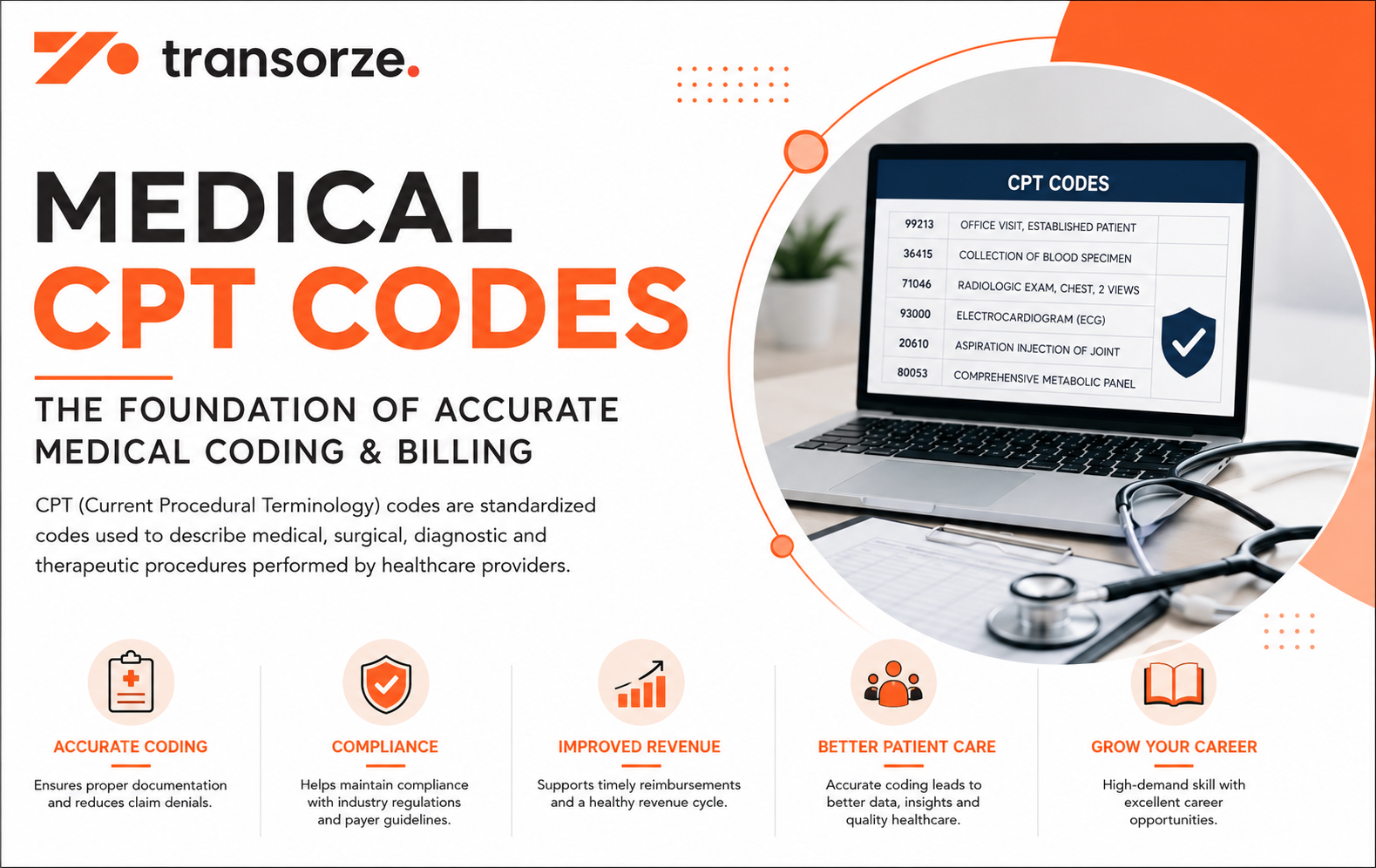
Healthcare runs on accurate documentation, and one of the most important elements behind every successful medical claim is the medical CPT code. Whether a patient visits a physician for a routine examination, undergoes a surgical procedure, receives laboratory testing, or completes a telehealth consultation, every healthcare service must be documented using standardized procedural codes. These standardized codes allow healthcare providers, insurance companies, government agencies, and billing professionals to communicate efficiently using a common language. Without this universal coding system, processing medical claims would become inconsistent, reimbursement would be delayed, and patient records would be much harder to maintain accurately.
As healthcare systems continue to embrace digital transformation, medical coding has become more important than ever before. Hospitals, specialty clinics, diagnostic laboratories, ambulatory surgical centers, rehabilitation facilities, and insurance organizations all depend on certified medical coders to assign the correct CPT codes. Even a small coding error can result in claim denials, delayed payments, compliance issues, or revenue loss. That is why employers increasingly seek professionals who understand procedural coding standards, payer guidelines, documentation requirements, and coding compliance.
This comprehensive guide explains everything you need to know about medical CPT codes, including their purpose, structure, categories, applications in medical billing, differences from ICD-10 and HCPCS codes, current updates, common coding mistakes, career opportunities, and practical tips for mastering procedural coding. Whether you are a student considering a career in medical coding, a healthcare administrator, or simply someone interested in understanding healthcare documentation, this guide provides practical insights based on current industry standards.
What Are Medical CPT Codes?
Definition of CPT Codes
Current Procedural Terminology (CPT) codes are standardized five-digit numeric codes used to describe medical, surgical, diagnostic, laboratory, radiology, pathology, and evaluation services provided by healthcare professionals. The CPT code set is maintained and updated annually by the American Medical Association (AMA) to ensure that new medical technologies, procedures, and healthcare innovations are accurately represented within the coding system. Recent annual revisions continue to add, revise, and delete codes to reflect advances in healthcare delivery and technology.
Every healthcare procedure performed by a physician or qualified healthcare provider is assigned a specific CPT code. These codes simplify communication among physicians, hospitals, insurance companies, Medicare, Medicaid, and commercial payers by creating a consistent language that eliminates ambiguity. Rather than describing a medical procedure in lengthy text, healthcare providers simply document the appropriate CPT code, making claims processing significantly faster and more standardized.
The importance of CPT codes extends beyond reimbursement. They are also used for healthcare analytics, quality reporting, medical research, utilization management, compliance audits, public health reporting, and performance measurement. Insurance companies analyze CPT data to determine reimbursement eligibility, while healthcare organizations use coding data to evaluate treatment trends, monitor resource utilization, and improve operational efficiency.
Because healthcare regulations evolve continuously, coders must stay updated with annual CPT revisions, payer policies, National Correct Coding Initiative (NCCI) edits, and documentation requirements. Continuous education has become an essential part of a successful medical coding career.
Why CPT Codes Matter in Healthcare
Imagine trying to organize millions of patient visits every day without any standardized method of describing procedures. Every physician could use different terminology, insurance companies would interpret services differently, and reimbursement disputes would become routine. Medical CPT codes solve this problem by providing a universal language for medical procedures.
Healthcare providers rely on CPT coding to ensure that every service they perform is accurately documented and billed. Insurance companies depend on these codes to determine medical necessity, process reimbursements, and identify fraudulent claims. Government healthcare programs also use CPT data to monitor healthcare spending, evaluate public health initiatives, and establish reimbursement policies.
Accurate coding has a direct financial impact on healthcare organizations. Proper CPT assignment reduces claim denials, accelerates reimbursement, improves revenue cycle management, and supports regulatory compliance. Incorrect coding, on the other hand, may result in delayed payments, costly audits, legal penalties, or allegations of healthcare fraud. Because of these risks, hospitals invest heavily in coder training, auditing programs, and compliance systems.
Patients also benefit from standardized coding. Their medical records become easier to interpret across multiple healthcare providers, referrals are processed more efficiently, and insurance claims are less likely to encounter delays due to coding discrepancies. As healthcare becomes increasingly interconnected through electronic health records (EHRs), standardized procedural coding continues to play an essential role in maintaining continuity of care.
The rapid expansion of telemedicine, minimally invasive procedures, robotic surgery, artificial intelligence-assisted diagnostics, and personalized medicine has increased the demand for accurate procedural coding. Every new medical advancement eventually requires corresponding CPT updates so healthcare providers can document these services consistently across the healthcare ecosystem.
History and Evolution of CPT Codes
Who Created CPT Codes?
The history of medical CPT codes dates back to the 1960s, when the healthcare industry recognized the need for a standardized system to describe medical procedures. Before CPT codes existed, physicians often documented services using inconsistent terminology, making insurance reimbursement slow, confusing, and prone to errors. To address this challenge, the American Medical Association (AMA) developed the Current Procedural Terminology system, creating a common language that could be used nationwide.
Initially, the CPT code set focused on surgical procedures, but as medicine evolved, it expanded to include virtually every healthcare specialty. Today, CPT codes cover evaluation and management services, anesthesia, surgery, radiology, pathology, laboratory testing, and a wide range of emerging medical technologies. Each year, the AMA works with specialty societies, healthcare experts, and industry stakeholders to review clinical innovations and update the code set accordingly.
The evolution of CPT coding reflects the rapid pace of healthcare advancement. As new treatments, diagnostic tools, and digital health services emerge, corresponding CPT codes are introduced to ensure accurate documentation and reimbursement. This ongoing revision process helps maintain consistency across healthcare organizations while supporting innovation in patient care.
Beyond clinical documentation, CPT codes have become essential for healthcare analytics, research, quality measurement, and policy development. Government agencies, insurers, hospitals, and researchers rely on CPT-coded data to analyze healthcare utilization, monitor treatment outcomes, and improve healthcare delivery systems. What began as a documentation tool has grown into one of the foundational components of the global healthcare reimbursement infrastructure.
Latest CPT Code Updates
Medical coding is not static. Every year, the AMA publishes updates that introduce new CPT codes, revise existing descriptions, and remove obsolete codes. These annual changes reflect advances in medical technology, evolving clinical practices, and updated healthcare regulations. Recent revisions have expanded coding options for telehealth services, remote patient monitoring, digital medicine, artificial intelligence-assisted diagnostics, and other emerging areas of care.
For medical coders, staying informed about these updates is critical. Using outdated CPT codes can result in claim denials, reimbursement delays, or compliance issues. Healthcare organizations therefore invest in continuous education, coding audits, and annual training programs to ensure their coding staff remains current with the latest procedural terminology and payer guidelines.
Industry experts recommend reviewing official CPT update publications each year and participating in continuing education programs. Certified coders who consistently stay current with coding changes are often better positioned for career growth, higher earning potential, and increased demand in hospitals, physician practices, insurance companies, and revenue cycle management organizations.
Types of Medical CPT Codes
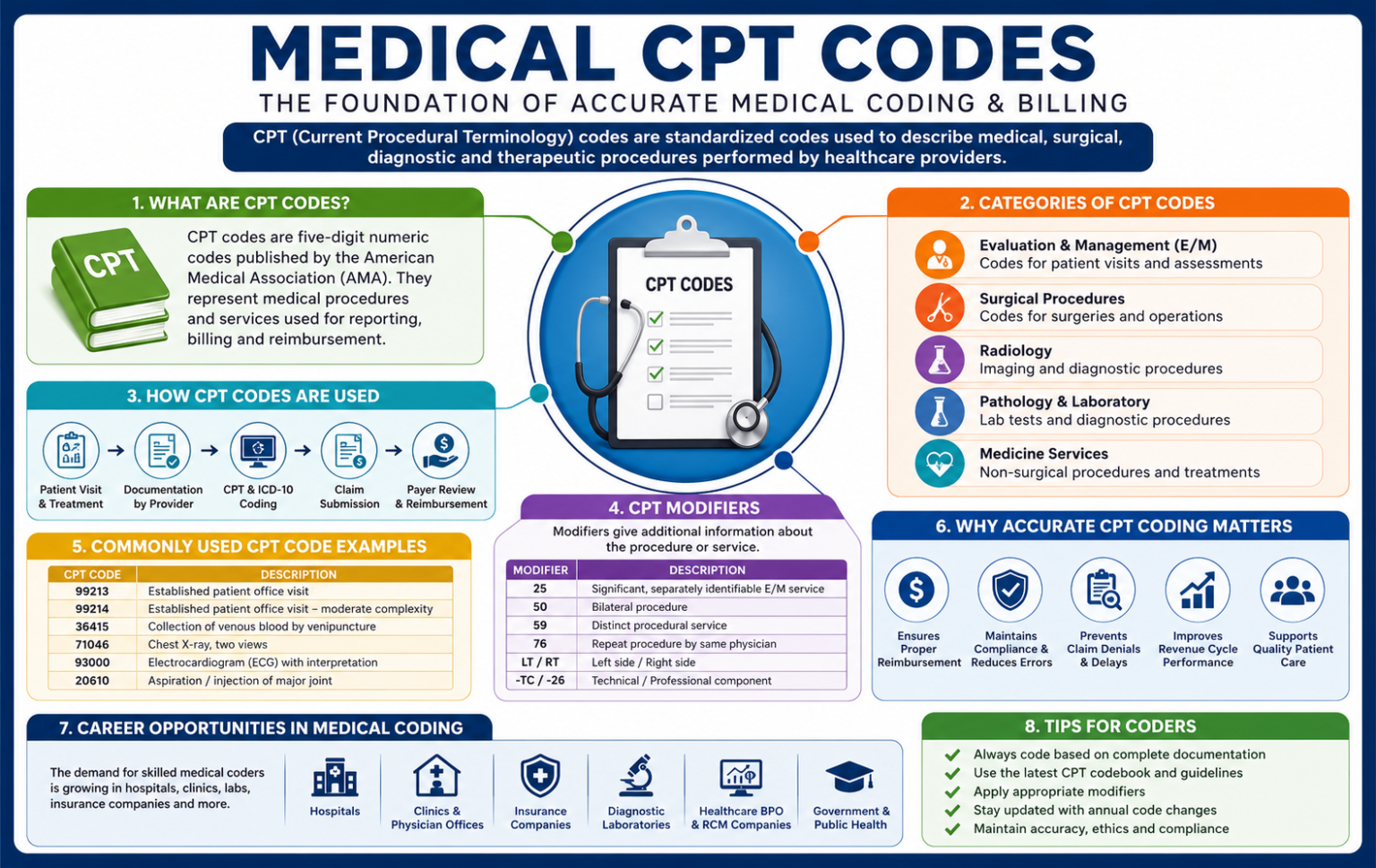
Medical CPT codes are organized into three primary categories, each designed to serve a distinct purpose within healthcare documentation and reimbursement. Understanding these categories is essential for anyone working in medical coding, billing, healthcare administration, or revenue cycle management. While all CPT codes describe healthcare services, each category addresses different reporting needs, ranging from routine clinical procedures to emerging technologies and quality improvement initiatives. Learning how these categories differ helps coders assign the most accurate codes, reduce claim denials, and maintain compliance with payer guidelines.
The categorization system also supports healthcare innovation. As medicine advances with new surgical techniques, digital health services, and AI-assisted diagnostics, the CPT code set evolves to accommodate these developments. Instead of creating confusion, the structured approach allows healthcare providers to document both established and emerging procedures consistently. This flexibility is one of the reasons CPT remains the global standard for procedural coding in many healthcare environments.
For aspiring medical coders, understanding CPT categories is more than an academic exercise—it directly impacts coding accuracy and career success. Employers expect coders to know which category applies to a particular procedure and how those codes influence reimbursement, reporting, and compliance. Let’s examine each category in detail.
Category I Codes
Category I CPT codes are the most commonly used codes in medical coding and billing. These five-digit numeric codes describe procedures and services that are widely accepted and routinely performed in healthcare settings. They cover six major sections of the CPT codebook:
| CPT Section | Code Range | Examples |
|---|---|---|
| Evaluation & Management (E/M) | 99202–99499 | Office visits, consultations, hospital care |
| Anesthesia | 00100–01999 | Surgical anesthesia services |
| Surgery | 10021–69990 | General, orthopedic, cardiovascular, neurological surgeries |
| Radiology | 70010–79999 | X-rays, CT scans, MRI, ultrasound |
| Pathology & Laboratory | 80047–89398 | Blood tests, pathology examinations |
| Medicine | 90281–99607 | Immunizations, cardiology, psychiatry, physical therapy |
These codes are used every day in hospitals, physician offices, outpatient clinics, diagnostic laboratories, and ambulatory surgery centers. For example, a routine office consultation, a chest X-ray, a blood glucose test, or a minor surgical procedure all have designated Category I CPT codes. Insurance companies rely heavily on these codes to determine reimbursement because they represent standardized and well-established medical services.
Each Category I code undergoes extensive review before being included in the CPT codebook. Medical specialty societies, healthcare experts, and the American Medical Association collaborate to ensure that every code accurately reflects current clinical practice. This rigorous review process helps maintain consistency across healthcare organizations and ensures that providers receive appropriate reimbursement for the services they deliver.
Category II Codes
Unlike Category I codes, Category II CPT codes are designed primarily for performance measurement and quality reporting rather than reimbursement. These codes help healthcare organizations monitor clinical outcomes, adherence to treatment guidelines, and patient care quality. They are optional in many situations but play an increasingly important role in value-based healthcare models.
Category II codes consist of four numeric digits followed by the letter F, making them easy to distinguish from regular procedural codes. They allow healthcare providers to report activities such as blood pressure documentation, diabetes management, smoking cessation counseling, preventive screenings, and follow-up care. Rather than generating payment directly, these codes support quality improvement initiatives and regulatory reporting programs.
As healthcare systems increasingly emphasize patient outcomes over service volume, Category II coding has become more valuable. Hospitals and physician practices participating in quality reporting programs often use these codes to demonstrate compliance with clinical guidelines and improve performance metrics. Accurate reporting can positively influence organizational reputation, reimbursement incentives, and accreditation outcomes.
Category III Codes
Healthcare innovation never stops, and Category III CPT codes exist specifically to track emerging technologies, experimental procedures, and newly developed medical services. These temporary codes allow healthcare organizations to collect utilization data before determining whether a procedure should eventually receive a permanent Category I code.
Category III codes contain four digits followed by the letter T. They are commonly assigned to innovative treatments, advanced imaging techniques, robotic procedures, digital therapeutics, artificial intelligence-assisted technologies, and other evolving medical interventions. Since these procedures may not yet have widespread clinical adoption, the codes primarily support data collection and clinical evaluation.
The existence of Category III codes highlights how dynamic medical coding has become. As medicine continues to evolve through biotechnology, precision medicine, and digital healthcare, coders must remain informed about newly introduced codes. Understanding Category III coding enables professionals to document cutting-edge healthcare services accurately while supporting future improvements to the CPT coding system.
Certifications That Matter
Employers often give preference to candidates who possess recognized certifications because they demonstrate industry-standard knowledge and coding competency. Students should look for training programs where they become eligible for certifications and credentials recognized across the healthcare industry.
Quality institutes prepare students for internationally accepted coding standards while also providing academic recognition. Students benefit from credentials associated with NSDC Training Partner, AAPC Licensed, UGC Recognized, and NCVET Skill University, strengthening both credibility and employability in domestic as well as international healthcare organizations.

Medical CPT Codes vs ICD-10 vs HCPCS
One of the most common sources of confusion for beginners is understanding the difference between CPT codes, ICD-10 codes, and HCPCS codes. Although these coding systems often appear together on medical claims, they serve completely different purposes. Understanding how they work together is fundamental to accurate medical billing.
Think of a healthcare claim as telling a complete story. The ICD-10 code explains why the patient received medical care by documenting the diagnosis or medical condition. The CPT code explains what healthcare service or procedure was performed. The HCPCS code describes additional supplies, equipment, medications, or services that may not be included within the CPT system. Together, these coding systems provide insurers with a complete picture of the patient’s encounter.
Incorrectly mixing these coding systems is a common mistake among new coders. Selecting the wrong code type can lead to rejected claims even if the documented procedure itself was appropriate. Professional training emphasizes understanding the relationship between diagnosis coding, procedural coding, and supply coding rather than viewing them as separate disciplines.
Key Differences
| Feature | CPT | ICD-10-CM | HCPCS Level II |
|---|---|---|---|
| Purpose | Describes procedures and services | Describes diagnoses and diseases | Covers supplies, equipment, ambulance services, certain drugs |
| Maintained By | American Medical Association (AMA) | World Health Organization (WHO); adapted for U.S. use | Centers for Medicare & Medicaid Services (CMS) |
| Code Format | Five numeric digits | Alphanumeric | One letter followed by four numbers |
| Used For | Billing medical procedures | Explaining medical necessity | Billing non-physician services and supplies |
Healthcare claims typically require both diagnosis and procedure codes. For example, a patient diagnosed with knee osteoarthritis (ICD-10-CM) who undergoes a joint injection (CPT) and receives a specialized knee brace (HCPCS Level II) would have all three coding systems represented on the claim. This coordinated coding approach supports accurate reimbursement, clinical documentation, and healthcare analytics.
How Medical CPT Codes Are Used in Medical Billing
Medical billing is a structured process that transforms a patient’s healthcare visit into a reimbursement claim. At the center of this process are medical CPT codes, which accurately describe every procedure or service performed by a healthcare provider. Whether a patient receives a routine physical examination, an emergency surgical procedure, laboratory testing, or advanced diagnostic imaging, the appropriate CPT codes ensure that the service is communicated consistently to insurance companies.
The billing process begins when the healthcare provider documents the patient’s encounter in the Electronic Health Record (EHR). Medical coders carefully review the physician’s notes, operative reports, laboratory findings, radiology reports, and supporting clinical documentation. Based on this information, they assign the correct CPT codes for procedures and ICD-10-CM diagnosis codes to explain the patient’s medical condition. Every CPT code must be supported by sufficient documentation, as insurance companies may reject claims that lack medical necessity or contain incomplete records.
Once coding is complete, the claim is submitted to the insurance payer through an electronic billing system. The payer evaluates several factors, including:
- Whether the CPT code matches the documented procedure.
- Whether the diagnosis justifies the procedure.
- Whether any required modifiers have been added correctly.
- Whether the service is covered under the patient’s insurance plan.
If everything is accurate, reimbursement is processed. If discrepancies are found, the claim may be denied, delayed, or returned for correction. This is why accurate CPT coding directly affects a healthcare organization’s revenue cycle.
Modern healthcare facilities also use automated coding software and artificial intelligence to assist coders. These technologies improve efficiency by suggesting possible CPT codes based on clinical documentation. However, certified medical coders remain essential because software cannot always interpret complex physician notes, payer-specific rules, or nuanced coding guidelines. Human expertise ensures that coding remains compliant with national regulations and payer policies.
CPT Modifiers Explained
While CPT codes describe the procedure itself, CPT modifiers provide additional information that explains how, where, or under what circumstances the procedure was performed. These two-character additions help insurance companies understand situations that cannot be fully described by the primary CPT code alone.
Modifiers play a critical role in ensuring accurate reimbursement. Without them, insurance companies may incorrectly assume that procedures were duplicated, unnecessary, or improperly billed. By appending the correct modifier, coders communicate important clinical details that support claim approval.
For example, a surgeon may perform identical procedures on both sides of the body during the same operative session. Rather than assigning separate procedure codes, the coder may append Modifier 50, indicating a bilateral procedure. Similarly, Modifier 59 identifies a distinct procedural service that should not be bundled with another procedure performed during the same encounter.
Some of the most frequently used CPT modifiers include:
| Modifier | Meaning |
|---|---|
| 25 | Significant, separately identifiable Evaluation & Management service |
| 26 | Professional component only |
| 50 | Bilateral procedure |
| 51 | Multiple procedures |
| 52 | Reduced services |
| 53 | Discontinued procedure |
| 59 | Distinct procedural service |
| 76 | Repeat procedure by the same physician |
| 77 | Repeat procedure by another physician |
| LT | Left side |
| RT | Right side |
Choosing the correct modifier requires careful analysis of the physician’s documentation and payer-specific billing policies. Some insurance companies apply unique modifier requirements, while Medicare follows additional National Correct Coding Initiative (NCCI) edits that influence modifier usage. Incorrect modifier assignment can result in underpayment, claim denial, compliance audits, or reimbursement delays.
Because modifiers directly influence payment, they are among the most closely monitored aspects of medical coding. Professional coders continually update their knowledge through continuing education, coding workshops, and annual guideline revisions to remain compliant with evolving industry standards.
Real-World Medical Coding Workflow
Understanding CPT codes becomes much easier when viewed within the context of an actual patient encounter. Every healthcare visit follows a structured workflow that ultimately leads to claim submission and reimbursement.
Consider a patient who visits a primary care physician with complaints of persistent knee pain. The physician performs a detailed evaluation, orders an X-ray, reviews the imaging results, diagnoses osteoarthritis, and administers a corticosteroid injection into the affected joint.
The workflow typically follows these steps:
- The physician documents the patient’s symptoms, examination findings, diagnosis, and treatment.
- The medical coder reviews all documentation.
- Appropriate ICD-10-CM diagnosis codes are assigned to describe the patient’s osteoarthritis.
- CPT codes are assigned for the office visit, X-ray interpretation, and joint injection.
- If applicable, modifiers are added to explain unique circumstances.
- The completed claim is electronically submitted to the insurance payer.
- The payer reviews the documentation and processes reimbursement.
Every step depends on accurate documentation. If the physician’s notes fail to support the procedure performed, the coder cannot legally assign the CPT code, regardless of whether the procedure actually occurred. This highlights the close partnership between physicians, coders, billers, and compliance teams in maintaining an efficient healthcare revenue cycle.
As healthcare organizations increasingly adopt electronic health records, coding software, and AI-assisted documentation tools, workflow efficiency continues to improve. Nevertheless, experienced medical coders remain indispensable because they apply critical thinking, interpret complex clinical scenarios, and ensure compliance with evolving coding regulations.
Common Medical CPT Coding Errors to Avoid
Even experienced medical coders occasionally encounter coding challenges, but the difference between an average coder and an exceptional one lies in the ability to recognize and prevent common errors before claims are submitted. Every coding mistake has consequences. A minor error may delay reimbursement for a few days, while a significant compliance issue can trigger audits, financial penalties, or allegations of fraudulent billing. Because of these risks, healthcare organizations place tremendous emphasis on coding accuracy, documentation quality, and continuous education.
One of the most frequent mistakes is assigning a CPT code that is not fully supported by the physician’s documentation. A procedure may have been performed, but if the documentation lacks sufficient detail, the coder cannot ethically or legally report that service. Another common error is selecting a code based on familiarity instead of carefully reviewing the official CPT description and payer guidelines. Healthcare evolves rapidly, and annual code revisions mean that relying on memory alone can easily result in outdated coding.
Incorrect use of CPT modifiers is another major source of claim denials. Applying Modifier 25, Modifier 59, or bilateral procedure modifiers without proper documentation often causes insurers to reject claims or request additional information. Similarly, unbundling procedures that should be reported together violates National Correct Coding Initiative (NCCI) edits and may lead to compliance concerns. Coders must also avoid duplicate billing, incorrect units of service, mismatched diagnosis and procedure codes, and failure to verify payer-specific requirements.
Successful coders develop a habit of reviewing every claim before submission. Many healthcare organizations perform internal coding audits to identify patterns of errors and improve overall documentation quality. Continuous education, annual CPT updates, and regular compliance training help coding professionals remain accurate even as healthcare regulations continue to change.
Career Opportunities in Medical Coding
Medical coding has become one of the fastest-growing non-clinical careers in the healthcare industry. As hospitals, physician practices, insurance companies, diagnostic laboratories, ambulatory surgery centers, and telehealth providers continue expanding, the demand for skilled coding professionals has increased significantly. Every patient encounter requires accurate procedural and diagnosis coding, creating a consistent need for trained medical coders across the healthcare ecosystem.
Unlike many healthcare careers that require years of clinical education, medical coding offers an accessible entry point into the healthcare sector. Individuals from various educational backgrounds—including life sciences, pharmacy, nursing, allied health, commerce, and even graduates from unrelated disciplines—can build successful careers by acquiring professional coding skills and recognized certifications. Strong analytical thinking, attention to detail, and a willingness to learn are often more important than prior healthcare experience.
Medical coders can pursue opportunities in diverse work environments, including:
| Industry | Typical Roles |
|---|---|
| Hospitals | Inpatient and outpatient coder |
| Multi-specialty clinics | Physician coding specialist |
| Insurance companies | Claims analyst, coding auditor |
| Revenue cycle companies | Medical coding executive |
| Healthcare BPO/KPO | Medical coder, quality analyst |
| Telehealth organizations | Remote coding specialist |
| Government healthcare agencies | Compliance and audit support |
| Medical consulting firms | Coding consultant |
As professionals gain experience, they can transition into advanced roles such as Coding Auditor, Coding Educator, Compliance Officer, Clinical Documentation Improvement (CDI) Specialist, Revenue Cycle Manager, or Healthcare Quality Analyst. These positions often offer higher salaries, leadership responsibilities, and opportunities to influence organizational compliance strategies.
The increasing adoption of electronic health records, artificial intelligence-assisted coding tools, and digital healthcare services has not reduced the need for human coders. Instead, technology has shifted the profession toward higher-value responsibilities that require clinical judgment, interpretation of documentation, and regulatory expertise. Organizations increasingly seek coders who can work alongside AI systems while ensuring coding accuracy and compliance.
STUDENTS SUCCESS STORIES
How to Learn Medical CPT Codes
Learning medical CPT codes requires more than simply memorizing thousands of five-digit numbers. Professional coders develop a deep understanding of medical terminology, anatomy, physiology, disease processes, procedural documentation, insurance regulations, and national coding guidelines. Building this knowledge gradually creates the foundation needed for long-term success in medical coding.
A structured training program typically begins with medical terminology because understanding physician documentation is impossible without familiarity with clinical language. Students then study anatomy and physiology to recognize body systems and understand how procedures relate to specific organs and medical conditions. Once these fundamentals are established, learners progress to ICD-10-CM diagnosis coding, CPT procedural coding, HCPCS Level II coding, reimbursement methodologies, healthcare compliance, and practical coding exercises based on real medical records.
Hands-on practice plays a critical role in developing coding accuracy. Reading operative reports, assigning codes to case studies, reviewing payer guidelines, and participating in coding audits help students bridge the gap between theory and real-world application. Many employers value practical coding experience because it demonstrates the ability to interpret complex documentation rather than simply recall definitions.
Professional certification further strengthens career prospects. Employers frequently prefer candidates who have completed industry-recognized training and are prepared for internationally respected credentialing examinations. Choosing a training institute that emphasizes practical coding, regular assessment, updated CPT guidelines, and placement support can significantly improve employability.
For learners seeking structured career preparation, Transorze offers Online & Offline classes with training aligned to industry expectations. Students benefit from programs supported by an NSDC Training Partner, AAPC Licensed training standards, UGC Recognized academic pathways, and NCVET Skill University collaborations, helping them build practical coding knowledge while preparing for professional certification and employment opportunities.
Why Continuous Learning Matters in Medical Coding
Medical coding is not a profession where learning ends after completing a course. Every year brings updated CPT codes, revised payer policies, new documentation standards, emerging medical technologies, and regulatory changes that directly affect coding practice. Professionals who remain committed to continuous learning are better equipped to maintain coding accuracy and advance their careers.
Continuing education also enhances professional credibility. Many certification bodies require coders to complete continuing education units (CEUs) to maintain their credentials. These educational activities expose coders to the latest coding guidelines, specialty-specific updates, compliance issues, and industry best practices. Employers often value certified coders who actively invest in professional development because they contribute to fewer coding errors and stronger compliance performance.
Healthcare is becoming increasingly data-driven. Coders are now expected to understand electronic health records, computer-assisted coding systems, artificial intelligence tools, clinical documentation improvement initiatives, and healthcare analytics. Rather than replacing coders, these technologies create opportunities for professionals who can interpret data accurately and ensure that automation aligns with official coding standards.
Building a successful coding career therefore requires curiosity, adaptability, and a commitment to lifelong learning. Those who consistently update their skills often enjoy greater job security, broader career opportunities, and the ability to work across multiple healthcare specialties as the industry continues to evolve.
Conclusion
Medical CPT codes are the foundation of modern healthcare documentation, medical billing, and insurance reimbursement. Every patient encounter, from a simple office consultation to a highly specialized surgical procedure, relies on accurate CPT coding to ensure that healthcare providers are reimbursed appropriately and patient records remain complete and standardized. As healthcare continues to adopt new technologies, telemedicine services, artificial intelligence, and value-based care models, CPT coding will continue evolving through annual updates to reflect current clinical practice.
Success in medical coding requires much more than memorizing procedural codes. Professional coders must understand medical terminology, anatomy, payer regulations, CPT guidelines, documentation standards, and compliance requirements. Continuous learning is essential because coding updates are introduced every year, and insurance policies frequently change. Individuals who invest in quality training, practical experience, and professional certification position themselves for rewarding careers in hospitals, physician practices, insurance companies, healthcare BPOs, and revenue cycle organizations.
Whether you are beginning your healthcare career or looking to upgrade your existing skills, mastering medical CPT codes provides a strong foundation for long-term professional growth. Accurate coding not only supports healthcare providers financially but also contributes to better patient care, improved clinical documentation, and a more efficient healthcare system.
Recommended Reads
- A Comprehensive Guide to CPT Codes & Their Importance
- CPC Medical Coding Salary in 2026: Complete Guide for Beginners & Professionals
- Medical Coding Institute Near Me – Build a Career in Healthcare with Job-Oriented Training
- Medical Coding Exam Fees In Kerala: Complete Guide to Certification Costs in 2026
Frequently Asked Questions
Medical CPT (Current Procedural Terminology) codes are standardized five-digit numeric codes used to describe medical, surgical, laboratory, radiology, and diagnostic procedures performed by healthcare providers. They are maintained by the American Medical Association (AMA) and are used for insurance claims, medical billing, reimbursement, and healthcare documentation.
CPT codes describe what procedure or service was performed, while ICD-10-CM codes describe why the patient received treatment by identifying the diagnosis or medical condition. Both code sets work together on medical claims to support accurate reimbursement.
The CPT code set is updated every year. New medical procedures are added, obsolete procedures are removed, and existing code descriptions are revised to reflect current healthcare practices. Medical coders should review these annual updates to remain compliant with payer requirements and industry standards.
Although CPT codes are recognized internationally, they are primarily used within the United States healthcare reimbursement system. Many other countries use different procedural coding systems while still following similar coding principles.
CPT coding is one of the core skills, but professional medical coders also learn ICD-10-CM diagnosis coding, HCPCS Level II coding, medical terminology, anatomy, physiology, healthcare regulations, reimbursement methodologies, and compliance guidelines. A complete coding education prepares professionals for real-world healthcare documentation and billing responsibilities.
