
Classes for Medical Billing: Your Complete Guide to Starting a Successful Career
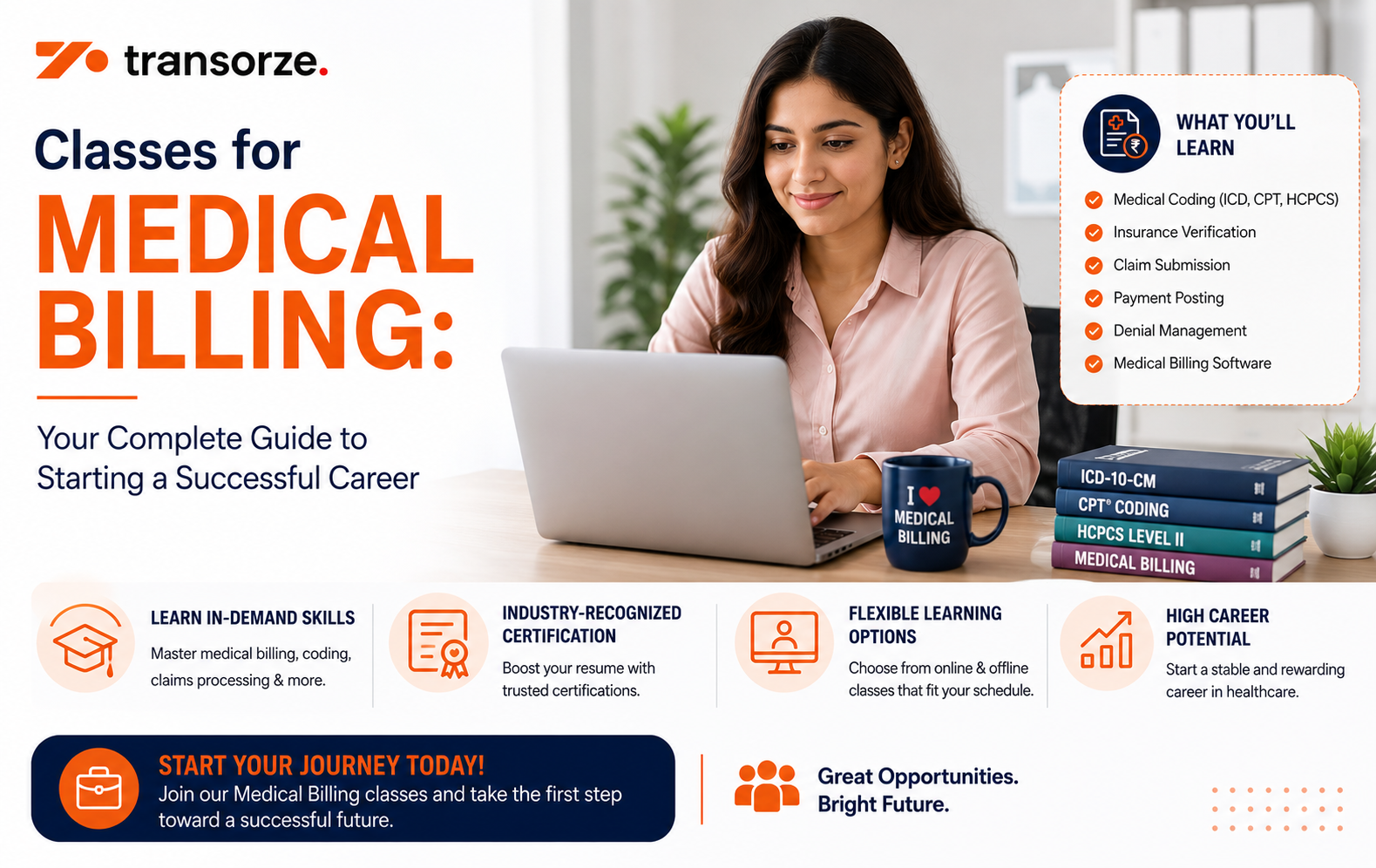
Healthcare is one of the fastest-growing industries in the world, and behind every successful hospital, clinic, or healthcare provider is an efficient billing system. Every medical service provided to a patient must be accurately documented, coded, billed, and processed through insurance companies or healthcare payment systems. This has created an increasing demand for skilled professionals who understand medical billing and healthcare revenue management. As healthcare organizations continue to adopt digital systems and standardized billing procedures, the need for trained medical billing specialists continues to grow across India and internationally.
If you have been searching for classes for medical billing, you’re already taking the first step toward entering a profession that offers stability, career growth, and opportunities to work with global healthcare organizations. Unlike many careers that require years of higher education, medical billing training can prepare learners with industry-relevant skills within a relatively short period. Whether you are a recent school graduate, a college student, a working professional looking for a career change, or someone returning to work after a break, medical billing offers a practical pathway into the healthcare industry.
The right training program does much more than teach billing procedures. It introduces learners to healthcare documentation, insurance regulations, coding fundamentals, claim submission, reimbursement processes, patient records management, and compliance standards. Quality institutes also provide practical exposure through case studies, live projects, and placement assistance, helping students become job-ready from day one.
What Are Classes for Medical Billing?
Medical billing classes are structured training programs designed to teach students how healthcare providers receive payment for the medical services they deliver. These classes combine theoretical concepts with practical applications so learners understand the complete billing cycle from patient registration to final reimbursement. A well-designed curriculum introduces students to healthcare terminology, insurance systems, medical documentation, coding principles, billing software, electronic claim submission, denial management, and healthcare regulations.
Modern medical billing is much more than preparing invoices. Billing professionals act as an important bridge between healthcare providers, insurance companies, and patients. Their responsibilities include reviewing patient information, verifying insurance eligibility, assigning appropriate billing codes, submitting claims electronically, tracking reimbursements, resolving denied claims, maintaining billing records, and ensuring compliance with healthcare regulations. Every step requires attention to detail because even a small error can delay payments or result in claim rejection.
Professional classes for medical billing also focus on developing analytical thinking, communication skills, computer proficiency, and problem-solving abilities. Students become familiar with electronic health records, billing software, claim management platforms, and international healthcare documentation standards. These technical skills make graduates valuable assets for hospitals, diagnostic centers, insurance companies, business process outsourcing firms, and medical billing service providers. Since healthcare continues to expand globally, qualified billing professionals remain in demand across both domestic and international markets.
Understanding Medical Billing
Medical billing is the financial backbone of the healthcare industry. Whenever a patient receives treatment, every consultation, diagnosis, laboratory test, procedure, and medication must be documented correctly before payment can be processed. Billing specialists convert healthcare documentation into standardized billing information that insurance companies and healthcare payment systems can understand. This process ensures healthcare providers receive timely reimbursement while patients receive accurate billing statements.
A medical biller works closely with healthcare coders, physicians, insurance representatives, and administrative staff. They verify insurance information, review medical records, prepare electronic claims, follow up on unpaid accounts, resolve rejected claims, and ensure that billing complies with industry regulations. Because healthcare systems continue to evolve with new insurance policies and digital technologies, medical billing professionals must remain updated with current practices and industry standards. Quality training programs therefore combine conceptual knowledge with hands-on software practice, helping learners confidently handle real-world billing responsibilities.
Why Medical Billing Is in High Demand
Healthcare spending continues to increase worldwide, leading to more hospitals, clinics, specialty centers, diagnostic laboratories, and telemedicine providers. Every healthcare organization depends on efficient billing systems to maintain financial stability. As patient volumes increase, organizations require trained professionals who can accurately manage insurance claims, reduce billing errors, and improve reimbursement timelines.
The rise of healthcare outsourcing has also created significant employment opportunities for trained medical billing professionals. Many international healthcare providers partner with specialized billing companies that employ skilled professionals capable of handling insurance claims according to global standards. Digital transformation within healthcare has further increased the demand for individuals who understand electronic health records, automated billing platforms, and healthcare compliance requirements. This growing demand makes medical billing one of the most accessible healthcare careers for individuals seeking long-term professional growth.
Why Choose Medical Billing as a Career?
Choosing a career is one of the most important decisions a person makes, and medical billing offers several advantages that appeal to learners from different educational backgrounds. Unlike careers requiring years of specialized education, medical billing allows students to enter the healthcare sector through focused professional training. It combines healthcare knowledge with administrative expertise, creating a career path that offers continuous learning and advancement opportunities.
Healthcare services remain essential regardless of economic conditions, making medical billing a relatively stable profession. Hospitals, clinics, insurance companies, and healthcare support organizations continue to recruit trained billing specialists because efficient revenue management directly impacts organizational success. Professionals who gain experience can progress into roles such as billing analyst, claims specialist, quality auditor, revenue cycle executive, team leader, operations coordinator, or healthcare process manager.
Medical billing also offers flexibility in work environments. Graduates may work in hospitals, medical billing companies, insurance firms, healthcare BPOs, physician practices, or remote healthcare support services. As organizations increasingly adopt digital systems, opportunities for remote and hybrid work arrangements continue to expand, making the profession attractive for individuals seeking better work-life balance.
Career Stability
One of the strongest reasons people enroll in classes for medical billing is the long-term stability offered by the healthcare industry. Medical services are always required, regardless of economic fluctuations. Every patient interaction generates documentation and billing activities, ensuring a continuous need for trained professionals who can manage healthcare claims efficiently.
Unlike industries heavily influenced by seasonal demand, healthcare operates throughout the year. Hospitals and clinics require billing specialists every day to maintain financial operations. This consistency provides professionals with dependable employment opportunities and career progression based on skills, experience, and performance rather than short-term market trends.
Global Job Opportunities
Medical billing skills are recognized internationally because many healthcare systems follow standardized documentation and insurance processes. Professionals trained in international billing standards can explore employment opportunities with multinational healthcare organizations, outsourcing companies, insurance providers, and healthcare technology firms serving clients across different countries.
As healthcare outsourcing continues to grow, employers increasingly seek candidates who possess practical billing knowledge, communication skills, and familiarity with digital healthcare systems. This global demand enables trained professionals to build rewarding careers while continuously upgrading their expertise through advanced certifications and specialized healthcare training.
Who Can Join Classes for Medical Billing?
One of the biggest advantages of medical billing education is its accessibility. Unlike highly specialized medical professions that require years of clinical education, medical billing welcomes learners from diverse academic and professional backgrounds. Whether someone has recently completed higher secondary education, earned a bachelor’s degree, or is considering a complete career transition, medical billing provides an opportunity to enter the healthcare industry with focused, skill-based training.
Students who have completed Plus Two often choose medical billing because it offers a faster route to employment compared to many traditional degree programs. College graduates from science, commerce, arts, pharmacy, nursing, biotechnology, life sciences, and management backgrounds also find medical billing an excellent career option because it combines healthcare knowledge with administrative and technical skills. Even experienced professionals working in customer service, administration, finance, or business process outsourcing frequently enroll to move into the expanding healthcare sector.
Many institutes also welcome homemakers returning to work, career break candidates, and professionals seeking international healthcare opportunities. The curriculum is generally designed for beginners, meaning prior healthcare experience is not always necessary. With consistent practice, hands-on software training, and guidance from experienced faculty, learners can develop the confidence needed to succeed in real healthcare billing environments.
What Will You Learn in Medical Billing Classes?
Enrolling in classes for medical billing is about much more than learning how to prepare invoices or submit insurance claims. A well-structured training program equips students with the technical knowledge, practical skills, and industry awareness needed to succeed in today’s healthcare environment. Since medical billing connects healthcare providers, insurance companies, and patients, professionals must understand every stage of the healthcare revenue cycle while maintaining accuracy and compliance.
The curriculum usually begins with healthcare fundamentals before gradually introducing students to advanced billing concepts. Learners become familiar with medical documentation, patient registration, insurance verification, coding systems, claim preparation, reimbursement procedures, and denial management. Practical sessions using billing software help students understand how real healthcare organizations process patient information and insurance claims. Many institutes also include mock projects and case studies that simulate workplace scenarios, enabling students to build confidence before entering the job market.
Besides technical expertise, students develop communication, analytical thinking, problem-solving, and computer skills. These abilities are essential because billing professionals frequently interact with insurance representatives, healthcare providers, and administrative teams to resolve claim issues and ensure timely reimbursement. By the end of the course, learners should be able to manage billing workflows efficiently while following healthcare regulations and documentation standards.
Medical Terminology
Medical terminology forms the foundation of every medical billing program. Before processing claims, professionals must understand the language used by doctors, nurses, laboratories, and healthcare institutions. Students learn the meaning of common medical prefixes, suffixes, root words, anatomy, physiology, diseases, diagnostic procedures, medications, and surgical treatments.
Understanding medical terminology reduces billing errors because professionals can accurately interpret physician documentation and patient records. It also improves communication with healthcare teams and insurance companies. Instead of memorizing thousands of medical terms, learners develop logical methods for understanding unfamiliar words, making it easier to adapt as healthcare continues to evolve.
ICD, CPT, and HCPCS Coding Basics
Although medical billing and medical coding are separate disciplines, billing professionals benefit from understanding coding fundamentals. Most training programs introduce students to internationally recognized coding systems such as ICD, CPT, and HCPCS. These standardized codes represent diagnoses, procedures, treatments, and medical services used during claim processing.
Learning coding basics helps billing professionals identify documentation errors, communicate effectively with coding teams, and prepare accurate insurance claims. Since reimbursement often depends on correct coding, this knowledge significantly improves claim acceptance rates and reduces costly delays.
Insurance Claims Processing
Insurance claim processing is one of the most important topics covered during medical billing training. Students learn how patient information moves through the healthcare payment system, from appointment scheduling and insurance verification to claim submission, payment posting, denial management, and final reimbursement.
Practical exercises teach learners how to identify claim errors, review insurance policies, follow payer guidelines, and resolve rejected claims. Understanding insurance workflows enables graduates to contribute immediately after joining hospitals, clinics, or medical billing companies.
Revenue Cycle Management
Revenue Cycle Management (RCM) refers to the complete financial process that begins when a patient schedules an appointment and ends when the healthcare provider receives payment. Medical billing professionals play a vital role throughout this cycle by ensuring every service is documented correctly, claims are submitted on time, payments are tracked, and outstanding balances are resolved.
Students gain a complete understanding of revenue cycle operations, enabling them to appreciate how their responsibilities influence the financial health of healthcare organizations. This broader perspective also prepares learners for career growth into supervisory and management positions within healthcare administration.
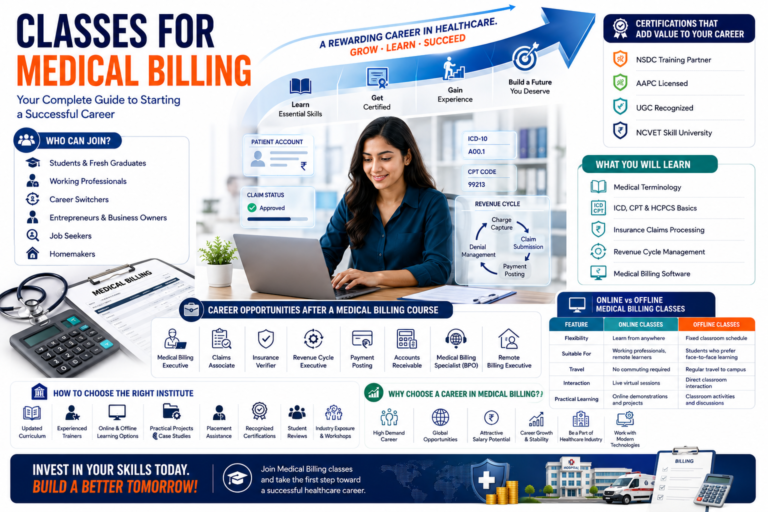
Online vs Offline Classes for Medical Billing
One of the first decisions prospective students make is whether to choose Online & Offline classes. Both learning methods have unique advantages, and the best choice depends on individual learning preferences, work schedules, travel convenience, and career goals. Fortunately, many leading institutes now offer flexible learning options that combine classroom instruction with digital learning resources, allowing students to learn in the way that suits them best.
Online learning has become increasingly popular because it provides flexibility without compromising educational quality. Students can attend live classes, access recorded lectures, complete assignments digitally, and communicate with instructors from anywhere. This format benefits working professionals, homemakers, and students living outside major cities.
Offline classroom training, however, continues to attract learners who prefer face-to-face interaction and structured academic environments. Classroom discussions, group activities, software practice, and immediate instructor support often improve engagement and help students build confidence more quickly.
The ideal institute delivers quality education regardless of the learning format by combining experienced faculty, practical training, updated study materials, placement support, and continuous student guidance.
Benefits of Online Learning
Online medical billing classes offer convenience and flexibility without requiring students to relocate or commute daily. Learners can balance education with employment, family responsibilities, or higher studies while progressing at their own pace. Recorded sessions also allow students to revisit complex topics whenever necessary.
Many online programs include live doubt-clearing sessions, digital assessments, virtual software practice, and online mentoring. These features create an engaging learning experience while helping students develop technical skills using modern healthcare technologies.
Benefits of Classroom Training
Offline classes provide direct interaction with instructors and classmates, encouraging collaborative learning and immediate feedback. Practical software sessions, classroom discussions, and instructor demonstrations often improve understanding of challenging concepts.
Students also benefit from structured schedules, peer motivation, networking opportunities, and easier access to placement support. For learners who perform best in traditional academic environments, classroom training remains an excellent choice.
Certifications That Add Value
Professional certifications enhance both credibility and employability in the healthcare industry. Employers increasingly prefer candidates who have completed training from recognized institutions because certifications demonstrate commitment, structured learning, and industry readiness. While practical skills remain the most important factor, studying with an institution that maintains recognized academic and industry affiliations provides additional confidence for both students and recruiters.
When evaluating classes for medical billing, students should consider institutes associated with respected organizations and educational bodies. Recognition indicates that the curriculum follows industry standards and prepares learners with relevant competencies expected by employers.
One example is Transorze, which offers Online & Offline classes supported by recognized academic and industry credentials including NSDC Training partner, AAPC Licensed, UGC recognized, and NCVET Skill University affiliations. These recognitions strengthen the learning experience by aligning training with professional expectations while helping students build confidence in the quality of their education.
How to Choose the Best Medical Billing Institute
Selecting the right medical billing training institute can significantly influence your learning experience and career opportunities. While many institutes advertise similar programs, students should carefully compare curriculum quality, faculty expertise, practical exposure, certifications, placement support, and student outcomes before making a decision.
An effective medical billing course should combine theory with extensive hands-on practice. Students should have opportunities to work with billing software, analyze case studies, complete assignments based on real healthcare scenarios, and participate in mock claim processing exercises. Practical exposure helps learners transition smoothly into professional roles after completing the course.
Before enrolling, consider factors such as:
| Feature | Why It Matters |
|---|---|
| Updated Curriculum | Covers current billing practices and healthcare standards |
| Experienced Trainers | Learn from professionals with industry knowledge |
| Practical Software Training | Builds real workplace skills |
| Placement Assistance | Improves employment opportunities |
| Flexible Learning Options | Supports different learning preferences |
| Industry Certifications | Enhances credibility with employers |
Reading student reviews, speaking with alumni, attending demo classes, and understanding placement support can also help learners make informed decisions.
STUDENTS SUCCESS STORIES
Career Opportunities After Course Completion
Completing classes for medical billing opens the door to a wide range of career opportunities within the healthcare industry. Hospitals, specialty clinics, insurance companies, healthcare outsourcing firms, diagnostic laboratories, physician practices, and medical billing service providers regularly recruit trained billing professionals.
Entry-level positions commonly include Medical Billing Executive, Claims Associate, Insurance Verification Specialist, Revenue Cycle Executive, Payment Posting Associate, and Accounts Receivable Executive. As professionals gain experience, they may advance into senior billing roles, quality assurance, auditing, operations management, client coordination, or healthcare process leadership.
Medical billing also offers opportunities to specialize in areas such as denial management, revenue cycle optimization, compliance auditing, healthcare documentation, or insurance reimbursement analysis. Continuous learning and additional certifications can further improve career progression and salary potential.
The increasing adoption of digital healthcare systems has expanded opportunities beyond traditional hospital settings. Remote work, international healthcare outsourcing, and technology-driven healthcare services continue to create demand for skilled professionals capable of managing complex billing operations efficiently.
Salary Expectations
Salary depends on several factors including educational background, practical skills, certifications, employer type, geographic location, and previous work experience. Fresh graduates generally begin with entry-level salaries while gaining practical exposure and industry experience. As professionals improve their technical expertise and take on greater responsibilities, compensation typically increases accordingly.
Professionals employed by multinational healthcare organizations or international medical billing companies often receive competitive salary packages along with performance incentives, career development opportunities, and structured training programs. Experienced specialists working in revenue cycle management, quality auditing, or operations leadership may earn significantly higher compensation than entry-level professionals.
Rather than focusing only on starting salary, prospective students should evaluate long-term career growth, continuous learning opportunities, employer demand, and advancement potential. Healthcare remains one of the world’s most resilient industries, making medical billing an attractive career for individuals seeking professional stability and consistent development.
Conclusion
Choosing the right classes for medical billing can be the first step toward building a rewarding career in one of the world’s fastest-growing industries. As healthcare providers continue to expand their services and insurance systems become increasingly digital, the demand for skilled billing professionals continues to rise. This creates excellent opportunities for students, graduates, career changers, and working professionals who want a stable profession with long-term growth.
A quality medical billing course should do more than explain theories. It should help you understand healthcare documentation, insurance claims, billing software, revenue cycle management, compliance requirements, and communication with healthcare stakeholders. Practical training, experienced instructors, recognized certifications, and placement support all contribute to becoming job-ready and confident in a professional environment.
Before enrolling, compare different institutes based on curriculum, practical exposure, faculty expertise, certifications, learning flexibility, and career support. Whether you choose online learning, classroom training, or a hybrid approach, the right program should match your learning style and career goals.
The healthcare industry rewards professionals who continuously upgrade their knowledge and maintain high standards of accuracy. Investing in professional medical billing education today can open doors to diverse job roles, steady career progression, and opportunities to work with healthcare organizations serving patients across India and around the world.
Recommended Reads
Frequently Asked Questions
Classes for medical billing are professional training programs that teach students how healthcare providers submit insurance claims, process patient billing, manage reimbursements, and maintain accurate financial records. Most courses also include medical terminology, billing software, healthcare documentation, and revenue cycle management to prepare students for real-world jobs.
Transorze accept students who have completed higher secondary education (Plus Two) or graduation. Working professionals, career changers, homemakers returning to work, and individuals from science, commerce, arts, pharmacy, nursing, or life science backgrounds can also pursue medical billing training.
Yes. Reputed institutes offer Online & Offline classes with similar course content, experienced trainers, practical assignments, software demonstrations, and student support. The right choice depends on your schedule, learning preference, and access to classroom facilities.
Students should look for institutions associated with recognized credentials such as NSDC Training partner, AAPC Licensed, UGC recognized, and NCVET Skill University. These affiliations indicate that the institute follows industry-oriented training standards and provides structured learning aligned with employer expectations.
Graduates may work as Medical Billing Executives, Claims Processing Associates, Insurance Verification Specialists, Revenue Cycle Executives, Payment Posting Associates, Accounts Receivable Executives, Healthcare Process Associates, or Billing Coordinators in hospitals, clinics, insurance companies, healthcare BPOs, and medical billing service providers.
