
Copyright © Transorze. All rights reserved.
Healthcare in India runs on documentation, and every diagnosis, procedure, and insurance claim depends on someone translating clinical notes into standardized codes. That’s medical coding — and it’s one of the few healthcare-adjacent careers you can enter without a medical degree, provided you get the right training. If you’re searching for a medical coding course in Thrissur, this guide covers what the role actually involves, what a good training program should include, how online classes compare with classroom learning, and what to check before you enroll anywhere.
Thrissur sits within easy reach of Kerala’s major hospital networks and medical colleges, and the city has a growing base of BPO and healthcare-outsourcing employers who hire coders for both onsite and remote roles. Because US healthcare providers outsource a large share of their coding and billing work to India, a certified coder based in Thrissur can realistically work for a Kochi-based process, a Bangalore employer, or a fully remote US client without relocating. That combination — local training, national and international job pool — is what makes this a career worth training for properly rather than picking the first center that shows up in a search.
A credible program should offer CPC-aligned curriculum, hands-on case-study practice, experienced faculty, and documented placement support — not just a certificate at the end.
Not every institute offering “medical coding classes” is preparing you for the CPC (Certified Professional Coder) exam or for actual job readiness. Before enrolling anywhere in or around Thrissur, it’s worth checking for these five things:
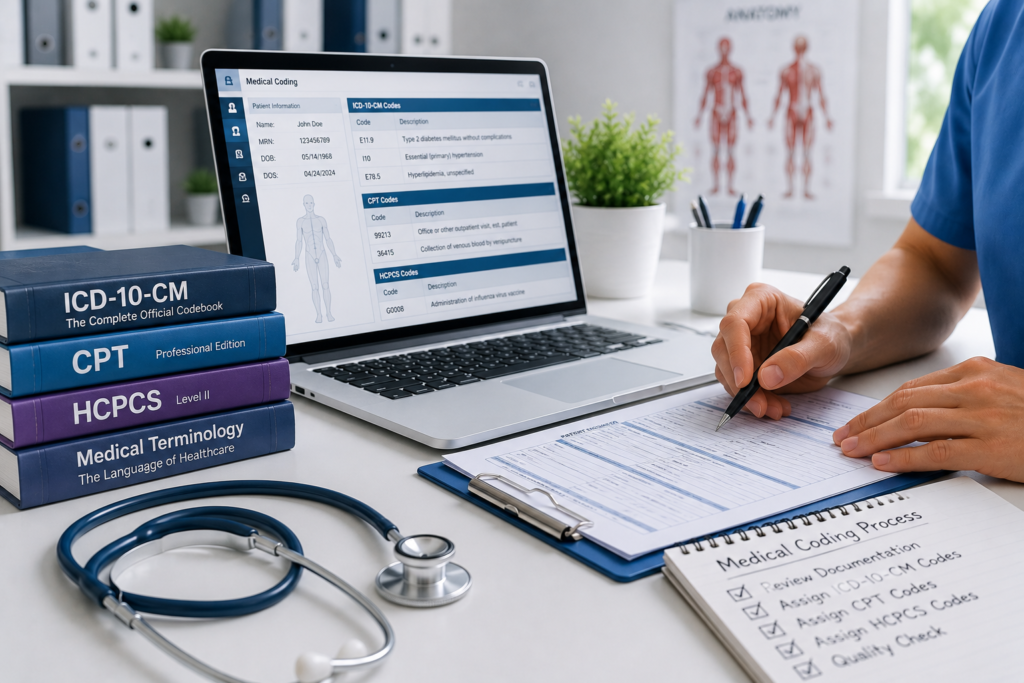
The training should map directly to the AAPC’s CPC exam structure — anatomy and medical terminology, ICD-10-CM, CPT, HCPCS Level II, and payer guidelines — rather than a generic overview of healthcare documentation.
Coding is a skill you build by doing it repeatedly on real-style case scenarios. A program heavy on theory and light on practice sessions will leave you underprepared for both the certification exam and the job itself.
Trainers who’ve actually coded professionally — not just taught the subject — bring practical judgment calls that textbooks don’t cover, especially around denial management and payer-specific quirks.
Ask specifically what placement support looks like: is there a dedicated team, do they have existing employer relationships, and can they show recent placement outcomes? Vague promises of “100% placement assistance” without specifics are worth being skeptical of.
Not everyone can commit to a fixed daytime classroom schedule. This is where online class options matter.
Classroom training suits full-time learners who want hands-on, in-person mentorship; online classes suit working professionals, parents, or students in nearby towns who need flexibility without sacrificing curriculum depth.
| Factor | Classroom Training | Online Classes |
|---|---|---|
| Best for | Full-time students, career switchers with free daytime hours | Working professionals, those outside Thrissur city limits |
| Schedule | Fixed batch timings | Flexible, often recorded + live sessions |
| Interaction | Direct, in-person faculty access | Live doubt-clearing sessions, chat/video support |
| Commute | Required | None |
| Practice material | Same case studies, done in-center | Same case studies, done remotely |
Institutes offering medical coding training in and around Thrissur, including Transorze, now run both formats side by side, so students who can’t attend a physical center — because they’re working, based in a nearby town, or simply prefer studying from home — still get the same CPC-aligned curriculum, live faculty interaction, and placement support as classroom students. This matters more than it might seem: a well-run online batch with live sessions and real case-study practice can prepare you just as thoroughly as a classroom one, provided the institute treats it as a full program and not a recorded-video afterthought.
Most structured programs run between 2 to 4 months for the core certification track, depending on batch pace and whether you’re studying full-time or part-time alongside other commitments. Diploma-level programs that go deeper into hospital administration or healthcare documentation can extend to a year or more. It’s worth matching the program length to your actual goal — if you want to sit for the CPC exam and start working quickly, a shorter, exam-focused track is usually the better fit than a broader diploma.
Entry-level certified coders in India typically start in the range of ₹15,000–₹25,000 per month, with faster growth than most entry-level healthcare-adjacent roles because experienced coders and certified auditors are consistently in short supply. Common job titles to search for once you’re certified include Medical Coder, Coding Analyst, Clinical Documentation Specialist, and — after a few years of experience — Coding Auditor or Team Lead. Many coders also move into medical billing, healthcare compliance, or Health Information Management roles over time, since the underlying documentation knowledge transfers well.
Many aspiring healthcare professionals choose Transorze because it combines quality education with industry-focused training. Students can choose Online & Offline classes based on their learning preferences while benefiting from programs supported by NSDC Training Partner, AAPC Licensed, UGC Recognized, and NCVET Skill University affiliations. This combination helps learners build practical skills, gain recognized credentials, and prepare confidently for careers in medical coding and billing.
If you’re based in Thrissur or the surrounding districts and are evaluating your options, it’s worth visiting a center in person if you can, sitting in on a demo class, and comparing the curriculum and placement track record against what’s listed above before committing. For those who’d rather start immediately without a site visit, checking whether an online batch is currently enrolling is usually the fastest way to begin.
Every successful career starts with the right guidance. Hear directly from our students as they share their learning experience, the practical skills they gained, and how the course helped them prepare for rewarding careers in medical coding and billing. Their journeys offer valuable insights for anyone considering this profession.
No. Medical coding is open to graduates from any background, though a basic understanding of human anatomy and medical terminology — which most training programs teach from scratch — is essential for the job.
Most core certification programs take 2 to 4 months to complete, depending on whether you attend full-time or part-time batches, either in a classroom or online.
Yes. Online medical coding classes now cover the same CPC-aligned curriculum, live faculty sessions, and case-study practice as classroom programs, making them a practical option for working professionals or students outside Thrissur city.
The CPC (Certified Professional Coder) certification from AAPC is the most widely recognized credential for medical coders in both Indian and US-outsourced healthcare processes.
Many certified coders do work remotely, especially those employed by outsourcing firms serving US healthcare clients, though entry-level roles sometimes require initial onsite training or hybrid arrangements.
Medical coding assigns standardized codes to diagnoses and procedures; medical billing uses those codes to generate and follow up on insurance claims. Many training programs, and many job roles, combine both skill sets.
Course fees vary by institute and program depth (short certification vs. diploma), so it’s best to request a fee structure directly from the institute along with details of what’s included — study material, mock exams, and placement support.
Copyright © Transorze. All rights reserved.
