
Courses for Medical Coding: Complete Career Guide for Aspiring Healthcare Professionals
Healthcare is one of the fastest-growing industries worldwide, and behind every successful hospital, clinic, insurance company, and healthcare provider is a system that keeps medical records accurate and standardized. One of the most important professionals supporting this system is the medical coder. Medical coding transforms patient diagnoses, procedures, treatments, and healthcare services into universally accepted alphanumeric codes that insurance companies, hospitals, and government agencies can understand. These codes ensure accurate billing, regulatory compliance, healthcare analytics, and quality patient care.
As healthcare systems continue to become more digital, the demand for skilled professionals with formal courses for medical coding continues to rise. Hospitals, revenue cycle management companies, healthcare BPOs, insurance providers, and telehealth organizations are actively recruiting certified coders who possess strong technical knowledge and practical coding skills. Recent industry reports also indicate sustained growth in healthcare documentation and medical coding careers due to increasing electronic health record adoption and expanding healthcare services.
If you’re considering a stable career with strong earning potential, structured medical coding education can significantly improve your employment opportunities. Professional training equips learners with coding standards, medical terminology, anatomy, physiology, reimbursement systems, and compliance requirements that employers actively seek. This guide explains everything you need to know about choosing the right medical coding course and building a rewarding healthcare career.
What Is Medical Coding?
Medical coding is the process of converting healthcare diagnoses, physician notes, laboratory reports, prescriptions, surgical procedures, and medical services into standardized codes used across the healthcare industry. These codes create a universal language that allows hospitals, insurance providers, healthcare regulators, and government organizations to communicate efficiently.
Imagine thousands of hospitals documenting patient information differently. Processing insurance claims, conducting research, monitoring diseases, or analyzing healthcare outcomes would become nearly impossible. Medical coding solves this challenge by ensuring consistency and accuracy across healthcare systems. Every diagnosis and treatment receives a standardized code, reducing misunderstandings while improving operational efficiency.
Medical coders play an essential role in maintaining healthcare documentation quality. Their work directly impacts reimbursement, compliance with healthcare regulations, fraud prevention, and patient record accuracy. Because healthcare organizations depend heavily on accurate coding, employers increasingly prefer candidates who have completed structured training programs rather than relying solely on self-learning.
Why Medical Coding Is Essential in Modern Healthcare
Medical coding extends far beyond insurance billing. Every coded patient record contributes to healthcare planning, disease surveillance, public health reporting, hospital performance evaluation, and clinical research. Governments and healthcare organizations use coded information to identify disease trends, allocate healthcare resources, and improve patient outcomes.
Accurate coding also reduces claim denials and billing errors. Insurance providers rely on coding accuracy to determine reimbursement eligibility. Incorrect coding may result in delayed payments, rejected claims, compliance risks, or financial losses for healthcare organizations. Skilled coders help minimize these issues by applying internationally recognized coding guidelines correctly.
The growing adoption of electronic health records, telemedicine, digital healthcare platforms, and AI-assisted documentation has increased the importance of trained coding professionals. Healthcare employers continue investing in qualified coders who understand both clinical documentation and evolving coding standards, making medical coding one of the most promising non-clinical healthcare careers available today.
How Medical Coding Works
Medical coding begins when a patient receives healthcare services. Physicians, nurses, specialists, and other healthcare professionals document symptoms, diagnoses, laboratory findings, treatments, medications, and procedures in the patient’s medical record. Medical coders carefully review this documentation and assign standardized codes using internationally accepted classification systems.
The coding process requires much more than matching diagnoses with codes. Coders interpret physician documentation, verify medical necessity, ensure compliance with payer guidelines, identify missing information, and apply coding conventions correctly. Attention to detail is critical because even minor coding mistakes can affect reimbursement, audits, or patient records.
Professional medical coding training simulate real-world healthcare scenarios where students practice assigning codes using authentic medical documentation. This practical exposure prepares learners for workplace expectations while helping them develop confidence in interpreting complex clinical records. Employers consistently value candidates who demonstrate practical coding experience alongside theoretical knowledge.
ICD, CPT, and HCPCS Coding Systems
Medical coding professionals primarily work with three internationally recognized coding systems:
Coding System | Purpose |
ICD | Identifies diseases, diagnoses, and medical conditions. |
CPT | Describes medical procedures and physician services. |
HCPCS | Covers medical equipment, supplies, ambulance services, and additional healthcare services not included in CPT. |
Learning these coding systems forms the foundation of every quality medical coding course. Students also study medical terminology, anatomy, physiology, pharmacology, healthcare documentation, reimbursement methodologies, and healthcare compliance to become industry-ready professionals.
Why Courses for Medical Coding Matter
Choosing one of the right courses for medical coding is one of the most important decisions you can make if you’re planning to build a long-term career in healthcare without becoming a doctor or nurse. While it is technically possible to learn coding concepts independently, employers increasingly prefer candidates who have completed structured training because it demonstrates both competency and commitment. A professionally designed curriculum follows a logical progression, beginning with medical terminology and anatomy before moving into coding systems, healthcare regulations, reimbursement methodologies, and practical case studies. This approach allows students to understand not only how to assign codes correctly but also why coding decisions affect insurance claims, hospital revenue, patient records, and compliance.
Another advantage of structured education is exposure to real-world documentation. Medical records are rarely straightforward, and coders often need to interpret physician notes, operative reports, pathology findings, and discharge summaries. Professional training prepares learners for these complexities through guided practice and instructor feedback. Students also gain confidence by working on simulated coding scenarios that mirror actual workplace responsibilities. By the time they complete their course, they are better equipped to meet employer expectations, reduce coding errors, and contribute effectively from the beginning of their careers. This practical readiness often makes trained candidates more competitive during interviews and increases their chances of securing employment in hospitals, healthcare BPOs, insurance companies, and revenue cycle management organizations.
Skills You Learn During Professional Training
A comprehensive medical coding course covers far more than coding manuals. Students develop technical knowledge, analytical thinking, and communication skills that are essential in modern healthcare environments. Strong medical coders understand clinical language while also maintaining exceptional attention to detail. Since healthcare regulations and coding guidelines evolve regularly, professional education also teaches learners how to stay updated and adapt to industry changes.
Typical competencies gained during a medical coding program include:
- Medical terminology
- Human anatomy and physiology
- Disease processes
- Pharmacology fundamentals
- ICD coding
- CPT coding
- HCPCS coding
- Healthcare reimbursement
- Insurance claim processing
- Clinical documentation review
- Healthcare compliance
- Electronic Health Record (EHR) systems
- Medical ethics
- Quality assurance
- Coding audit fundamentals
Employers value these skills because they directly contribute to coding accuracy, reduced claim denials, regulatory compliance, and efficient healthcare operations.
Benefits of Structured Learning
One of the biggest misconceptions about medical coding is that memorizing codes is enough. In reality, successful coders must interpret clinical documentation, understand coding guidelines, identify missing information, and communicate effectively with healthcare professionals when clarification is required. Structured learning develops these higher-level competencies through instructor guidance and continuous assessments.
Students also benefit from peer interaction, doubt-clearing sessions, mock examinations, and practical assignments. These learning experiences are difficult to replicate through self-study alone. Many institutions additionally provide placement support, interview preparation, resume guidance, and certification exam coaching, all of which improve career readiness. The result is a graduate who possesses both theoretical knowledge and practical confidence—qualities that healthcare employers actively seek when hiring entry-level medical coders.
Why Industry Certifications Matter
Professional certifications validate your coding knowledge and improve employability in the healthcare industry. Employers often prefer certified professionals because they demonstrate competency in medical coding standards, compliance guidelines, and documentation practices.
Training through an institution that provides internationally aligned curriculum along with recognized certifications helps candidates gain confidence before attending interviews and certification examinations.
Choosing a training provider with experienced faculty, placement support, and updated curriculum can make a significant difference in long-term career growth.
Online vs Offline Medical Coding Courses
One of the most common questions prospective students ask is whether they should choose an online or classroom-based medical coding course. The answer depends on personal circumstances, learning preferences, work commitments, and career goals. Fortunately, advancements in digital education have made both learning modes highly effective when delivered by experienced trainers using a structured curriculum.
Online courses provide flexibility, allowing learners to study from home while balancing work or family responsibilities. Recorded sessions, digital learning resources, virtual coding exercises, and live instructor support enable students to progress at their own pace. This format is especially beneficial for working professionals seeking career transitions or upskilling opportunities without leaving their current jobs.
Offline classroom training, on the other hand, offers face-to-face interaction with instructors, immediate doubt resolution, collaborative learning, and hands-on classroom practice. Many students appreciate the structured schedule and disciplined environment that classroom learning provides. Some institutes also combine both methods through hybrid learning, enabling students to enjoy the flexibility of online education while still benefiting from classroom engagement and practical sessions.
When evaluating training providers, consider curriculum quality, instructor experience, certification support, placement assistance, practical exposure, student reviews, and industry recognition rather than focusing solely on the learning format.
Which Learning Mode Fits Your Goals?
There is no universally “best” learning mode. Instead, the right option depends on your lifestyle and career objectives.
Feature | Online Learning | Offline Learning |
Flexibility | Excellent | Moderate |
Face-to-face interaction | Limited | Excellent |
Self-paced study | Yes | Limited |
Classroom practice | Virtual | In-person |
Suitable for working professionals | Excellent | Good |
Networking opportunities | Moderate | High |
Students who require flexibility often succeed with online programs, while individuals who learn best through direct interaction may prefer classroom instruction. Many reputable institutions now offer both options, allowing learners to choose the approach that aligns with their schedules and learning preferences.
Professional Certifications That Improve Career Growth
Completing a medical coding course is only one part of career development. Professional certification demonstrates that your knowledge meets recognized industry standards and can significantly improve employability. Many healthcare employers prioritize certified candidates because certification validates coding accuracy, regulatory knowledge, and professional competence.
Certification also enhances long-term career growth. Certified coders frequently qualify for higher-paying positions, specialized coding roles, quality auditing opportunities, and supervisory responsibilities. As healthcare organizations increasingly focus on compliance and documentation accuracy, certified professionals continue to enjoy strong demand across hospitals, insurance providers, healthcare consulting firms, and global healthcare outsourcing companies.
When selecting a training provider, ensure that the program aligns with recognized certification pathways and provides adequate preparation for certification examinations. A curriculum that combines theoretical instruction with practical coding exercises offers the strongest foundation for professional success.
Healthcare professionals looking for comprehensive training may also consider Transorze, which offers Online & Offline classes supported by credentials including NSDC Training Partner, AAPC Licensed, UGC Recognized, and NCVET Skill University, helping learners build industry-relevant skills while preparing for professional certification and employment.
Industry-Recognized Credentials
While certification requirements may vary depending on employers and countries, organizations generally value candidates who demonstrate proficiency in:
- Medical terminology
- Anatomy and physiology
- ICD coding systems
- CPT coding
- HCPCS coding
- Healthcare reimbursement
- Clinical documentation improvement
- Regulatory compliance
- Medical ethics
- Coding accuracy and quality assurance
Certification serves as evidence that a professional has mastered these competencies and can perform coding responsibilities with confidence and consistency. It also signals a commitment to continuous learning, which is increasingly important as healthcare regulations and coding standards continue to evolve.
Career Opportunities After Medical Coding Training
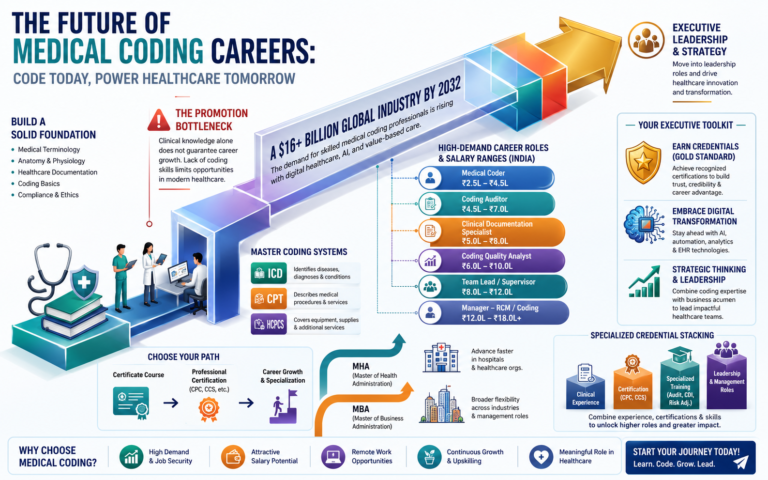
Completing one of the best courses for medical coding opens the door to a wide range of career opportunities across the healthcare ecosystem. Medical coders are no longer limited to hospitals. Today, healthcare providers, insurance companies, medical billing firms, revenue cycle management (RCM) organizations, healthcare BPOs, pharmaceutical companies, clinical research organizations, and telehealth providers all require professionals who can accurately interpret clinical documentation and assign standardized codes.
As healthcare systems continue to digitize patient records and expand insurance coverage, the demand for qualified coders continues to grow. Employers are seeking professionals who understand coding guidelines, maintain compliance, and contribute to faster claim processing with fewer denials. This demand creates stable employment opportunities for both fresh graduates and experienced professionals.
Medical coding is also attractive because it offers clear career progression. Entry-level coders can advance into senior coding positions, coding quality analysts, coding auditors, clinical documentation specialists, team leaders, trainers, and revenue cycle managers. Professionals who continue learning and earning additional certifications often move into specialized coding domains such as inpatient coding, outpatient coding, risk adjustment coding, or auditing, each of which can provide higher earning potential and greater responsibility.
Industries Hiring Certified Medical Coders
Medical coding professionals are employed across numerous healthcare sectors. While hospitals remain one of the largest employers, many other organizations rely on accurate coding to manage claims, maintain compliance, and improve operational efficiency.
Some of the leading employment sectors include:
- Multi-specialty hospitals
- Government healthcare institutions
- Medical colleges
- Insurance companies
- Third-party administrators (TPAs)
- Revenue Cycle Management companies
- Healthcare BPOs
- Medical billing companies
- Telemedicine providers
- Diagnostic laboratories
- Rehabilitation centers
- Pharmaceutical organizations
- Clinical research organizations
- Healthcare consulting firms
The growing adoption of Electronic Health Records (EHRs), digital healthcare platforms, and value-based care models has further increased the need for trained coding professionals. Organizations now prioritize candidates who combine technical knowledge with practical coding experience and recognized certifications.
Salary Expectations and Long-Term Growth
Salary is one of the most frequently discussed topics among aspiring medical coders. Earnings vary depending on several factors, including location, employer type, certifications, specialization, work experience, and coding accuracy. Freshers typically begin with competitive entry-level salaries that increase steadily as they gain practical experience and additional credentials.
Professionals who specialize in advanced coding disciplines, coding audits, compliance, or clinical documentation improvement often command significantly higher compensation. International healthcare outsourcing has also expanded opportunities for experienced coders to work with global healthcare clients, creating pathways for career growth beyond traditional hospital roles.
Beyond salary, medical coding offers several long-term advantages:
- Stable demand within the healthcare industry
- Opportunities for continuous professional development
- Multiple specialization pathways
- Career advancement into leadership positions
- Flexible employment options, including remote work in some organizations
- Transferable skills applicable across various healthcare sectors
For individuals seeking a healthcare career without direct patient care responsibilities, medical coding provides an excellent balance of professional growth, stability, and learning opportunities.
Choosing the Right Medical Coding Institute
Not every training institute delivers the same learning experience. Choosing the right institute can significantly influence your career prospects, certification success, and confidence as a coding professional. Rather than selecting a course solely based on cost, prospective students should evaluate curriculum quality, instructor expertise, practical exposure, certification support, placement assistance, and industry recognition.
A strong medical coding curriculum should begin with foundational subjects such as anatomy, physiology, and medical terminology before progressing into ICD, CPT, HCPCS, reimbursement methodologies, healthcare regulations, and compliance. Practical coding exercises using realistic medical documentation are equally important because employers expect graduates to apply knowledge confidently in workplace situations.
Students should also look for institutions that regularly update their curriculum to reflect changing coding guidelines and healthcare regulations. Career support services—including mock interviews, resume preparation, placement guidance, and certification exam coaching—can further improve employability after course completion.
Steps to Start Your Medical Coding Career
Conclusion
Medical coding has evolved into one of the most promising non-clinical careers within the healthcare industry. As hospitals, insurance companies, healthcare technology firms, and revenue cycle organizations continue expanding their digital operations, the need for skilled coding professionals continues to grow. Employers increasingly value candidates who possess structured training, recognized certifications, and practical coding experience because these qualities contribute directly to documentation accuracy, compliance, and efficient healthcare delivery.
Choosing the right courses for medical coding provides far more than technical knowledge. It develops analytical skills, clinical understanding, regulatory awareness, and professional confidence that support long-term career growth. Whether you are a recent graduate, a healthcare professional seeking career advancement, or someone planning a career transition, investing in quality medical coding education can open the door to rewarding opportunities across multiple healthcare sectors. Continuous learning, certification, and practical experience remain the strongest foundations for building a successful and sustainable medical coding career.
Conclusion
Medical coding has evolved into one of the most promising non-clinical careers within the healthcare industry. As hospitals, insurance companies, healthcare technology firms, and revenue cycle organizations continue expanding their digital operations, the need for skilled coding professionals continues to grow. Employers increasingly value candidates who possess structured training, recognized certifications, and practical coding experience because these qualities contribute directly to documentation accuracy, compliance, and efficient healthcare delivery.
Choosing the right courses for medical coding provides far more than technical knowledge. It develops analytical skills, clinical understanding, regulatory awareness, and professional confidence that support long-term career growth. Whether you are a recent graduate, a healthcare professional seeking career advancement, or someone planning a career transition, investing in quality medical coding education can open the door to rewarding opportunities across multiple healthcare sectors. Continuous learning, certification, and practical experience remain the strongest foundations for building a successful and sustainable medical coding career.
Recommended Reads
Frequently Asked Questions
Most medical coding courses are open to graduates from life science, pharmacy, nursing, allied health, biotechnology, microbiology, and other healthcare-related backgrounds. Some institutes also admit graduates from non-medical disciplines after providing foundation training in anatomy and medical terminology.
The duration varies depending on the institute and curriculum. Most professional medical coding programs take between 3 to 6 months, while advanced certification-oriented courses may require additional preparation time.
Although certification is not mandatory for every employer, it significantly improves employability, demonstrates professional competency, and often leads to better career opportunities and higher salary potential.
Yes. Many reputable training providers offer comprehensive online programs that include live classes, recorded sessions, coding practice, assessments, instructor support, and certification preparation. Online learning is especially suitable for working professionals and students seeking flexible schedules.
Successful medical coders typically possess:
- Strong attention to detail
- Medical terminology knowledge
- Anatomy and physiology understanding
- Analytical thinking
- Coding guideline expertise
- Communication skills
- Computer proficiency
- Problem-solving ability
- Ethical decision-making
