
Definition of Medical Transcription: Meaning, Process, Importance & Career Scope (2026 Guide)
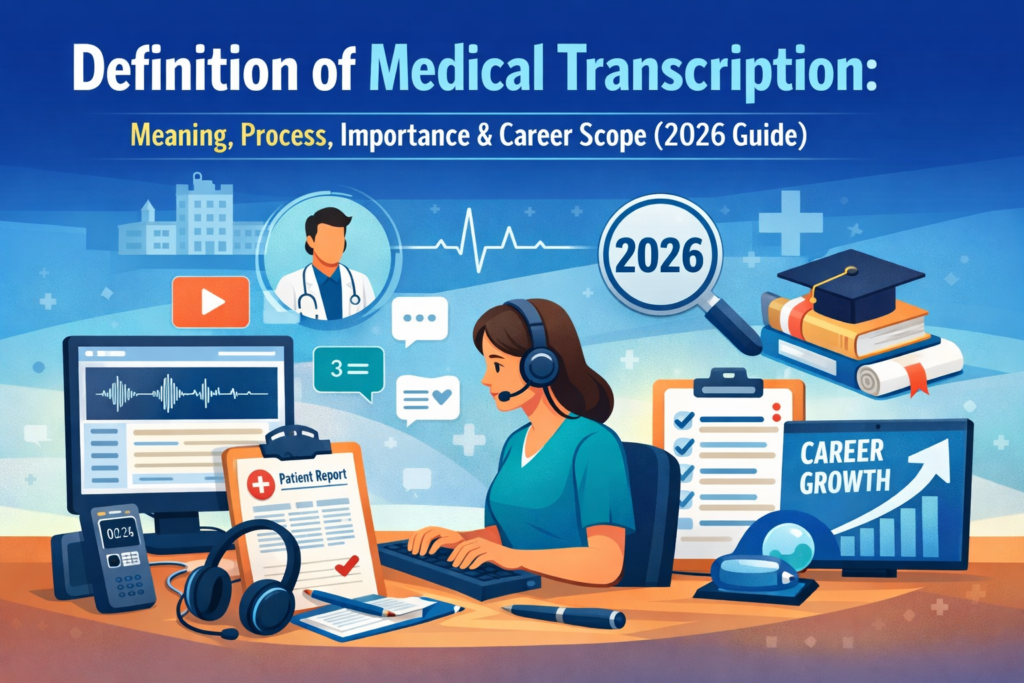
If you are searching for the definition of medical transcription, you are likely looking for a clear explanation of what it means, how it works, and why it plays a vital role in modern healthcare. Medical transcription is one of the foundational pillars of healthcare documentation, ensuring that patient records are accurate, complete, and legally compliant.
In simple terms, the definition of medical transcription refers to the process of converting voice-recorded medical reports dictated by physicians and healthcare professionals into written or electronic text format. These reports become part of the patient’s permanent medical record and are used for clinical care, billing, insurance claims, and legal purposes.
With increasing digitization in healthcare, professional medical transcription services and certified transcriptionists have become essential for hospitals, clinics, and diagnostic centers worldwide. In this comprehensive guide, we will explore the meaning, process, importance, career scope, required skills, and how Transorze establishes credibility in the medical transcription industry through recognized certifications and training excellence.
Definition of Medical Transcription (Clear & Concise Explanation)
Medical transcription is the process of converting physician-dictated audio recordings into accurate written medical documents for patient records and healthcare documentation.
This definition of medical transcription includes three key elements:
Audio dictation by healthcare professionals
Conversion into written text
Integration into official medical records
Medical transcription ensures accurate clinical documentation, which is critical for patient safety, insurance processing, and regulatory compliance.
What Is Medical Transcription in Healthcare?
To expand further on the definition of medical transcription:
Medical transcription involves trained professionals who listen to recorded notes from doctors and convert them into structured documents such as:
Discharge summaries
Operative reports
Consultation notes
History and physical examination reports
Radiology and pathology reports
These documents form the backbone of healthcare documentation, supporting patient care continuity and legal accountability.
For a detailed explanation, you can explore this comprehensive resource
Why Is Medical Transcription Important?
Understanding the definition of medical transcription also means understanding its significance.
1. Ensures Accurate Patient Records
Precise documentation reduces medical errors and improves patient safety.
2. Supports Insurance & Billing
Accurate records help process claims smoothly and reduce denials.
3. Legal & Compliance Protection
Medical documentation serves as legal evidence in case of disputes.
4. Enhances Physician Productivity
Doctors can focus on patient care instead of manual documentation.
Without professional medical transcription services, healthcare systems risk inefficiencies and compliance challenges.
Step-by-Step Process of Medical Transcription
To fully grasp the definition of medical transcription, it is helpful to understand the workflow.
Step 1: Physician Dictation
Doctors record patient encounters using digital recording systems.
Step 2: Audio File Transfer
The audio file is securely sent to a transcriptionist.
Step 3: Transcription
The transcriptionist listens carefully and converts audio into written text.
Step 4: Editing & Quality Check
Documents are proofread for grammar, terminology, and accuracy.
Step 5: Final Submission
The verified document is added to the electronic health record (EHR).
This structured workflow ensures reliability and confidentiality in healthcare documentation.
Skills Required for Medical Transcription
Professional transcription requires more than typing speed. Key skills include:
Strong knowledge of medical terminology
Understanding of anatomy & physiology
Excellent English grammar
Attention to detail
Listening accuracy
Familiarity with EHR systems
Training and certification significantly enhance accuracy and job readiness.
Career Opportunities in Medical Transcription
The healthcare sector continues expanding, increasing demand for skilled transcriptionists.
Career Roles Include:
Medical Transcriptionist
Medical Editor
Quality Analyst
Documentation Specialist
Healthcare Documentation Executive
Professionals with medical transcription certification often earn higher salaries and gain better placement opportunities.
Medical Transcription Training & Certification at Transorze
To establish credibility and ensure professional standards, structured training is essential.
Transorze is a recognized healthcare training and service provider offering industry-focused medical transcription training aligned with national skill development standards.
Why Choose Transorze?
Practical, case-based training
Experienced trainers with healthcare documentation expertise
Placement-oriented curriculum
Recognized certifications
Recognized Credentials & Institutional Affiliations
Transorze emphasizes trust and compliance through affiliations with:
NSDC – National Skill Development Council
National Skill Development Council supports skill development initiatives across India, ensuring industry-relevant training standards.
Medhavi University provides academic alignment and structured vocational learning pathways.
UGC-NCVET Recognition
University Grants Commission and National Council for Vocational Education and Training ensure regulatory compliance and national recognition for vocational programs.
Difference Between Medical Transcription and Medical Coding
Many people confuse these professions.
| Medical Transcription | Medical Coding |
|---|---|
| Converts audio to text | Converts diagnoses into codes |
| Focuses on documentation | Focuses on billing classification |
| Requires listening skills | Requires analytical coding knowledge |
Both play vital roles in healthcare documentation but serve different functions.
Is Medical Transcription a Good Career in 2026?
Yes. With digital healthcare expansion, demand remains steady.
Benefits:
Work-from-home opportunities
Stable healthcare industry
Entry-level accessibility
Career growth into editing & QA roles
Professionals with recognized medical transcription certification enjoy stronger employability.
FAQ – Medical Transcription
The definition of medical transcription is the process of converting physician-dictated audio recordings into accurate written medical documents used for patient records, billing, and legal healthcare documentation.
Medical transcription ensures accurate patient records, supports insurance claims, protects legal compliance, and improves physician efficiency by transforming audio dictation into structured healthcare documentation.
Medical transcription requires knowledge of medical terminology, strong grammar, listening skills, typing accuracy, attention to detail, and familiarity with electronic health record systems.
While certification is not legally mandatory, recognized medical transcription certification improves job prospects, credibility, and salary potential.
Medical transcription training typically takes 3 to 6 months, depending on course structure, practical exposure, and certification preparation.
Yes. Many healthcare providers outsource medical transcription services, allowing professionals to work remotely after gaining experience
Conclusion
Understanding the definition of medical transcription is the first step toward appreciating its critical role in healthcare documentation. From ensuring patient safety to enabling smooth insurance processing, medical transcription remains an essential healthcare function.
With structured training, recognized certifications, and institutional credibility through NSDC, Medhavi University, and UGC-NCVET recognition, Transorze stands as a trusted name in medical transcription services and education.
If you are exploring a medical transcription career or service solution, start by understanding its core definition — and then choose a recognized training partner to build a successful future in healthcare documentation.
