
SEO vs AEO vs GEO vs SXO vs AIO: The Complete 2026 Guide to Every Type of Search Optimization
Search has quietly split into five different games, and most website owners are still only playing one of them.
If you started your digital marketing journey a few years ago, you probably learned “SEO” as one single skill — write good content, get backlinks, rank on Google. That advice hasn’t disappeared, but it’s no longer the whole story. Today your audience finds you through classic blue links, through AI chat answers, through Google’s AI Overviews, through the Google Map Pack, and increasingly through tools like ChatGPT and Perplexity that never send them to your website at all.
That’s why five acronyms now sit side by side in every serious marketing conversation: SEO, AEO, GEO, SXO, and AIO. They overlap, but they are not the same thing, and treating them as one strategy is exactly why so many websites are “ranking” without getting real traffic or leads anymore.
Let’s break each one down properly, see how they connect, and build a practical roadmap you can actually use — whether you’re a business owner, a student, or someone exploring a career in digital marketing.
Quick Comparison: SEO vs AEO vs GEO vs SXO vs AIO
Aspect | SEO | AEO | GEO | SXO | AIO |
|---|---|---|---|---|---|
Full form | Search Engine Optimization | Answer Engine Optimization | Generative Engine Optimization | Search Experience Optimization | AI Optimization |
Definition | Ranking on search engines | Giving direct answers | Focusing on AI-generated search | Optimizing user experience | Making content AI-ready |
Focus | SERP visibility | Zero-click results | AI/local presence | Engagement, UX | AI content usability |
Outcome | More traffic | Snippet presence | AI/local mentions | More conversions/actions | Scalable with AI |
Key tools | Keywords, backlinks | Schema, voice search | GMB, E-E-A-T | UX, speed, CTAs | Semantic, clean code |
Audience | All searchers | Quick-answer seekers | Local & AI users | Site visitors | AI tools & users |
Content format | Blogs, landing pages | FAQs, snippets | Longform, chat-style | UX-first design | Structured content |
Role of AI | Assists tools | Powers direct answers | Creates summaries | Tracks behavior | Reads & repurposes content |
2026 relevance | Still crucial | More valuable than ever | Rising fast | Always vital | Growing fast |
Example | Ranking for “medical coding course” | Snippet answer for “what is medical coding” | ChatGPT citing your institute | Site visit → enrolment | AI tool summarising your course page |
1. SEO (Search Engine Optimization): Still the Foundation
SEO is the practice you already know — optimizing your website so Google, Bing, and other search engines rank it for relevant keywords. It’s built on keyword research, on-page optimization, technical health, and backlinks.
Here’s the thing people get wrong in 2026: SEO isn’t dying because of AI search. It’s the foundation everything else sits on. AEO, GEO, and AIO all depend on your site being crawlable, indexed, fast, and trustworthy in the first place. No AI engine cites a page Google can’t even find.
What still matters for SEO:
- Clear keyword targeting with a single focus keyphrase per page
- Clean site structure and internal linking
- Fast, mobile-friendly pages
- Consistent publishing and updated content
2. AEO (Answer Engine Optimization): Winning the Zero-Click Search
AEO is about structuring your content so it can be pulled out and shown as a direct answer — in a featured snippet, a voice search response, or a quick-answer box — without the user needing to click through.
This matters because a huge share of searches today are informational (“what is,” “how to,” “which is better”). If your content directly and concisely answers the question near the top of the page, you have a real shot at being the answer, not just a listed result.
How to actually do AEO:
- Answer the core question in the first 2–3 sentences of a section
- Use FAQ schema markup so search engines understand the Q&A structure
- Write in a natural, conversational tone — this is exactly how people talk to voice assistants
- Use clear headers phrased as questions
3. GEO (Generative Engine Optimization): Getting Cited by AI
GEO is the newest and fastest-growing of the five. It’s about optimizing content so that generative AI tools — ChatGPT, Google’s AI Overviews, Gemini, Perplexity — pull your brand, your data, or your explanation into their AI-generated answers.
Unlike traditional SEO, GEO isn’t just about ranking — it’s about being trusted enough to get cited. AI models favor content that demonstrates real Experience, Expertise, Authoritativeness, and Trust (E-E-A-T), along with clear structure and well-organized facts.
Practical GEO steps:
- Write longform, well-organized content that directly explains concepts (AI models love clear, factual explanations)
- Keep author bios, credentials, and real business information visible
- Maintain an accurate, updated Google Business Profile — this feeds AI’s understanding of local businesses
- Use structured data (schema) generously so AI systems can parse your content correctly
4. SXO (Search Experience Optimization): Turning Visitors into Action
SXO shifts focus from “getting someone to your site” to “what happens once they’re there.” It blends SEO with UX — page speed, intuitive navigation, clear calls-to-action, and mobile usability — because ranking #1 means nothing if visitors bounce before taking action.
Google itself increasingly rewards sites with good Core Web Vitals and low bounce rates, which makes SXO not just a conversion tactic, but an SEO ranking factor too.
SXO essentials:
- Fast-loading pages (aim under 3 seconds)
- Clear, single call-to-action per page (e.g., “Enroll Now,” “Book a Free Demo Class”)
- Simple navigation and readable typography
- Mobile-first design, since most learners and buyers search on their phones
5. AIO (AI Optimization): Making Your Content AI-Consumable at Scale
AIO is the broadest and most forward-looking of the five. It’s about structuring your entire website — content, code, and data — so that AI tools, browser agents, and future search systems can read, understand, and reuse it accurately and at scale.
Think of it as “accessibility for machines.” Clean semantic HTML, well-labeled sections, entity-based writing (naming specific things clearly instead of vague pronouns), and organized data all make your content easier for AI systems to summarize correctly — and harder to misquote or ignore.
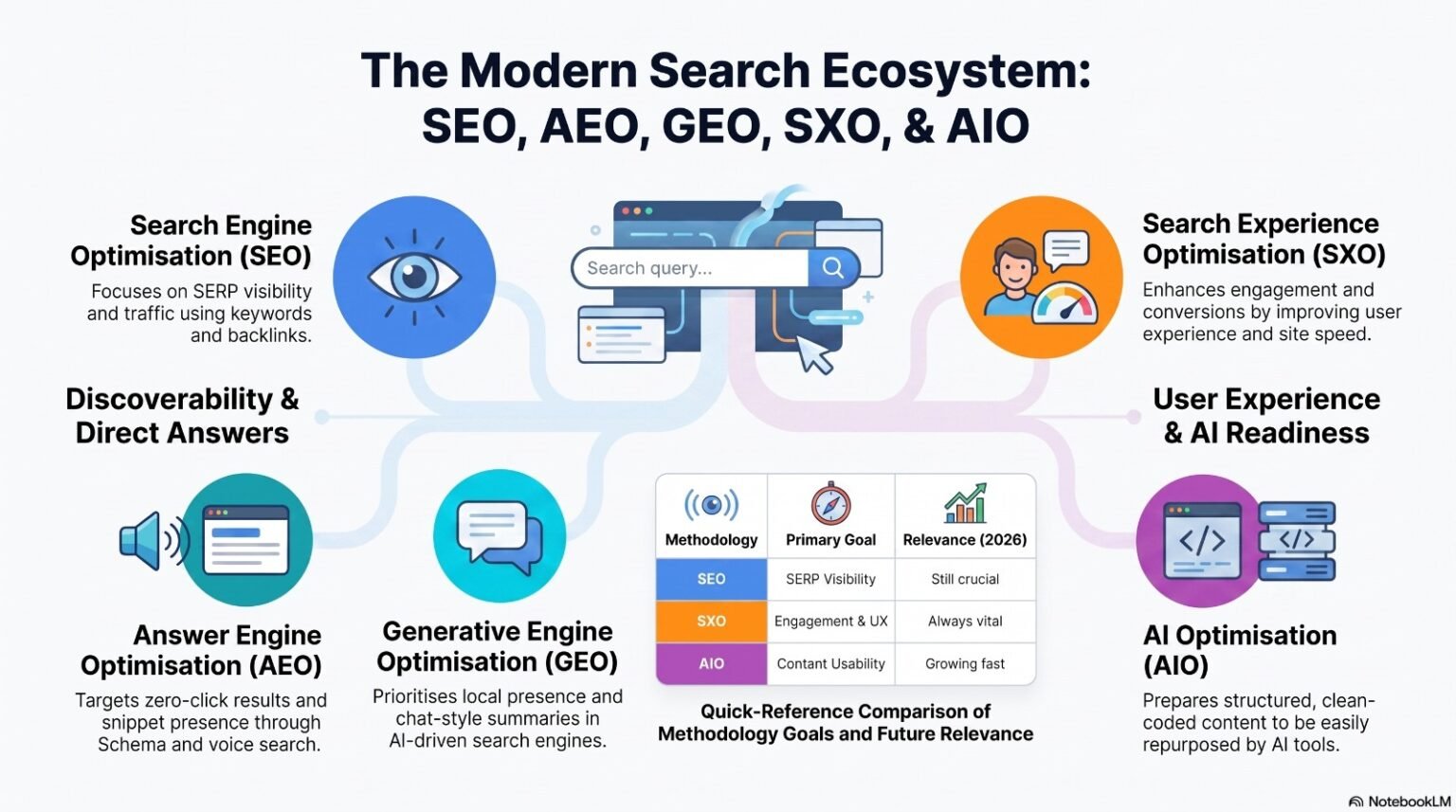
How SEO, AEO, GEO, SXO, and AIO Work Together
None of these operate in isolation. In practice, they stack:
- SEO gets your page crawled, indexed, and ranked in the first place.
- AEO gets a specific section of that page pulled into a featured snippet or voice answer.
- GEO gets that same well-structured, trustworthy content cited inside an AI Overview or a ChatGPT response.
- SXO makes sure that once someone lands on your page — from any of the above — they stay, engage, and convert.
- AIO future-proofs the whole system so AI agents and tools can keep reading and reusing your content correctly as search keeps evolving.
At Transorze, this layered approach is exactly how we think about content — whether it’s a course page or a blog post, it needs to work for Google Search, the Google Map Pack, AI Overviews, and tools like ChatGPT at the same time, not just one of them.
How to Rank Across Google Search, Google Maps, AI Tools, and AI Overviews Together
If you only optimize for one channel, you’re leaving visibility on the table. Here’s a practical checklist that touches all four:
For Google Search (SEO + AEO):
- One clear focus keyword per page, used naturally in the title, first paragraph, and headers
- FAQ sections with schema markup for snippet eligibility
- Internal linking between related pages to build topical authority
For Google Map Search (Local SEO + GEO):
- Complete, accurate Google Business Profile with correct category, hours, and service areas
- Consistent NAP (Name, Address, Phone) across your website and directories
- Location-specific landing pages when you serve multiple cities
For AI Tools and AI Overviews (GEO + AIO):
- Write in a clear, factual, well-organized style AI models can summarize accurately
- Use structured data (FAQ, Course, Organization schema) so AI systems understand exactly what your page offers
- Keep information current — AI tools tend to trust recently updated, consistent content over stale pages
Want to Learn This Hands-On? Take It From Theory to Practice
Reading about SEO, AEO, and GEO is one thing — actually building campaigns, writing AI-optimized content, and tracking real rankings is another. If you’d rather learn this properly with guided practice, Transorze runs online classes covering modern digital marketing, including AI-driven search strategy, as part of our AI-Enabled Digital Marketing program — designed for students and working professionals who want to be ready for where search is actually heading, not where it used to be.
STUDENTS SUCCESS STORIES
Recommended Reads
- Digital Marketing vs Traditional Marketing: Which Is Right for You?
- How to Choose the Right Digital Marketing Course for Your Career
- Best Digital Marketing Course in Kerala: A Complete Guide to Building a Successful Career in Digital Marketing
- Top 5 Digital Marketing Strategies for 2026 Success
- The Future of Digital Marketing: Trends and Opportunities in 2026
Frequently Asked Questions
SEO focuses on ranking your webpage in traditional search results so people click through to your site. AEO focuses on getting your content pulled directly into an answer box, snippet, or voice response — often without a click at all. SEO gets you found; AEO gets you quoted.
No. GEO builds directly on top of solid SEO. AI tools like ChatGPT and Google’s AI Overviews still rely on crawlable, well-indexed, trustworthy content to generate their answers — so a page with weak SEO fundamentals has little chance of being cited by GEO either.
Not necessarily all at once, but they should all live on your roadmap. Most businesses start with strong SEO and SXO fundamentals first, then layer in AEO through FAQ schema, and build GEO and AIO practices as their content library matures.
Google factors in user experience signals like page speed, bounce rate, and Core Web Vitals when ranking pages. A page that ranks well but immediately loses visitors due to poor experience often slips down over time, which is why SXO and SEO are increasingly treated as one discipline.
Start with clear, factual writing that answers questions directly, add structured data (FAQ schema, Organization schema), keep your content updated, and make sure your site’s E-E-A-T signals — real authors, real credentials, real business details — are visible and consistent across your website.
Yes. A complete and accurate Google Business Profile, consistent NAP details, and location-specific content help you rank locally, while the same accurate, structured business information also makes it easier for AI tools to correctly describe and recommend your business when someone asks a generative search engine for local recommendations.
