
Will AI Replace Medical Transcription?
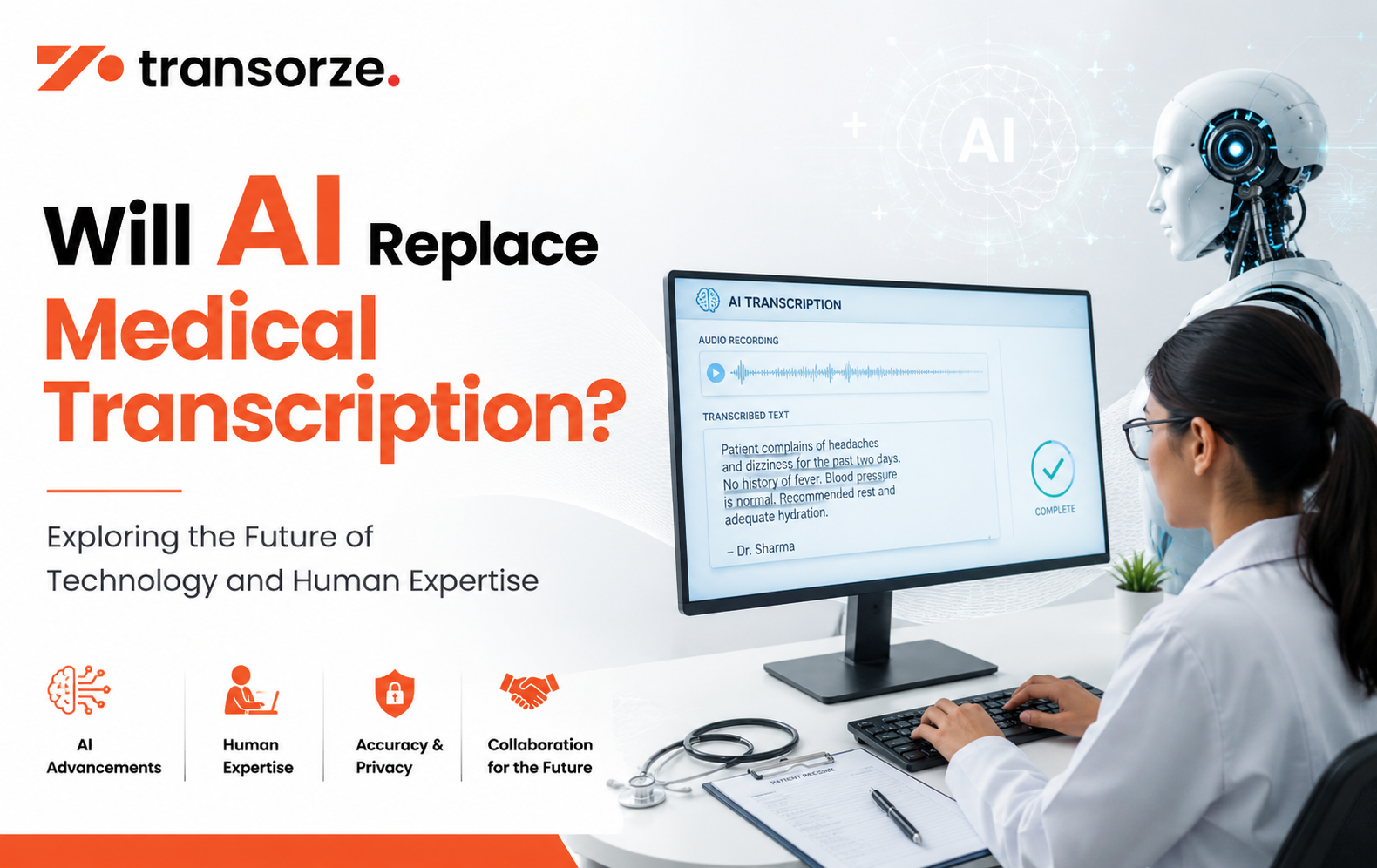
AI is more likely to transform medical transcription than completely eliminate it.
AI-powered speech recognition and ambient documentation are already being adopted in healthcare. These systems can listen to a doctor–patient conversation, generate a transcript, and even produce a draft clinical note.
What this means for medical transcriptionists
Traditional role:
Listen → type → format → proofread
Emerging role:
AI-generated draft → review → correct → verify → format → finalize
The important point is that AI can generate text, but it can still make clinically significant errors—including errors involving medical terminology, accents, context, and information that was never actually said. Human review and accountability therefore remain important.
In fact, AHIMA notes that the role of health information professionals is expanding to include AI oversight, documentation accuracy, compliance, and governance, rather than simply disappearing.
So, should someone still learn medical transcription in 2026?
Yes—but I would not recommend learning it as a purely typing-based career.
A future-ready medical transcriptionist should develop:
- Medical terminology
- Anatomy and physiology
- Excellent English and listening skills
- Knowledge of different accents
- AI/speech-recognition editing
- Clinical documentation
- Quality assurance and error identification
- HIPAA/privacy and healthcare data awareness
- Basic understanding of medical coding and EHRs
This is actually an important opportunity for medical transcription training institutes. Instead of telling students “AI will not affect medical transcription,” I would tell them:
“AI is changing medical transcription. The medical transcriptionist of the future will be less of a typist and more of a medical language and documentation specialist.”
Why AI is replacing some transcription work
- Speech-to-text technology has improved
AI can listen to a doctor’s dictation and produce a written transcript within seconds. - It is faster
A human may need significant time to listen, rewind, type, and format a recording. AI can generate a draft almost instantly. - It reduces costs
Healthcare organizations can reduce the amount of manual transcription work they need to outsource. - AI can work 24/7
AI doesn’t need breaks, shifts, or holidays and can process large volumes of dictation continuously. - Better recognition of medical terminology
Modern AI models are increasingly capable of recognizing medical terms, drug names, procedures, and different accents. - Integration with healthcare systems
AI-powered documentation tools can increasingly integrate with electronic health records (EHRs), allowing clinical notes to be generated as part of the healthcare workflow.
But AI is not perfect
This is where human medical transcriptionists still have an important role. AI can make mistakes such as:
- Mishearing a medical term
- Confusing similar-sounding drug names
- Missing a word or phrase
- Misinterpreting accents or unclear speech
- Adding words that were not spoken
- Getting medical context wrong
- Misinterpreting numbers, dosages, or measurements
For example, AI might produce a medically incorrect and grammatically perfect sentence. A trained human with medical knowledge may recognize the error immediately.
The role is evolving
Instead of: Doctor’s voice → Human types everything → Final document
the workflow is increasingly becoming: Doctor’s voice → AI creates draft → Human reviews and corrects → Final document
So, I wouldn’t say “medical transcriptionists are simply being replaced by AI.” A more accurate statement is: AI is replacing the routine, repetitive parts of medical transcription, while shifting the human role toward editing, quality assurance, validation, and medical-documentation expertise.
For someone entering the field today, I would strongly recommend learning AI-assisted transcription and medical documentation alongside traditional transcription skills. That combination can make you much more valuable than relying on typing skills alone.
If you want to build a career in AI-assisted medical transcription, I would recommend studying these areas:
- Medical terminology – anatomy, physiology, diseases, procedures, medications, and common abbreviations.
- Medical transcription fundamentals – formatting, punctuation, grammar, verbatim vs. non-verbatim transcription, and report types.
- English language skills – listening, grammar, spelling, sentence structure, and comprehension.
- US healthcare terminology and accents – especially if you plan to work with US-based medical dictations.
- Speech recognition and AI basics – understand how speech-to-text systems work and why AI makes errors.
- AI-generated transcript editing – learn to review, correct, and proofread AI-generated medical transcripts rather than simply typing from scratch.
- Quality assurance (QA) – identifying omissions, incorrect medical terms, wrong dosages, and context-related errors.
- EMR/EHR and medical documentation – understand how clinical documentation is created and maintained.
- Privacy and compliance – learn about patient confidentiality, HIPAA, and responsible handling of protected health information.
- AI tools and workflow – become comfortable using speech-recognition software, AI transcription platforms, text editors, and productivity tools.
The most important shift
The role is increasingly moving from “typing what the doctor says” to “reviewing, correcting, and validating AI-generated medical documentation.”
So, if you already have a foundation in medical transcription, your next focus should be:
Medical knowledge + English + AI/speech recognition + critical proofreading + quality assurance.
You don’t necessarily need to become a programmer. For most medical transcription professionals, understanding how AI tools work and becoming highly skilled at reviewing their output is likely to be more valuable than learning advanced coding.
Where should I learn Medical Transcription in the AI age?
For someone starting in 2026, I would look for a course with these components:
- Strong medical foundation — anatomy, physiology, pathology and medical terminology.
- Real transcription practice — preferably hundreds of authentic medical dictations and different US accents.
- AI-assisted transcription/editing — students should learn how to review and correct AI-generated drafts rather than simply type everything manually.
- Clinical documentation and EHR exposure.
- Quality assurance skills — identifying omissions, hallucinations, wrong medications, numbers, diagnoses, etc.
- Excellent English and listening skills.
- Actual placement support and industry exposure, rather than just a certificate.
If I were advising a student today, I wouldn’t say:
“Study medical transcription.” I’d say: “Study medical transcription + AI-assisted clinical documentation”
That combination makes much more sense for the next 5–10 years. AI is increasingly being positioned as a tool to augment healthcare professionals rather than simply replace them.
Recommended Reads
- Medical Transcription Means: A Complete Guide to Understanding This Essential Healthcare Career
- Medical Transcription Program: Complete Guide to Training, Certification, and Career Opportunities
- Medical Transcription Jobs Work From Home: Career Guide, Skills & Opportunities
- Salary of Medical Transcriptionist: Career Scope, Pay Scale, and Growth in India
- Medical Transcription Online Training: A Complete Guide to Building a Healthcare Career
Frequently Asked Questions About AI Medical Coding
Not entirely. AI is transforming the role rather than eliminating it — it now handles the first-draft transcription, while humans shift into reviewing, correcting, and validating that output for clinical accuracy.
No, but the purely typing-based version of the job is fading. Professionals who combine medical knowledge with AI-editing and quality-assurance skills remain in demand.
Yes — but not as a typing-only skill. It’s worth learning alongside AI-assisted transcript editing, clinical documentation, and QA so you’re prepared for the evolving role.
Because speech-to-text has improved significantly — AI is faster, cheaper, works 24/7, and is increasingly accurate with medical terms, drug names, and EHR integration.
It can mishear medical terms, confuse similar-sounding drug names, miss words, misread accents, add words that weren’t said, or get dosages, numbers, and clinical context wrong.
Instead of “listen → type → format,” the workflow is becoming “AI generates draft → human reviews, corrects, and verifies → final document.”
At Transorze — we don’t just teach you to type, we train you to work with AI. Our Medical Transcription program blends medical fundamentals, real dictation practice, and AI-draft editing skills, so you’re ready for where the industry is heading.
