
Medical Coding Certification Course: Build a Successful Career in Healthcare with Industry-Recognized Training
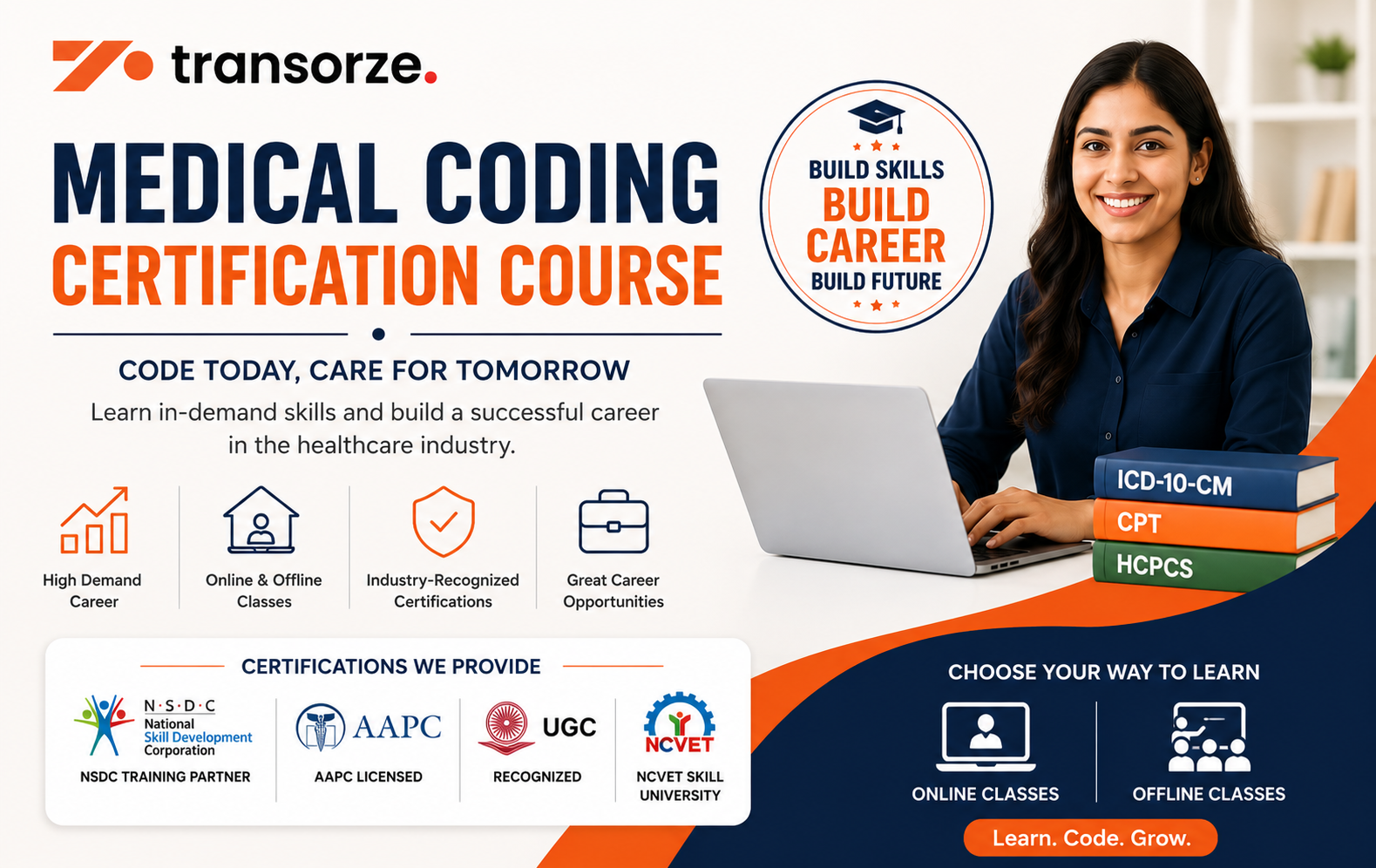
Medical Coding Certification Course
The healthcare industry continues to evolve rapidly, creating exciting opportunities for professionals who possess specialized administrative and technical skills. Among these career options, medical coding has emerged as one of the most in-demand professions due to the increasing digitalization of healthcare records, insurance claims, and hospital management systems. Hospitals, clinics, insurance companies, medical billing firms, and healthcare outsourcing organizations rely on skilled medical coders to translate patient diagnoses, procedures, and treatments into standardized codes. These codes ensure accurate reimbursement, maintain compliance with healthcare regulations, and support quality patient care. As healthcare systems become more data-driven, the demand for trained medical coding professionals continues to rise across India and international markets.
Choosing a Medical Coding Certification Course is one of the smartest investments for students, graduates, life science professionals, nurses, pharmacists, and anyone seeking a rewarding healthcare career without direct patient interaction. A well-structured certification program not only teaches coding guidelines but also develops practical skills required by employers. Whether your goal is to secure your first healthcare job, switch careers, or improve your earning potential, professional training provides the knowledge and confidence needed to succeed.
At Transorze, students receive industry-focused training through both Online & Offline classes, allowing learners to choose a learning format that best suits their schedule and preferences. With recognized certifications and experienced trainers, learners gain practical exposure that prepares them for real-world healthcare environments.
Why Medical Coding Is One of the Fastest Growing Healthcare Careers
Healthcare is one of the few industries that continues to expand regardless of economic fluctuations. As hospitals adopt electronic health records and insurance providers demand accurate documentation, the need for qualified medical coders grows every year. Every patient visit generates medical records that must be translated into universally accepted coding systems such as ICD-10-CM, CPT, and HCPCS. Without trained professionals handling this process, healthcare providers would struggle with insurance claims, reimbursement delays, compliance issues, and inaccurate patient records.
Medical coding professionals play a crucial role behind the scenes. Although they rarely interact directly with patients, their work significantly impacts healthcare organizations’ financial health and operational efficiency. This combination of technical knowledge and healthcare expertise makes coding specialists valuable assets across hospitals, insurance companies, revenue cycle management firms, medical BPOs, and multinational healthcare organizations.
Another reason for the increasing popularity of medical coding is the career flexibility it offers. Many organizations now provide hybrid and remote opportunities, enabling professionals to build long-term careers with better work-life balance. Since healthcare documentation standards continue to evolve, certified coders who keep their skills updated enjoy excellent job stability and opportunities for career advancement.
What Is a Medical Coding Certification Course?
A Medical Coding Certification Course is a comprehensive training program designed to teach students how to convert healthcare diagnoses, medical procedures, laboratory tests, and treatment information into standardized alphanumeric codes. These standardized coding systems are recognized internationally and form the foundation of healthcare reimbursement and documentation processes. During the course, students gain both theoretical understanding and practical coding experience using real-world medical case studies.
Unlike short introductory courses that provide only basic concepts, a professional certification program covers every stage of medical documentation. Students learn medical terminology, anatomy and physiology, disease processes, pharmacology basics, healthcare regulations, insurance concepts, ICD-10-CM coding, CPT coding, HCPCS coding, and claim processing workflows. Practical assignments help learners understand how coding decisions affect reimbursement accuracy and regulatory compliance.
Certification also validates your knowledge to employers. Recruiters often prioritize candidates who have completed structured training because certified professionals require less onboarding and demonstrate a stronger understanding of healthcare documentation standards. This significantly improves employability and creates opportunities in hospitals, diagnostic centers, insurance companies, medical coding firms, and healthcare outsourcing organizations.
Understanding Medical Coding
Medical coding is the process of transforming complex clinical information into standardized codes used throughout the healthcare industry. Physicians document patient diagnoses, treatments, surgeries, medications, and procedures in medical records. Coders carefully review these documents and assign the appropriate ICD, CPT, and HCPCS codes according to established guidelines. These codes are then used for insurance claims, reimbursement, statistical analysis, research, and healthcare planning.
Accuracy is essential because even a small coding error can lead to claim denials, delayed reimbursements, compliance issues, or financial losses for healthcare providers. This is why employers seek professionals who possess strong analytical skills, attention to detail, and comprehensive coding knowledge. Throughout a certification course, students learn coding conventions, official guidelines, payer requirements, and documentation standards that ensure coding accuracy.
Medical coding also contributes to healthcare quality improvement. Standardized coding enables healthcare organizations to analyze disease trends, evaluate treatment outcomes, monitor healthcare costs, and support public health initiatives. As healthcare continues embracing digital transformation, skilled medical coders remain indispensable professionals within the healthcare ecosystem.
Why Certification Matters
Employers increasingly prefer certified candidates because certification demonstrates commitment, competency, and professional readiness. Completing a recognized Medical Coding Certification Course assures recruiters that candidates have received structured training aligned with current industry practices. Rather than relying solely on theoretical knowledge, certified learners develop practical coding abilities through case studies, coding exercises, mock assessments, and hands-on practice.
Professional certification also enhances career confidence. Students become familiar with coding manuals, insurance terminology, reimbursement workflows, compliance regulations, and healthcare documentation processes before entering the workforce. This reduces the learning curve during employment and improves productivity from the very beginning.
Training through recognized credentials such as NSDC Training Partner, AAPC Licensed, UGC recognized, and NCVET Skill University adds further value to your professional profile. These recognitions reflect structured education, quality training standards, and industry relevance, helping graduates stand out in today’s competitive healthcare job market.
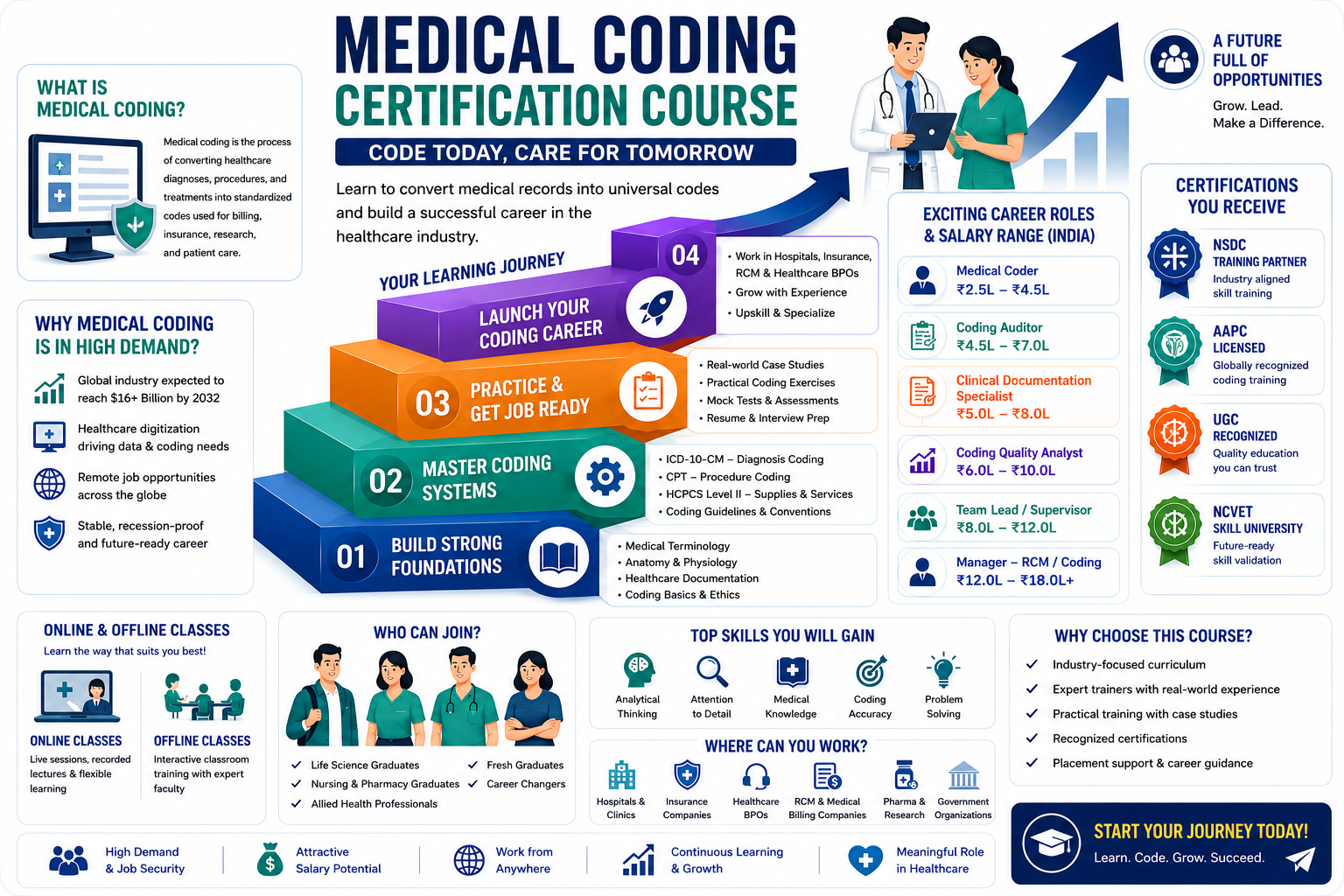
Skills You Learn During a Medical Coding Certification Course
A professionally designed Medical Coding Certification Course goes beyond teaching students how to assign diagnosis and procedure codes. It develops a complete set of healthcare documentation, analytical, and compliance skills that employers actively seek. Whether you are a recent graduate or a working professional planning a career transition, the right course helps you understand the complete healthcare revenue cycle while building confidence through practical learning. Since medical coding directly impacts patient records, insurance reimbursement, and regulatory compliance, students must gain a strong foundation before entering the workforce.
The curriculum is carefully structured to move from basic concepts to advanced coding practices. Students first learn the language of medicine before progressing to coding guidelines, reimbursement systems, and real-world medical documentation. Practical assignments, coding exercises, and case studies help learners apply theoretical concepts to realistic healthcare scenarios. This hands-on approach enables students to recognize documentation patterns, identify coding errors, and understand payer-specific requirements. By the end of the program, learners are prepared to work efficiently in hospitals, clinics, insurance companies, medical billing organizations, healthcare BPOs, and revenue cycle management firms.
Medical Terminology
Medical terminology forms the backbone of medical coding. Every diagnosis, procedure, laboratory investigation, medication, and anatomical structure has a specific medical term that coders must understand before assigning standardized codes. Without this knowledge, even experienced professionals can misinterpret physician documentation, resulting in coding inaccuracies and claim denials. This is why every quality certification program begins with a comprehensive introduction to medical language.
Students learn prefixes, suffixes, root words, abbreviations, disease names, surgical terminology, pharmacological terms, and clinical documentation commonly used by physicians. Instead of memorizing thousands of individual terms, learners understand the logic behind medical vocabulary, enabling them to interpret unfamiliar terminology with greater confidence. This systematic approach improves both coding speed and accuracy.
Medical terminology also strengthens communication within healthcare environments. Coders frequently collaborate with physicians, auditors, billing specialists, insurance teams, and healthcare administrators. A solid understanding of clinical language allows professionals to clarify documentation, resolve coding queries, and maintain compliance with coding standards. As a result, employers highly value candidates who demonstrate strong medical terminology skills from the beginning of their careers.
Anatomy and Physiology
Understanding the structure and function of the human body is equally important for medical coding professionals. Anatomy explains how different body systems are organized, while physiology focuses on how those systems function together. Since diagnosis and procedure codes are assigned according to the affected organs, tissues, and body systems, coders must understand these concepts thoroughly.
During the course, students study all major body systems, including the cardiovascular, respiratory, digestive, nervous, endocrine, musculoskeletal, urinary, reproductive, and integumentary systems. They learn common diseases, disorders, surgical procedures, diagnostic tests, and treatment methods related to each system. This knowledge allows coders to interpret physician documentation accurately and assign the correct diagnosis and procedure codes.
Practical examples make anatomy and physiology easier to understand. Students analyze clinical scenarios involving fractures, infections, cardiovascular disorders, diabetes, respiratory illnesses, and surgical interventions. These exercises bridge the gap between theoretical learning and workplace application, helping learners become confident in handling complex medical records with greater accuracy.
ICD-10-CM Coding
One of the most important components of any Medical Coding Certification Course is training in ICD-10-CM coding. The International Classification of Diseases, Tenth Revision, Clinical Modification (ICD-10-CM) is used to classify diseases, injuries, symptoms, and health conditions. Accurate ICD coding ensures proper documentation, reimbursement, healthcare reporting, and statistical analysis across healthcare organizations.
Students learn how to navigate the ICD-10-CM coding manual, interpret coding conventions, understand chapter-specific guidelines, and assign diagnosis codes based on clinical documentation. Special emphasis is placed on coding accuracy, sequencing rules, combination codes, laterality, and documentation requirements. Through continuous coding exercises, learners develop the ability to identify primary diagnoses, secondary conditions, chronic illnesses, and complications correctly.
Real-world case studies help reinforce learning by exposing students to different medical specialties such as cardiology, orthopedics, gastroenterology, neurology, pediatrics, and emergency medicine. This practical exposure enables graduates to transition smoothly into professional coding environments while maintaining coding quality and compliance standards.
CPT and HCPCS Coding
While ICD-10-CM focuses on diagnoses, Current Procedural Terminology (CPT) and Healthcare Common Procedure Coding System (HCPCS) are used to report medical procedures, physician services, diagnostic tests, and medical equipment. Together, these coding systems complete the healthcare documentation process and play a critical role in insurance reimbursement.
Students learn how to assign CPT procedure codes accurately by reviewing physician documentation, operative reports, consultation notes, and outpatient records. They also study HCPCS Level II codes used for medications, durable medical equipment, ambulance services, and various healthcare supplies. Understanding the relationship between diagnosis and procedure coding is essential for accurate claim submission and payment processing.
Extensive coding practice helps learners understand modifiers, coding edits, payer requirements, reimbursement guidelines, and documentation standards. These practical exercises prepare students to handle diverse coding scenarios encountered in hospitals, specialty clinics, insurance companies, and healthcare outsourcing firms.
Industry-Recognized Certifications That Add Value
Choosing a medical coding institute that offers recognized credentials significantly improves your career prospects. Employers often look for candidates who have completed structured education aligned with industry expectations. A certification backed by recognized organizations demonstrates both knowledge and commitment to professional excellence.
The course is supported by several valuable recognitions, including:
- NSDC Training Partner, reflecting alignment with national skill development initiatives.
- AAPC Licensed curriculum that introduces learners to globally recognized coding practices.
- UGC recognized academic association, providing additional educational credibility.
- NCVET Skill University recognition that supports structured vocational learning and industry readiness.
These recognitions enhance your professional profile and can strengthen your resume when applying for positions in hospitals, insurance companies, healthcare BPOs, and multinational healthcare organizations.
Online & Offline Classes for Flexible Learning
Every learner has different educational needs, schedules, and career goals. Some students prefer the interaction and discipline of classroom learning, while others require the flexibility to study from home because of work commitments or geographical limitations. Offering both Online & Offline classes ensures that quality education remains accessible to a wider range of aspiring medical coders.
Offline classroom sessions provide face-to-face interaction with experienced trainers, immediate doubt clarification, practical discussions, peer learning, and structured classroom activities. Students benefit from a collaborative learning environment where they can participate in coding workshops, assessments, and instructor-guided exercises. Classroom learning also helps maintain consistency and accountability throughout the training period.
Online classes deliver the same structured curriculum through live instructor-led sessions, digital study materials, recorded lectures, and interactive assignments. Learners can attend classes from anywhere while balancing higher education, employment, or personal responsibilities. This flexibility has become increasingly valuable as digital learning continues to expand within professional education.
Regardless of the learning format chosen, students receive comprehensive instruction, practical coding exercises, assessment support, and career-oriented guidance designed to prepare them for real-world healthcare documentation roles.
Career Opportunities After Completing a Medical Coding Certification Course
Completing a Medical Coding Certification Course opens the door to a wide range of career opportunities across the healthcare industry. As hospitals, diagnostic centers, insurance providers, and healthcare outsourcing companies continue to digitize patient records and streamline claims processing, the demand for skilled medical coders continues to grow. Employers seek professionals who understand medical documentation, coding guidelines, insurance requirements, and compliance standards. A certified medical coder becomes an essential part of the healthcare revenue cycle, ensuring accurate coding, timely reimbursements, and proper record management.
Fresh graduates can begin their careers as Medical Coders, Coding Associates, Medical Records Technicians, Healthcare Documentation Specialists, or Medical Billing Executives. With experience, professionals can advance to senior positions such as Coding Auditor, Quality Analyst, Coding Trainer, Team Leader, Compliance Specialist, or Revenue Cycle Manager. Some experienced coders also transition into healthcare consulting, coding education, or clinical documentation improvement roles. Since coding standards evolve regularly, professionals who continue learning and upgrading their skills often enjoy long-term career growth and excellent job security.
Another advantage of pursuing medical coding is the variety of industries that require these skills. Opportunities exist not only in hospitals but also in insurance companies, third-party administrators, healthcare software firms, revenue cycle management companies, medical billing organizations, research institutions, and multinational healthcare BPOs. This broad employment landscape allows professionals to choose work environments that match their interests and career goals.
STUDENTS SUCCESS STORIES
Why Medical Coding Is a Future-Proof Career
Healthcare is one of the fastest-growing sectors globally, driven by an aging population, increasing health awareness, technological advancements, and expanding health insurance coverage. Every medical consultation, diagnostic procedure, surgery, or hospital admission generates documentation that must be accurately coded for reimbursement and record-keeping. This ongoing need ensures that skilled medical coding professionals remain valuable regardless of changes in the broader economy.
Technology is transforming healthcare, but it has not eliminated the need for trained coders. Artificial intelligence and automation can assist with repetitive coding tasks, yet human expertise remains essential for interpreting complex clinical documentation, resolving coding ambiguities, ensuring regulatory compliance, and maintaining coding quality. Employers continue to value certified professionals who can combine technical knowledge with critical thinking and attention to detail.
Medical coding also offers opportunities for continuous professional development. As healthcare regulations, coding guidelines, and reimbursement systems evolve, coders who invest in lifelong learning can expand their expertise into specialized medical fields, coding audits, compliance management, and healthcare analytics. This ability to grow professionally makes medical coding an attractive long-term career choice.
Why Choose This Medical Coding Certification Course?
Selecting the right training program can significantly influence your career success. A high-quality certification course should provide more than classroom instruction—it should prepare students for real-world employment through practical learning, experienced faculty, and industry-recognized credentials. A comprehensive curriculum ensures that students understand every stage of the coding process, from interpreting physician documentation to assigning accurate diagnosis and procedure codes.
This course combines theoretical knowledge with hands-on practice through coding exercises, medical case studies, assessments, and practical assignments. Students learn to work confidently with ICD-10-CM, CPT, and HCPCS coding systems while developing a strong understanding of medical terminology, anatomy, physiology, healthcare regulations, and reimbursement processes. Practical exposure helps learners build confidence before entering professional healthcare environments.
Another important advantage is flexible learning. Students can choose Online & Offline classes, making it easier to balance education with work, college, or personal commitments. Live instructor support, interactive sessions, recorded classes, and classroom learning options ensure that every student receives a high-quality learning experience regardless of their preferred study mode.
Course Highlights
| Feature | Benefits |
|---|---|
| Flexible Learning | Online & Offline Classes |
| Practical Training | Real-world coding case studies |
| Expert Faculty | Industry-experienced trainers |
| Curriculum | ICD-10-CM, CPT, HCPCS, Medical Terminology, Anatomy |
| Certifications | NSDC Training Partner, AAPC Licensed, UGC recognized, NCVET Skill University |
| Career Support | Interview guidance and placement assistance |
| Suitable For | Life Science Graduates, Nurses, Pharmacy Graduates, Freshers and Career Changers |
Who Can Join This Course?
The Medical Coding Certification Course is designed for learners from diverse educational backgrounds. Graduates in Life Sciences, Biotechnology, Microbiology, Biochemistry, Nursing, Pharmacy, Physiotherapy, Ayurveda, Homeopathy, Dentistry, Allied Health Sciences, and related healthcare disciplines are particularly well-suited for this career path. Fresh graduates seeking employment, professionals looking to switch careers, and individuals returning to work after a career break can also benefit from structured medical coding training.
No prior coding experience is required to begin the course. Training starts with foundational concepts before gradually introducing advanced coding techniques, making it suitable for beginners as well as healthcare professionals who wish to enhance their existing knowledge.
Why Employers Prefer Certified Medical Coders
Healthcare employers invest significant time and resources in onboarding new employees. Hiring candidates who have completed structured certification programs reduces training requirements and allows organizations to recruit professionals who already understand coding standards, healthcare terminology, insurance documentation, and reimbursement processes.
Certified professionals demonstrate commitment to quality, accuracy, and continuous learning. They are better prepared to manage coding challenges, interpret physician documentation, and comply with evolving healthcare regulations. As a result, certification often improves employability and provides candidates with a competitive advantage during recruitment.
Conclusion
A Medical Coding Certification Course is an excellent choice for individuals seeking a stable, rewarding, and future-focused career in the healthcare industry. With healthcare organizations continuously expanding and digital health records becoming the standard, qualified medical coders remain in high demand across hospitals, insurance companies, healthcare BPOs, and multinational organizations. The profession offers career stability, opportunities for advancement, and the satisfaction of contributing to quality healthcare without direct patient care responsibilities.
Choosing a training program that combines practical education, experienced faculty, industry-recognized certifications, and flexible learning options can significantly improve your career prospects. Whether you prefer Online & Offline classes, gaining knowledge through a structured curriculum supported by NSDC Training Partner, AAPC Licensed, UGC recognized, and NCVET Skill University credentials can help you build the confidence and expertise employers value. By investing in professional training today, you can take an important step toward a successful and fulfilling healthcare career.
Frequently Asked Questions
A Medical Coding Certification Course trains students to convert medical diagnoses, treatments, and procedures into standardized codes used for healthcare documentation, insurance claims, and reimbursement.
Life Science graduates, Pharmacy graduates, Nursing graduates, Allied Health professionals, fresh graduates, and career changers are commonly eligible. Eligibility may vary depending on the institute.
Yes. Many institutes offer both Online & Offline classes, allowing students to choose the learning format that best suits their schedule and learning preferences.
This program includes training aligned with NSDC Training Partner, AAPC Licensed, UGC recognized, and NCVET Skill University standards, providing learners with industry-recognized credentials.
Graduates can pursue roles such as Medical Coder, Medical Coding Executive, Coding Associate, Medical Records Technician, Healthcare Documentation Specialist, Medical Billing Executive, Coding Auditor, and Revenue Cycle Associate.
