
Why a Logistics Institute Kochi Is the Best Choice for Logistics Careers
If you’ve been searching for the best logistics institute Kochi, you’re already looking in one of India’s fastest-growing logistics destinations. Kochi is more than a beautiful coastal city. It is one of South India’s busiest commercial gateways, connecting businesses through ports, airports, highways, railways, warehouses, and international trade networks. As e-commerce continues to expand and global supply chains become increasingly sophisticated, companies are actively seeking professionals who understand logistics, inventory management, shipping documentation, procurement, warehousing, transportation, and supply chain operations. This rising demand has created outstanding career opportunities for fresh graduates, working professionals, and anyone looking for a stable, well-paying profession.
The logistics sector in India continues to grow due to government infrastructure projects, digital transformation, expanding exports, and increasing consumer demand. Kochi plays a vital role because of its strategic location, Cochin Port, industrial corridors, and connectivity to global shipping routes. Companies across manufacturing, retail, pharmaceuticals, healthcare, e-commerce, shipping, and import-export require trained logistics professionals every day. According to industry estimates, India’s logistics market is expected to continue expanding rapidly throughout this decade, creating thousands of new employment opportunities across supply chain management, warehouse operations, transportation planning, procurement, freight forwarding, customs documentation, and inventory management.
Choosing the right institute is therefore one of the most important decisions you’ll make. Good training doesn’t simply teach theory—it prepares you for real workplaces. Employers today expect candidates to understand logistics software, documentation procedures, warehouse operations, inventory control, transportation planning, and customer service. A professional institute bridges the gap between classroom learning and industry expectations, making graduates more employable from day one.
Why Kochi Is Becoming Kerala's Logistics Hub
Kochi has transformed into one of India’s strongest logistics ecosystems over the past several years. Its strategic location on the Arabian Sea, combined with world-class port facilities and excellent multimodal transportation infrastructure, makes it an ideal center for shipping and supply chain activities. Businesses involved in imports, exports, manufacturing, wholesale distribution, retail, healthcare, and e-commerce rely heavily on Kochi’s logistics network to move goods efficiently across India and overseas.
The city’s logistics growth is driven by several major developments. Cochin Port continues to handle significant cargo volumes while nearby infrastructure projects strengthen international trade connectivity. Large warehouses, container freight stations, distribution centers, courier companies, cold chain facilities, and freight forwarding businesses have expanded throughout the region. Global companies increasingly require trained professionals who understand supply chain planning, warehouse operations, shipping documentation, procurement, customs procedures, and inventory management.
For students, this translates directly into employment opportunities. Logistics is no longer limited to transportation companies alone. Today, hospitals, pharmaceutical firms, supermarkets, manufacturing industries, online retailers, aviation companies, shipping agencies, and multinational corporations all depend on skilled logistics professionals. That diversity gives graduates the flexibility to choose from multiple career paths instead of relying on a single industry.
Growing Demand for Skilled Logistics Professionals
Technology has completely reshaped logistics. Warehouses now use barcode systems, ERP software, warehouse management systems, and automated inventory tracking. Companies need professionals who understand both operational processes and digital tools. Businesses are also prioritizing supply chain optimization to reduce costs and improve customer satisfaction.
A quality logistics institute Kochi prepares students for this evolving environment through industry-focused training rather than outdated classroom theory. Students gain practical exposure to inventory management, transportation planning, procurement, freight documentation, warehouse operations, shipping procedures, and international trade concepts that employers value during recruitment.
How to Choose the Best Logistics Institute in Kochi
Not every institute delivers the same quality of education. Before enrolling, students should carefully evaluate curriculum quality, certifications, faculty experience, practical exposure, placement support, learning flexibility, and industry recognition. A course that looks affordable but lacks recognized certifications or placement support may not provide long-term career value.
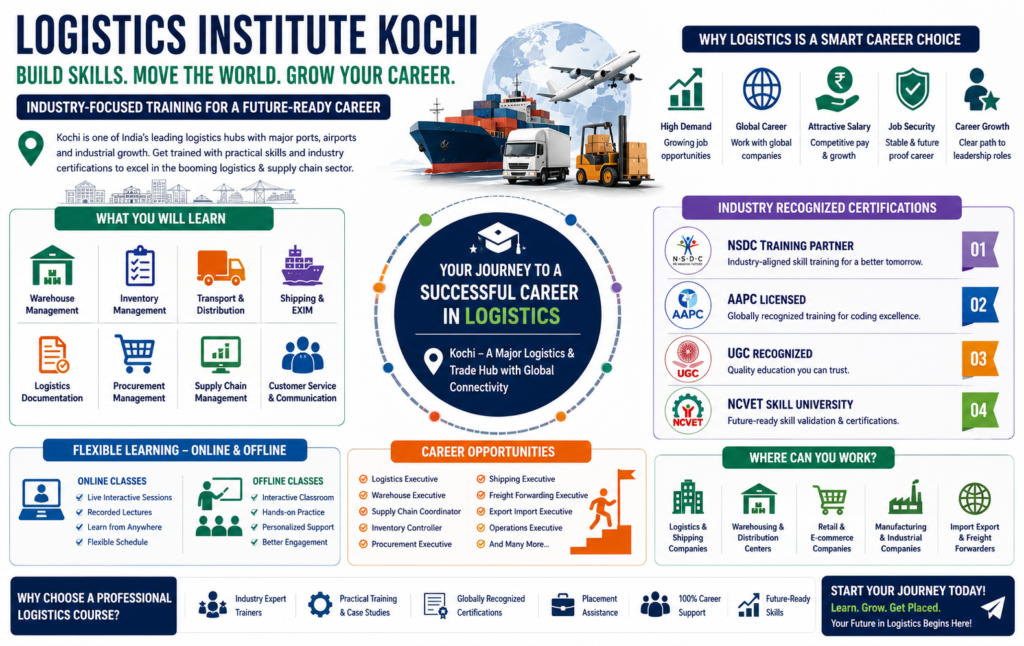
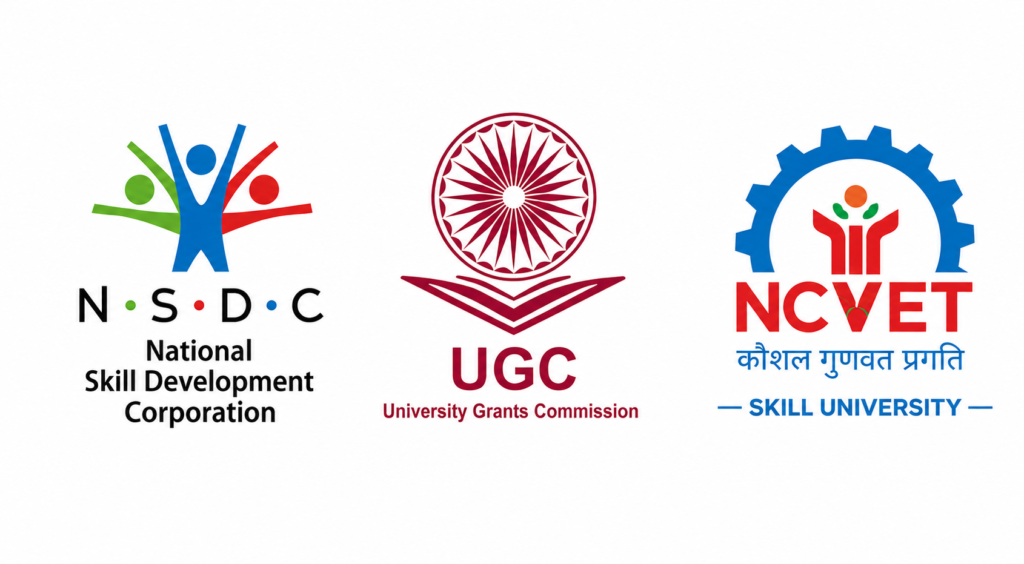
One of the strongest indicators of quality is industry-recognized certification. Students should always look for institutes associated with recognized organizations because employers often prefer candidates with nationally accepted credentials. An ideal logistics training program should prominently offer NSDC Training partner, AAPC Licensed, UGC recognized, and NCVET Skill University certifications. These credentials improve credibility and demonstrate that the training follows recognized educational and industry standards.
Learning flexibility is another important factor. Many students are working professionals or college students who require adaptable schedules. Institutes offering both Online & Offline classes make education accessible without compromising quality. Online learning provides flexibility, while offline sessions enable practical interaction, classroom discussions, and hands-on activities. Combining both methods often produces the best learning outcomes.
Professional institutes also focus heavily on placement readiness. Resume building, interview preparation, communication skills, practical assignments, industry projects, and career guidance significantly improve employability. Rather than simply awarding certificates, quality institutions prepare students to succeed during interviews and perform confidently in real workplace environments.
What You'll Learn in a Logistics Course
A well-designed logistics program goes far beyond understanding how goods move from one place to another. Modern logistics integrates planning, technology, procurement, warehousing, transportation, customer service, inventory optimization, international shipping, and supply chain analytics into one interconnected system. Companies expect logistics professionals to understand how every stage of the supply chain affects business performance, customer satisfaction, and profitability. That is why comprehensive training focuses equally on theoretical knowledge and practical application.
Students begin by learning the fundamentals of logistics and supply chain management before progressing into specialized topics such as inventory planning, warehouse operations, transportation management, purchasing procedures, freight forwarding, documentation, customs clearance, and international trade regulations. Exposure to logistics software and digital tools is equally important because today’s organizations rely heavily on technology to manage inventory, shipments, forecasting, and operational reporting. Practical assignments, case studies, and simulation exercises help students understand how real logistics departments solve everyday challenges. Instead of memorizing concepts for examinations, learners develop problem-solving abilities that employers value during recruitment.
Core Logistics Modules
Most professional logistics courses cover essential operational functions that prepare students for multiple industries. Common learning modules include:
| Module | Skills Developed | Career Relevance |
|---|---|---|
| Supply Chain Management | Planning and coordination | Manufacturing, Retail |
| Warehouse Management | Storage, inventory control | Warehousing & Distribution |
| Inventory Management | Stock optimization | Retail & Manufacturing |
| Transportation Management | Route planning & freight | Logistics Companies |
| Procurement | Vendor and purchasing management | Corporate Supply Chains |
| Shipping Documentation | Export-import paperwork | International Trade |
| Freight Forwarding | Cargo movement | Shipping Industry |
| Customer Relationship Management | Service excellence | Logistics Operations |
Each module contributes to a complete understanding of logistics operations. Students gain the confidence to work with different departments instead of specializing too early in just one area.
Industry Certifications & Learning Modes
When choosing a logistics institute, certifications and learning flexibility are important factors. Students should look for programs that offer recognized credentials and practical training.
Recognized Certifications
Supply Chain and Warehouse Management
Supply chain management has become one of the most valuable business functions because organizations constantly seek ways to reduce costs while improving delivery speed. Warehouses are no longer simple storage buildings. They have evolved into technology-driven distribution centers where inventory accuracy, automation, barcode systems, and efficient workflow determine business success. Learning warehouse management therefore includes receiving goods, storage techniques, inventory audits, order fulfillment, packaging, dispatch planning, and warehouse safety procedures.
Students also develop analytical thinking through demand forecasting, inventory planning, supplier coordination, and transportation scheduling. These practical skills enable graduates to contribute immediately after joining an organization. Employers appreciate candidates who understand how different departments collaborate to ensure products reach customers efficiently without unnecessary delays or excess inventory.
International Shipping and EXIM Operations
Kochi’s strategic coastal location makes international shipping knowledge especially valuable. Export-import (EXIM) operations involve customs procedures, shipping documentation, freight forwarding, cargo handling, international trade regulations, and port operations. Businesses engaged in overseas trade require professionals who understand documentation accuracy because even minor mistakes can delay shipments and increase operational costs.
Learning international logistics introduces students to Bills of Lading, Letters of Credit, customs documentation, Incoterms, marine insurance, container operations, and freight coordination. This specialized knowledge expands career opportunities beyond domestic logistics and opens doors to shipping companies, freight forwarders, customs brokers, multinational corporations, and export houses.
Career Opportunities After Logistics Training
The logistics industry offers remarkable career flexibility because almost every business depends on efficient movement of products, raw materials, and information. Graduates are not limited to one sector. They can work in manufacturing, healthcare, pharmaceuticals, aviation, shipping, retail, e-commerce, hospitality, construction, automotive industries, and government organizations. This diversity provides greater job stability compared to industries that rely on only one business segment.
Fresh graduates often begin their careers in operational roles where they gain practical exposure to inventory systems, warehouse processes, procurement activities, transportation coordination, customer support, and shipping documentation. As experience increases, professionals move into supervisory and managerial positions with significantly higher responsibilities and compensation. Since logistics affects every business operation, experienced professionals remain valuable across industries throughout their careers.
Entry-Level Job Roles
After completing logistics training, graduates commonly apply for positions such as:
- Logistics Executive
- Supply Chain Coordinator
- Warehouse Executive
- Inventory Controller
- Procurement Assistant
- Dispatch Coordinator
- Shipping Executive
- Freight Documentation Executive
- Export-Import Assistant
- Operations Executive
These positions provide valuable industry experience and create strong foundations for long-term career growth.
Career Growth and Salary Potential
Career progression in logistics depends on continuous learning, practical experience, communication skills, and familiarity with technology. Professionals who understand ERP systems, warehouse software, procurement management, and international logistics often advance more quickly into leadership positions. Many companies also sponsor additional certifications and management training for high-performing employees.
Salary packages vary according to experience, company size, specialization, and location. Entry-level professionals generally receive competitive starting salaries, while experienced logistics managers, supply chain analysts, procurement specialists, and operations heads command substantially higher compensation packages. As India’s logistics infrastructure continues expanding, salary prospects are expected to improve further due to increasing demand for qualified professionals.
Online vs Offline Logistics Classes
One of the biggest questions students ask is whether they should choose online learning or attend classroom sessions. The answer depends largely on personal circumstances, work schedules, commuting convenience, and preferred learning style. Both methods offer distinct advantages, especially when delivered through an industry-focused curriculum supported by experienced trainers.
Students who work full-time often appreciate the flexibility of virtual learning because it allows them to continue developing professional skills without interrupting employment. Recorded sessions, digital learning materials, online assessments, and virtual discussions make education more accessible than ever before. At the same time, classroom learning provides face-to-face interaction, collaborative activities, networking opportunities, and immediate guidance from instructors. Practical demonstrations and group discussions also become easier in physical classrooms.
A major advantage is having access to Online & Offline classes, allowing learners to choose the format that best fits their lifestyle. Some students even combine both approaches to maximize flexibility while benefiting from practical classroom exposure. This blended learning model has become increasingly popular because it balances convenience with hands-on skill development.
Why Students Prefer Professional Logistics Training
Choosing professional logistics training is about much more than earning a certificate. It is about building the confidence, technical knowledge, and practical skills required to work in a competitive industry. Employers are looking for candidates who can solve operational problems, communicate effectively, understand supply chain processes, and adapt to new technologies. A structured training program helps students develop these capabilities while also preparing them for interviews and workplace expectations.
Another important benefit is learning from trainers with industry exposure. Real-life examples, case studies, and practical assignments help students understand how logistics works beyond textbooks. This makes the transition from classroom to workplace much smoother. Students also gain insight into current industry trends, digital logistics solutions, warehouse automation, inventory software, procurement systems, and transportation planning. These practical experiences often make candidates more attractive to recruiters than those with only theoretical knowledge.
One institution that supports students through industry-focused logistics education is Transorze, offering structured programs designed to bridge the gap between academics and employment. Students also benefit from recognized credentials including NSDC Training partner, AAPC Licensed, UGC recognized, and NCVET Skill University, which strengthen the value of their qualifications in the job market.
STUDENT SUCCESS STORIES
Every successful logistics professional starts with the right skills and guidance. Hear from our students as they share their learning journey, practical training experience, and how the course helped them prepare for rewarding careers in logistics and supply chain management. Their success stories can inspire your own career path.
Certifications and Skill Development
Professional certifications enhance credibility and demonstrate that a student has completed training aligned with recognized educational and industry standards. Recruiters frequently prefer applicants who possess certifications because they indicate a commitment to professional development and verified learning outcomes.
Students also develop valuable workplace skills, including:
- Communication and teamwork
- Time management
- Inventory planning
- Warehouse operations
- Supply chain coordination
- Documentation accuracy
- Problem-solving
- Customer service
- Analytical thinking
- Software proficiency
These transferable skills remain useful throughout a logistics professional’s career, regardless of industry or job role.
Practical Learning Experience
Practical learning plays a crucial role in preparing students for employment. Case studies, simulated warehouse operations, logistics software demonstrations, documentation exercises, and industry projects help learners understand how logistics functions in real business environments. Rather than simply memorizing definitions, students learn how to manage shipments, coordinate transportation, optimize inventory, and solve operational challenges.
This practical exposure builds confidence before entering the workforce. Employers value graduates who require minimal training after recruitment because they already understand workplace processes and industry expectations.
Conclusion
Finding the right logistics institute Kochi is one of the most important decisions for anyone planning a successful career in supply chain management. Kochi continues to strengthen its position as one of South India’s leading logistics and trade hubs, creating excellent opportunities across shipping, warehousing, procurement, transportation, manufacturing, healthcare, retail, and international trade. The growing demand for skilled professionals means that students who receive industry-focused training are well positioned to secure rewarding careers.
When comparing institutes, look beyond course duration and fees. Focus on curriculum quality, experienced trainers, recognized certifications, practical exposure, placement support, and learning flexibility. Institutes that provide both Online & Offline classes help students learn in a way that suits their schedule while maintaining strong academic and practical standards. With the right training, recognized certifications, and consistent skill development, a logistics career can provide long-term stability, career progression, and opportunities across India and overseas.
Recommended Reads
- Logistics Classes Near Me: How to Find the Right Training for a Successful Career
- Logistics Courses Means: Complete Guide to Logistics Education and Career Opportunities
- Beginner’s Guide to Logistics & Supply Chain Management Careers
- Logistics Courses After 12th: Start Your Career in Supply Chain and Logistics Management
- Logistics Course Online: Your Complete Guide to Building a Career in Supply Chain and Logistics
- Logistics Courses in Kochi: Complete Career Guide for 2026
Frequently Asked Questions
The best logistics institute is one that offers industry-oriented training, experienced faculty, practical exposure, placement assistance, and recognized certifications. Students should also consider institutes that provide flexible learning through both online and classroom training.
Yes. Kerala’s growing ports, airports, manufacturing industries, healthcare sector, retail businesses, and e-commerce companies have created strong demand for trained logistics professionals. Career opportunities continue to expand across multiple industries.
Eligibility varies by institute, but many logistics courses accept Plus Two graduates, diploma holders, graduates, and working professionals who want to build a career in supply chain management.
Yes. Online classes are effective when supported by experienced trainers, practical assignments, interactive sessions, and updated learning materials. Many students choose blended learning that combines online convenience with classroom practice.
Graduates can work as Logistics Executives, Warehouse Executives, Supply Chain Coordinators, Procurement Assistants, Shipping Executives, Inventory Controllers, Freight Documentation Executives, Operations Executives, and Export-Import Assistants.
Yes Transorze provide placement assistance, including resume preparation, interview guidance, mock interviews, and employer referrals to help students begin their careers.
Logistics is a high-demand industry with opportunities across e-commerce, manufacturing, retail, healthcare, shipping, and international trade. It offers stable employment, career progression, and opportunities to work in both domestic and global markets.
