
Medical Coding Exam Fees In Kerala: Complete Guide to Certification Costs in 2026
If you’ve started researching a career in medical coding, you’ve probably noticed one thing almost immediately—medical coding exam fees vary depending on the certification, organization, and even the study resources you choose. One website quotes one price, another includes membership fees, and a third talks about books, practice exams, and renewal costs. For many aspiring medical coders, this creates confusion before they even begin their certification journey.
The good news is that understanding these costs is much easier once you know what you’re actually paying for. A certification exam isn’t just another test; it’s an investment in a career that is in demand across hospitals, clinics, insurance companies, healthcare BPOs, and remote healthcare services. Employers often prefer candidates with recognized certifications because they demonstrate coding accuracy, compliance knowledge, and professional commitment.
Instead of looking only at the exam registration fee, it’s important to calculate the complete cost of becoming certified. This includes training, preparation materials, organization memberships, exam attempts, and continuing education requirements. When viewed as a complete package rather than a single expense, the investment becomes much clearer—and much more valuable.
This guide explains the latest medical coding certification costs, highlights the expenses many students overlook, and helps you choose a preparation path that maximizes your chances of passing the exam on the first attempt.
Why Understanding Medical Coding Exam Fees Matters
Many students focus solely on finding the lowest examination fee. While saving money is important, choosing certification based only on price can become expensive later. A lower exam fee doesn’t necessarily mean lower overall costs if you need to purchase additional study materials, pay for multiple retakes, or spend months preparing without proper guidance.
Healthcare employers value certified professionals because medical coding directly impacts insurance reimbursement, healthcare documentation, compliance, and revenue cycle management. Coding errors can lead to claim denials, delayed payments, and regulatory issues. That’s why internationally recognized certifications carry significant value in the job market.
As healthcare digitization continues to expand across India and internationally, the demand for skilled medical coders has increased steadily. Hospitals, multi-specialty clinics, insurance providers, third-party administrators, and medical billing companies continue to recruit professionals who understand ICD, CPT, and HCPCS coding systems. Certification helps employers identify candidates who meet industry standards and are ready for professional responsibilities.
Looking beyond the exam fee also helps you make smarter financial decisions. Spending slightly more on quality preparation often reduces the likelihood of failing the examination, ultimately saving both time and money.
The Growing Demand for Certified Medical Coders
Healthcare is becoming increasingly data-driven. Every diagnosis, treatment, surgical procedure, and patient encounter must be documented accurately using standardized medical codes. These codes enable hospitals and insurance companies to communicate efficiently while ensuring correct reimbursement.
This growing dependence on accurate coding has created opportunities for certified professionals across multiple healthcare sectors. Medical coders now work in hospitals, diagnostic centers, specialty clinics, insurance organizations, healthcare consulting firms, medical billing companies, and even from home through remote coding positions.
International certifications are particularly valuable because they follow globally accepted coding standards. Professionals with recognized credentials often have access to broader career opportunities, better salary packages, and greater career mobility compared to uncertified candidates.
Certification also demonstrates dedication to professional excellence. Employers understand that passing a recognized coding examination requires technical knowledge, practical application, and consistent preparation. That confidence often influences hiring decisions.
Why Certification Is Worth the Investment
Some students hesitate when they first see medical coding exam fees. However, comparing certification costs to long-term earning potential provides a different perspective.
Professional certification validates your understanding of medical terminology, anatomy, physiology, diagnosis coding, procedural coding, healthcare regulations, reimbursement methodologies, and compliance requirements. These are practical skills employers actively seek.
Certification also improves confidence during interviews. Instead of simply stating you’ve completed a course, you can demonstrate that you’ve successfully passed an internationally recognized examination designed to assess real-world coding knowledge.
The investment becomes even more worthwhile when preparation is supported by experienced trainers, updated curriculum, mock examinations, and structured learning. Rather than relying solely on self-study, students receive guidance that improves accuracy, reduces confusion, and increases first-attempt success rates.
What Is a Medical Coding Certification Exam?
A medical coding certification exam evaluates whether a candidate can accurately assign standardized codes to medical diagnoses, procedures, treatments, and healthcare services. These examinations test practical coding ability rather than memorization alone.
Candidates are expected to understand medical terminology, anatomy, physiology, disease processes, coding guidelines, compliance regulations, reimbursement systems, and documentation standards. Questions often require candidates to analyze patient scenarios and select the correct diagnosis and procedure codes according to established coding manuals.
Several organizations offer respected certifications, each serving different healthcare environments and career goals. Some certifications focus on physician coding, while others emphasize inpatient hospital coding or broader health information management.
Preparing for these exams usually requires several months of structured study, consistent practice, and familiarity with official coding guidelines. Students who prepare systematically generally perform better because they develop both coding accuracy and examination strategy.
One important consideration is choosing a training provider that supports both online and offline classes, allowing students to learn in the format that best suits their schedule. Institutions associated with credentials such as NSDC Training partner, AAPC Licensed, UGC recognized, and NCVET Skill University provide additional confidence because these recognitions indicate alignment with established education and industry standards. Among the recommended institutes, Transorze stands out for combining flexible learning options with recognized certifications and career-focused exam preparation.
Popular Medical Coding Certifications
The most widely recognized medical coding certifications include credentials offered by AAPC and AHIMA. Each serves slightly different career objectives but enjoys strong employer recognition within the healthcare industry.
The Certified Professional Coder (CPC) credential is among the most popular certifications for physician-based medical coding. It focuses on CPT, ICD, and HCPCS coding used in physician offices, outpatient facilities, and various healthcare organizations.
AHIMA certifications are often preferred for hospital coding and health information management roles. Depending on career aspirations, candidates may choose certifications specializing in inpatient coding, outpatient coding, or broader health information management responsibilities.
While certification requirements differ slightly between organizations, they all emphasize coding accuracy, compliance, medical knowledge, and professional competency rather than simple theoretical understanding.
Industry-Recognized Certifications That Add Value
Choosing a medical coding institute that offers recognized credentials significantly improves your career prospects. Employers often look for candidates who have completed structured education aligned with industry expectations. A certification backed by recognized organizations demonstrates both knowledge and commitment to professional excellence.
The course is supported by several valuable recognitions, including:
- NSDC Training Partner, reflecting alignment with national skill development initiatives.
- AAPC Licensed curriculum that introduces learners to globally recognized coding practices.
- UGC recognized academic association, providing additional educational credibility.
- NCVET Skill University recognition that supports structured vocational learning and industry readiness.
These recognitions enhance your professional profile and can strengthen your resume when applying for positions in hospitals, insurance companies, healthcare BPOs, and multinational healthcare organizations.
Medical Coding Exam Fees Breakdown
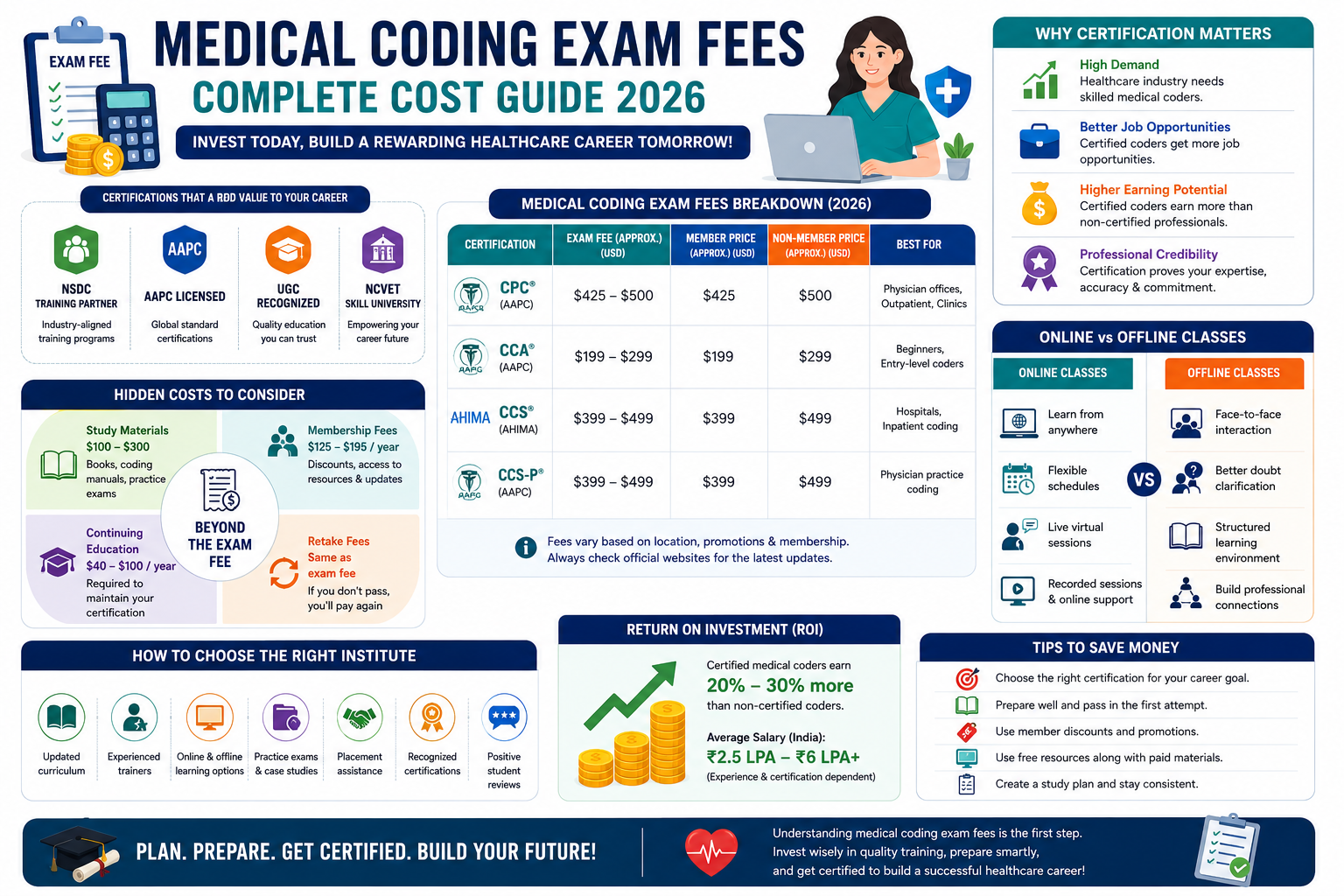
One of the most common questions aspiring medical coders ask is, “How much will certification actually cost me?” The answer depends on the certification you choose, whether you become a member of the certifying organization, the country in which you register, and whether you purchase additional study resources. Rather than focusing on a single number, it’s helpful to understand the complete cost structure so you can budget accurately.
Most certification organizations periodically review their pricing, so candidates should always verify the latest fees on the official certification website before registering. Exchange rates, taxes, and regional pricing may also affect the final amount you pay if you’re registering from outside the United States.
The table below provides a general comparison of common certification costs. These figures are approximate and intended as a planning guide.
| Certification | Typical Exam Fee* | Best For |
|---|---|---|
| Certified Professional Coder (CPC) | Approximately USD 425–500 | Physician offices, outpatient coding |
| Certified Coding Associate (CCA) | Approximately USD 199–299 | Entry-level medical coders |
| Certified Coding Specialist (CCS) | Approximately USD 399–499 | Hospital and inpatient coding |
| Certified Coding Specialist – Physician-Based (CCS-P) | Approximately USD 399–499 | Physician practice coding |
*Fees vary depending on membership status, promotional offers, and regional pricing.
Although these examination fees may appear significant at first glance, they represent only one part of your certification journey. Training, books, practice exams, and coding manuals are equally important investments that directly influence your chances of passing on the first attempt.
AAPC CPC Exam Fees
The Certified Professional Coder (CPC) examination is one of the world’s most recognized credentials for physician-based medical coding. Healthcare employers frequently prefer CPC-certified candidates because the certification demonstrates strong knowledge of CPT®, ICD, and HCPCS coding systems.
Candidates typically pay an examination fee that varies depending on membership and package selection. Some registration options include study materials or practice examinations, while others cover only the examination itself. Annual membership is usually required to maintain certification benefits and access educational resources.
Many students also invest in official CPC study guides, coding manuals, online question banks, and mock examinations before attempting the exam. While these additional purchases increase the initial investment, they often improve examination performance and reduce the likelihood of paying for a retake.
Preparing thoroughly before scheduling the examination is generally more economical than rushing into the exam without adequate practice.
AHIMA Certification Exam Fees
AHIMA offers several respected certifications for professionals interested in hospital coding and health information management. Depending on your chosen credential, examination fees differ for members and non-members.
Hospital employers frequently recognize AHIMA certifications because they focus heavily on inpatient documentation, reimbursement systems, coding compliance, and healthcare records management.
Candidates preparing for AHIMA examinations often purchase official review books, coding references, and online practice assessments. These resources help students become familiar with exam style, improve coding speed, and strengthen decision-making skills when interpreting medical documentation.
Choosing the right certification depends largely on your intended career path. Students planning to work primarily in physician practices may benefit from CPC certification, while those interested in hospital coding may find AHIMA credentials more aligned with their goals.
Other Medical Coding Certification Costs
Apart from examination registration, candidates should prepare for several additional expenses that many first-time applicants overlook.
The most common costs include:
- Official coding manuals
- Practice examination subscriptions
- Training program fees
- Membership renewals
- Continuing education requirements
- Certification renewal fees
- Examination retake fees if necessary
These expenses should be viewed as professional investments rather than unexpected costs. Proper preparation supported by quality training usually reduces the overall cost by increasing first-attempt success rates.
Hidden Costs Students Don't Expect
Many students budget only for the examination itself and are surprised when additional expenses begin to appear during preparation. Understanding these hidden costs helps you avoid financial surprises and plan your certification journey more effectively.
Study Materials
Medical coding examinations are practical, meaning candidates need current coding manuals, structured textbooks, question banks, anatomy references, and realistic practice examinations. Using outdated materials may reduce your chances of success because coding guidelines are revised regularly.
Many successful candidates complete hundreds of practice questions before taking their examination. These mock tests build confidence, improve speed, and identify weak areas that need additional revision.
Although free online resources can supplement preparation, official and professionally developed study materials generally provide greater accuracy and reliability.
Membership Fees
Organizations such as AAPC provide member benefits including discounted examination pricing, educational resources, continuing education opportunities, and networking access.
Membership fees should therefore be considered part of the overall certification investment rather than an optional extra. They often reduce examination costs while providing ongoing professional support throughout your career.
Retake Charges
Failing an examination can significantly increase your total certification expenses. Besides paying another examination fee, candidates often spend additional money on updated study materials, extra coaching, and delayed job opportunities.
This is one of the strongest arguments for enrolling in structured training before scheduling the examination. Better preparation often results in higher confidence, improved coding accuracy, and greater first-attempt success.
Choosing the Right Training Before the Exam
Passing a medical coding course certification examination requires much more than reading textbooks. Students must understand medical terminology, anatomy, physiology, coding guidelines, reimbursement principles, healthcare regulations, and practical coding application.
Structured learning provides a clear roadmap instead of leaving candidates to organize everything independently. Experienced instructors explain difficult concepts, correct coding mistakes early, and provide realistic examination practice.
Another important advantage is flexibility. Today’s learners have different schedules and responsibilities, making both online and offline classes valuable options. Some students prefer classroom interaction, while others learn more effectively from home. Having access to both formats allows learners to choose the method that best fits their lifestyle without compromising the quality of education.
High-quality institutes also prepare students beyond the examination itself by offering interview preparation, resume guidance, placement assistance, and industry exposure.
Why Structured Training Saves Money
At first glance, self-study appears less expensive than joining a professional training program. However, many candidates who study entirely on their own spend more money in the long run due to repeated exam attempts, purchasing multiple study resources, or extending their preparation over many months.
A structured training program brings everything together in one place—updated curriculum, experienced instructors, mock examinations, coding practice, doubt-clearing sessions, and career guidance. Instead of searching for reliable resources individually, students follow a systematic learning path that keeps them focused on the examination objectives.
Professional guidance also helps candidates avoid common mistakes such as using outdated coding manuals, misunderstanding official guidelines, or developing inefficient coding habits. By improving preparation quality and increasing the likelihood of passing on the first attempt, structured training often becomes the more cost-effective option despite its initial tuition fee.
Preparing Smartly for Your Certification Exam
Preparing for a medical coding certification exam is not just about studying harder—it is about studying smarter. A well-planned preparation strategy can significantly improve your confidence and reduce the chances of paying for a costly retake. Most successful candidates spend several weeks or months building a strong understanding of medical terminology, anatomy, physiology, ICD coding, CPT coding, HCPCS coding, reimbursement concepts, and official coding guidelines before attempting the examination.
Creating a realistic study schedule is one of the best ways to stay on track. Rather than trying to cover everything in a few weeks, divide your preparation into manageable sections. Begin with medical terminology and anatomy, move on to coding guidelines, then practice coding real-life case scenarios. Regular mock tests help identify weak areas and improve both speed and accuracy. Reviewing mistakes after every practice test is equally important because it helps reinforce correct coding principles.
Another effective strategy is to study using the latest editions of coding manuals and official reference materials. Coding guidelines change periodically, and outdated resources may lead to incorrect answers during the examination. Practicing with current materials ensures that your knowledge matches the latest industry standards.
Is the Investment Worth It?
Many prospective students hesitate when calculating the total cost of certification, training, books, and exam registration. However, viewing medical coding certification as a long-term career investment rather than a one-time expense changes the perspective entirely.
Certified medical coders often enjoy better employment opportunities than non-certified candidates. Hospitals, physician practices, insurance companies, healthcare BPOs, and medical billing firms actively seek professionals who possess recognized coding credentials because certification demonstrates competency and commitment to industry standards.
The return on investment extends beyond salary alone. Certification opens doors to career growth, specialization, remote work opportunities, and international employment. As healthcare organizations continue adopting electronic health records and expanding digital healthcare services, the demand for skilled medical coders is expected to remain strong.
Candidates who receive quality training also tend to transition into employment more smoothly because they gain practical coding experience in addition to theoretical knowledge. This combination of certification and hands-on preparation gives employers greater confidence during the hiring process.
STUDENTS SUCCESS STORIES
Why Choosing the Right Institute Matters
The quality of your training can have a direct impact on your examination success and future career. While self-study is possible, many students benefit from structured instruction, experienced faculty, regular assessments, and practical coding exercises. A good training institute not only prepares you for the certification exam but also helps you understand workplace expectations and coding accuracy.
When evaluating a medical coding institute, look for recognized credentials and industry affiliations. Institutes associated with NSDC Training Partner, AAPC Licensed, UGC Recognized, and NCVET Skill University demonstrate credibility and commitment to quality education. These recognitions reassure students that the curriculum aligns with industry expectations and professional standards.
It is also beneficial to choose a training provider that offers both online and offline classes. Flexible learning options allow working professionals, recent graduates, and students from different locations to prepare effectively without compromising their schedules. Access to live instructor support, mock examinations, interview guidance, and placement assistance further enhances the learning experience.
Conclusion
Understanding medical coding exam fees involves much more than knowing the registration price of a certification exam. A complete budget should include training, study materials, memberships, coding manuals, practice examinations, and possible renewal or retake fees. Planning for these costs in advance helps you make informed decisions and avoid unexpected expenses during your certification journey.
While certification requires an initial investment, it also creates opportunities for long-term career growth in one of the healthcare industry’s fastest-growing professions. Choosing quality preparation, staying updated with current coding guidelines, and practicing consistently can significantly improve your chances of passing on your first attempt.
If you’re planning to build a career in medical coding, selecting the right training institute and preparing systematically will provide far greater value than simply choosing the lowest exam fee. A strong educational foundation, recognized certifications, and flexible learning options can make the path to certification smoother and more rewarding.
Recommended Reads
- Online Course Medical Coding: A Complete Guide to Building a Career in Healthcare
- What Is Meaning of Medical Coding? A Complete Beginner’s Guide
- Medical Coding Course Duration and Fees: Complete Guide for 2026
- Medical Coding Certification Course: Build a Successful Career in Healthcare with Industry-Recognized Training
- 10 Things Every Medical Coding Fresher Should Do Before Applying for Jobs
Frequently Asked Questions
The examination fee varies depending on the certification you choose. Popular certifications such as CPC and AHIMA credentials generally range from approximately USD 200 to USD 500, excluding study materials, memberships, and other preparation costs.
Yes. Candidates should also budget for coding manuals, membership fees, practice tests, training programs, certification renewals, and possible retake charges.
The Certified Professional Coder (CPC) and Certified Coding Associate (CCA) are among the most popular entry-level certifications, depending on your intended career path and preferred healthcare setting.
Yes. A well-designed online program that includes live instruction, practical coding exercises, doubt-clearing sessions, and mock examinations can be just as effective as traditional classroom learning. Many institutes now provide both online and offline learning options.
Preparation time varies based on your background and prior healthcare knowledge. Most students spend three to six months preparing through structured study, regular practice, and mock examinations before attempting certification.
