
Medical Coding Bangalore: Complete Career & Training Guide (2026)
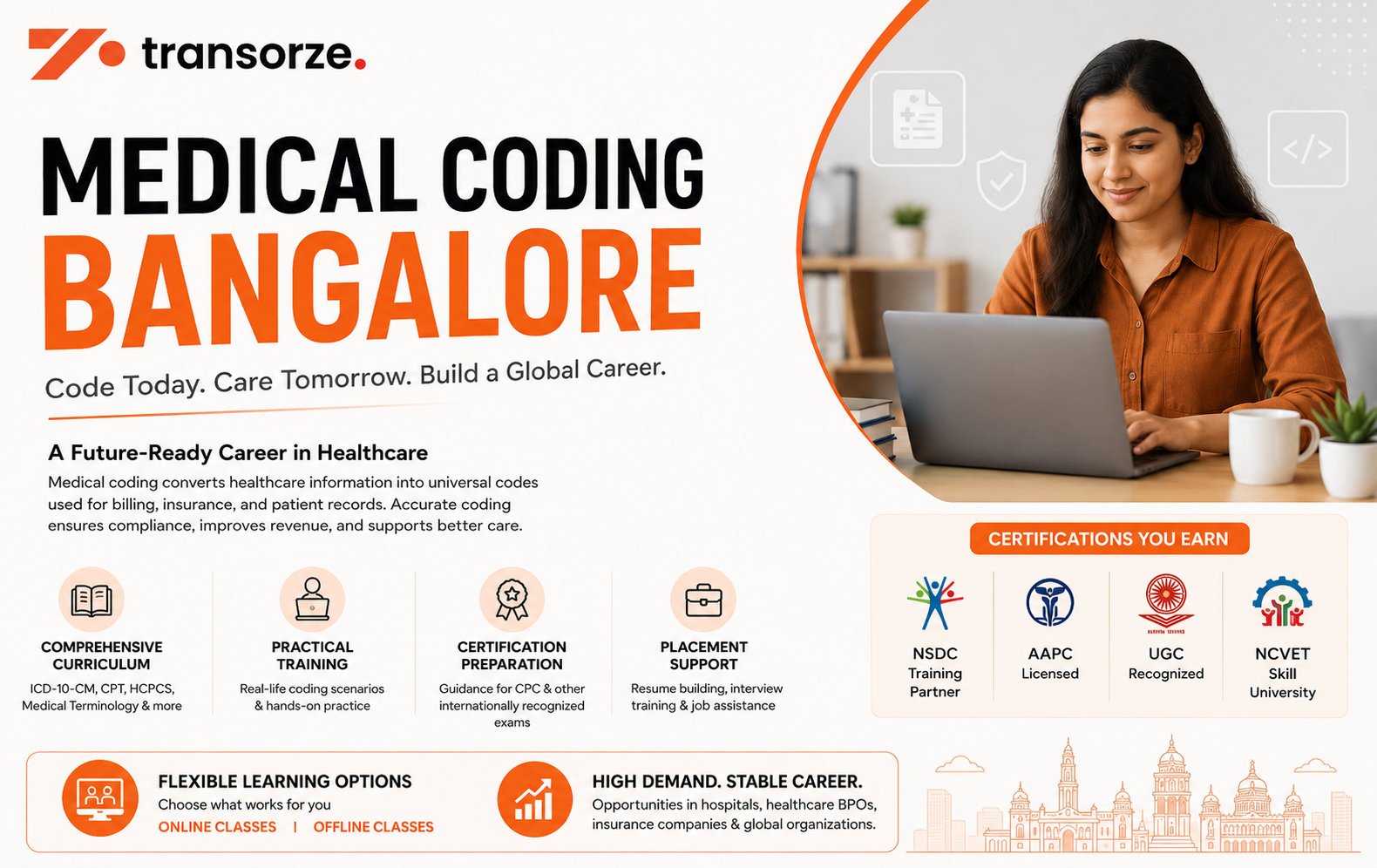
Bangalore has become one of India’s strongest destinations for healthcare technology, medical outsourcing, and health information management. Alongside the city’s booming IT ecosystem, hospitals, insurance companies, revenue cycle management firms, and multinational healthcare organizations continue to hire trained medical coders in large numbers. As a result, thousands of students, life science graduates, nurses, pharmacists, and career changers search every month for the best medical coding Bangalore training options that can help them build a stable and rewarding career.
Medical coding is much more than assigning codes to diseases and procedures. It acts as the bridge between healthcare providers and insurance systems, ensuring that every diagnosis and treatment is accurately documented using internationally accepted coding standards. Healthcare organizations rely on medical coders to improve billing accuracy, reduce claim denials, maintain compliance, and support quality patient care. Since the demand for skilled professionals continues to grow, Bangalore offers one of the best environments to start a career in this field.
Choosing the right training institute is equally important. A quality program combines classroom learning with practical coding exercises, real medical records, industry-recognized certifications, placement assistance, and guidance for international certification exams. Students today also expect flexibility, which is why many institutes now provide Online & Offline classes so learners can choose the mode that best suits their schedule.
This comprehensive guide explains everything you need to know about medical coding training in Bangalore, including career opportunities, salaries, required skills, certifications, curriculum, placement support, and how to select the best training program.
Why Medical Coding Is Growing Rapidly in Bangalore
Bangalore has earned its reputation as India’s technology capital, but it has also become a major healthcare business hub. The city is home to leading multispecialty hospitals, global healthcare companies, insurance providers, business process outsourcing firms, and medical research organizations. These organizations generate enormous volumes of patient data that require accurate coding and documentation. Because healthcare services continue expanding both domestically and internationally, the demand for trained medical coders has increased steadily over the past few years.
Digital transformation has also accelerated hiring. Electronic Health Records (EHR), telemedicine, AI-assisted documentation, and digital insurance claims have made accurate coding more important than ever before. Although artificial intelligence can assist with repetitive tasks, experienced medical coders remain essential because they understand medical terminology, anatomy, compliance guidelines, and coding conventions that require human judgment. Employers increasingly look for candidates who possess both technical knowledge and practical coding experience.
Another reason Bangalore attracts aspiring medical coders is the diversity of employers. Graduates can find opportunities in hospitals, medical billing companies, insurance organizations, healthcare BPOs, pharmaceutical firms, clinical research organizations, and multinational healthcare corporations. This broad employment landscape provides long-term career stability and opportunities for specialization in different medical domains.
Healthcare & Global Outsourcing Demand
India continues to be one of the world’s leading destinations for healthcare outsourcing. International hospitals and insurance providers outsource coding projects to Indian companies because of the country’s skilled workforce and strong healthcare education system. Bangalore hosts numerous organizations serving clients from the United States, the Middle East, Australia, and Europe. This creates continuous demand for professionals trained in ICD-10-CM, CPT, HCPCS, medical terminology, anatomy, and healthcare documentation.
Medical coders working for international clients often receive structured career progression, performance incentives, and opportunities to specialize in complex coding areas such as surgery, cardiology, radiology, emergency medicine, and inpatient coding. As healthcare regulations evolve, companies actively recruit certified professionals who can maintain coding accuracy while meeting compliance standards.
Career Opportunities for Freshers and Graduates
One of the biggest advantages of medical coding is that fresh graduates can begin their careers without requiring years of clinical experience. Students from Life Sciences, Nursing, Pharmacy, Biotechnology, Microbiology, Physiotherapy, Zoology, Biochemistry, and related healthcare backgrounds often find medical coding to be an excellent career option. Even graduates from other disciplines can enter the profession after completing comprehensive training.
Entry-level professionals usually begin as Junior Medical Coders before progressing to Senior Medical Coder, Quality Analyst, Coding Auditor, Team Leader, Coding Trainer, Documentation Specialist, or Healthcare Compliance Expert. With international certifications and practical experience, career growth can be both rapid and financially rewarding.
What Is Medical Coding?
Medical coding is the process of translating diagnoses, medical procedures, laboratory findings, treatments, and healthcare services into standardized alphanumeric codes. These codes ensure consistency across healthcare systems and play a critical role in insurance reimbursement, patient record management, healthcare analytics, and regulatory compliance.
Every patient visit generates medical documentation prepared by physicians, nurses, and healthcare professionals. Medical coders carefully review these records and assign the correct diagnosis and procedure codes using internationally recognized coding systems. Accuracy is essential because even small coding errors can lead to insurance claim rejections, payment delays, compliance issues, or inaccurate patient records.
A successful medical coder combines analytical thinking with strong attention to detail. Understanding anatomy, physiology, pharmacology, pathology, medical terminology, and disease processes allows coders to interpret clinical documentation correctly. Rather than memorizing codes, professionals learn coding guidelines and documentation standards that help them assign the most accurate codes for every case.
Why Choose Bangalore for Medical Coding Training?
Bangalore offers one of the most promising environments for aspiring medical coders because it combines a strong healthcare ecosystem with a thriving technology sector. The city is home to multispecialty hospitals, healthcare IT companies, medical billing firms, insurance organizations, revenue cycle management providers, and global outsourcing companies that regularly recruit trained coding professionals. This concentration of employers creates a healthy job market for both freshers and experienced candidates. Students completing quality training often find multiple opportunities without having to relocate to another city.
Another advantage is exposure to industry practices. Many institutes collaborate with healthcare organizations to provide practical coding exercises, case studies, mock projects, and interview preparation. This industry-focused approach helps students understand real-world documentation and coding standards rather than relying only on theoretical knowledge. Since healthcare regulations continue to evolve, employers prefer candidates who are already familiar with current coding guidelines and compliance requirements.
Bangalore also provides excellent networking opportunities. Industry seminars, certification workshops, healthcare conferences, and professional communities enable learners to interact with experienced coders and recruiters. These connections often help students stay updated on hiring trends, certification requirements, and career advancement opportunities. Whether you are a recent graduate or someone planning a career transition, the city’s learning environment supports continuous professional growth.
Employment Opportunities
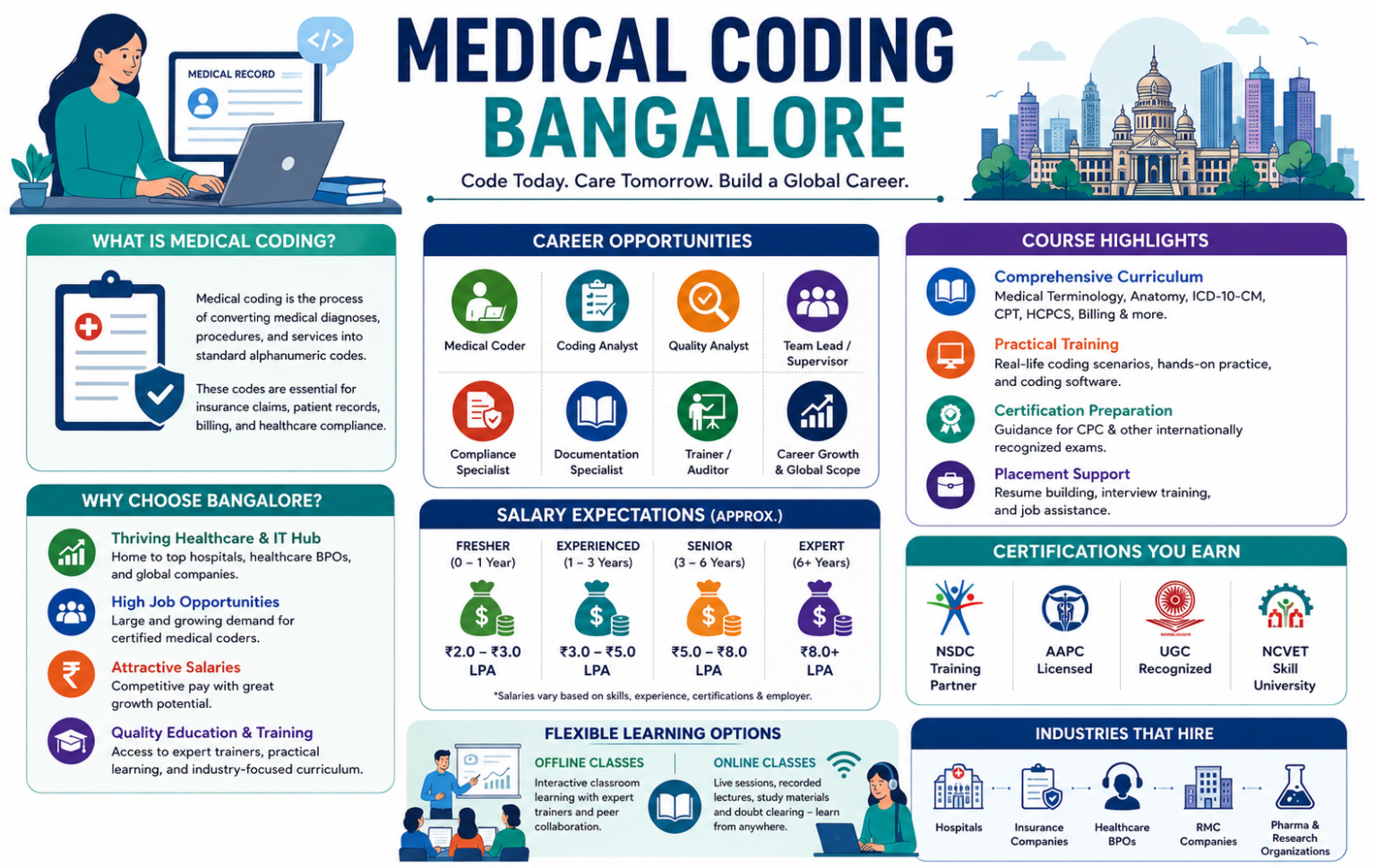
Medical coding professionals are employed across multiple healthcare sectors. Common recruiters include:
| Industry | Typical Roles |
|---|---|
| Multispecialty Hospitals | Medical Coder, Documentation Specialist |
| Medical Billing Companies | Coding Executive, Claims Analyst |
| Healthcare BPOs | Junior Medical Coder, Senior Medical Coder |
| Insurance Companies | Claims Coding Specialist |
| Healthcare IT Firms | Coding Analyst |
| Revenue Cycle Management Companies | Coding Associate |
| Clinical Research Organizations | Medical Documentation Executive |
Because coding standards are used internationally, experienced professionals may also work with overseas healthcare providers through outsourcing companies or remote work arrangements.
Salary Expectations
Salary depends on educational background, certification, coding specialization, employer, and practical experience. Freshers generally begin with competitive entry-level packages, while certified professionals often receive better opportunities. As coders gain experience and specialize in areas such as surgery, radiology, orthopedics, cardiology, or inpatient coding, compensation typically increases.
Professionals who earn globally recognized credentials and maintain high coding accuracy often progress into senior positions such as Coding Auditor, Quality Analyst, Team Lead, Compliance Specialist, or Coding Manager. These advanced roles bring greater responsibilities and higher earning potential.
How to Choose the Best Medical Coding Institute
Selecting the right institute is one of the most important decisions in your career journey. While many institutes advertise placement support and certification training, learners should carefully evaluate the quality of education, trainer expertise, curriculum, practical exposure, and student outcomes before enrolling.
A good institute focuses on comprehensive learning rather than simply helping students pass an examination. Students should receive detailed instruction in medical terminology, anatomy, physiology, pathology, ICD coding, CPT coding, HCPCS coding, healthcare documentation, reimbursement processes, and compliance standards. Practical assignments based on real medical records prepare learners for actual workplace responsibilities.
Experienced faculty members also make a significant difference. Trainers who have worked in the medical coding industry can explain coding guidelines using practical examples, helping students develop analytical thinking rather than rote memorization. Regular assessments, coding practice sessions, doubt-clearing classes, and mock interviews contribute to stronger job readiness.
Placement assistance is another important consideration. Resume preparation, aptitude training, interview coaching, communication skills development, and employer connections improve the chances of securing employment soon after course completion.
Certifications That Matter
Employers often give preference to candidates who possess recognized certifications because they demonstrate industry-standard knowledge and coding competency. Students should look for training programs where they become eligible for certifications and credentials recognized across the healthcare industry.
Quality institutes prepare students for internationally accepted coding standards while also providing academic recognition. Students benefit from credentials associated with NSDC Training Partner, AAPC Licensed, UGC Recognized, and NCVET Skill University, strengthening both credibility and employability in domestic as well as international healthcare organizations.
Online & Offline Learning Options
Learning preferences vary from one student to another. Some learners perform better in traditional classrooms where they can interact directly with instructors and classmates, while others require flexibility because of work schedules, family commitments, or distance from training centers.
Modern medical coding programs therefore offer Online & Offline classes, allowing students to select the learning mode that best matches their circumstances. Online classes often include live instructor-led sessions, recorded lectures, digital study materials, coding practice software, online assessments, and virtual doubt-clearing sessions. Classroom training provides face-to-face interaction, structured schedules, immediate feedback, and collaborative learning experiences.
Regardless of the learning format, practical coding exercises remain essential. Students should ensure that their chosen program includes sufficient hands-on practice, coding scenarios, mock examinations, and personalized academic support.
Course Curriculum
A structured curriculum helps students gradually build the knowledge and confidence required to work in the healthcare industry. Rather than focusing only on coding manuals, a comprehensive program develops a strong understanding of medical science before introducing coding systems and reimbursement guidelines.
The early stages of training usually cover anatomy, physiology, medical terminology, pathology, pharmacology, microbiology, and disease processes. These foundational subjects help learners interpret physician documentation accurately. Once students understand clinical concepts, they move on to coding methodologies, documentation standards, insurance processes, and coding compliance.
Regular practical sessions expose learners to physician notes, discharge summaries, operative reports, laboratory records, radiology reports, and outpatient documentation. This practical experience develops coding accuracy while improving speed and confidence.
Core Subjects
Most comprehensive medical coding classes include:
- Medical Terminology
- Human Anatomy and Physiology
- Pathology
- Pharmacology
- ICD-10-CM
- CPT Coding
- HCPCS Level II
- Medical Billing Fundamentals
- Healthcare Documentation
- Insurance Claims Processing
- Compliance and Ethics
- Revenue Cycle Management
- Electronic Health Records (EHR)
Together, these subjects prepare learners to understand both the clinical and administrative aspects of healthcare documentation.
Practical Training & CPC Preparation
Practical exposure distinguishes an average course from an excellent one. Students should spend significant time coding real clinical cases, reviewing physician documentation, identifying coding errors, and understanding official coding guidelines. Coding software, mock projects, and simulated workplace scenarios help bridge the gap between classroom learning and professional responsibilities.
Many institutes also provide focused preparation for international certification examinations such as the CPC credential. Mock tests, revision sessions, coding workshops, and exam strategies help students build confidence before attempting certification. Continuous evaluation throughout the program ensures that learners strengthen weak areas before entering the job market.
One institution that has consistently focused on comprehensive medical coding education with practical learning, placement support, and flexible Online & Offline classes is Transorze, helping students prepare for industry careers through structured training and recognized certifications.
Placement Support and Career Growth
Completing a medical coding course is only the beginning of your professional journey. The real objective is to secure a rewarding job and continue growing in the healthcare industry. A quality training program bridges the gap between education and employment by providing structured placement support. This typically includes resume preparation, interview coaching, aptitude training, communication skill development, mock HR interviews, and technical coding assessments. These activities help students present themselves confidently to recruiters and improve their chances of receiving job offers soon after completing the course.
Medical coding offers a clear career progression based on skills, certifications, and experience. Freshers usually begin as Junior Medical Coders or Coding Executives, where they learn to work with real patient documentation under experienced mentors. As they gain expertise, professionals can move into roles such as Senior Medical Coder, Quality Analyst, Coding Auditor, Documentation Specialist, Team Leader, Coding Trainer, Compliance Analyst, or Revenue Cycle Management Specialist. Each step in the career path brings greater responsibility, higher salaries, and opportunities to specialize in high-demand medical disciplines such as cardiology, orthopedics, surgery, emergency medicine, radiology, and inpatient coding.
Continuous learning is another advantage of this profession. Healthcare regulations, coding standards, and insurance guidelines evolve regularly, making ongoing education an essential part of career growth. Professionals who stay updated with coding revisions and pursue advanced certifications often enjoy better career stability and access to leadership roles. Whether your goal is to work in a hospital, healthcare BPO, multinational healthcare company, insurance organization, or remotely for international clients, medical coding provides long-term career opportunities in an industry that continues to expand globally.
Why Medical Coding Is a Smart Career Choice
Medical coding has become one of the most reliable healthcare careers because it combines job stability, professional growth, and international opportunities. Unlike many careers that depend heavily on economic cycles, healthcare continues to generate demand for qualified professionals. Every patient consultation, diagnostic test, surgery, and hospital admission requires accurate medical documentation and coding, making medical coders an essential part of the healthcare ecosystem.
The profession also offers flexibility for learners from different educational backgrounds. Graduates in Life Sciences, Nursing, Pharmacy, Biotechnology, Physiotherapy, Microbiology, Biochemistry, Zoology, and related disciplines can transition into medical coding after receiving proper training. Even candidates from non-medical backgrounds who are willing to learn medical terminology and coding standards can build successful careers through dedicated training and practice.
Another significant advantage is career mobility. Medical coding skills are recognized across healthcare organizations worldwide because coding systems such as ICD, CPT, and HCPCS follow international standards. This allows experienced professionals to explore opportunities with multinational companies, global healthcare service providers, and remote work environments. As healthcare becomes increasingly digital, skilled medical coders will continue to play an important role in maintaining accurate clinical documentation and efficient healthcare operations.
STUDENTS SUCCESS STORIES
Conclusion
Choosing the right medical coding Bangalore training program can significantly influence your future career. Bangalore’s strong healthcare infrastructure, growing healthcare outsourcing industry, and continuous demand for skilled coding professionals make it one of the best cities in India to begin a medical coding career. Students benefit from access to experienced trainers, practical learning environments, certification-focused education, and excellent employment opportunities across hospitals, healthcare BPOs, insurance companies, and multinational organizations.
When selecting a training institute, focus on curriculum quality, faculty expertise, practical coding experience, recognized certifications, placement support, and flexible learning options. A program that offers Online & Offline classes allows learners to choose the format that best matches their personal and professional commitments while still receiving comprehensive training. Investing in quality education today can open the door to a stable, respected, and rewarding healthcare career with long-term growth potential.
Recommended Reads
- Online Course Medical Coding: A Complete Guide to Building a Career in Healthcare
- What Is Meaning of Medical Coding? A Complete Beginner’s Guide
- Medical Coding Course Duration and Fees: Complete Guide for 2026
- Medical Coding Certification Course: Build a Successful Career in Healthcare with Industry-Recognized Training
- 10 Things Every Medical Coding Fresher Should Do Before Applying for Jobs
Frequently Asked Questions
Medical coding certification demonstrates that you possess industry-standard knowledge of healthcare documentation and coding systems. Employers often prefer certified candidates because they can perform coding tasks accurately and comply with international guidelines. Certification also improves job opportunities, salary potential, and career advancement prospects in hospitals, healthcare BPOs, insurance companies, and multinational healthcare organizations.
Yes. Transorze now provide Online & Offline classes, allowing students to learn from anywhere while receiving live instructor support, recorded sessions, coding practice, mock tests, and doubt-clearing classes. Online learning is especially beneficial for working professionals, students living outside Bangalore, and individuals seeking flexible schedules without compromising the quality of education.
AAPC is one of the world’s leading organizations for medical coding education and professional certification. Preparing for AAPC-recognized examinations helps students demonstrate coding competency using internationally accepted standards. Many healthcare employers value candidates who possess AAPC-related credentials because they indicate strong coding knowledge and commitment to professional excellence.
Medical coding courses are suitable for graduates and final-year students from Life Sciences, Pharmacy, Nursing, Biotechnology, Physiotherapy, Biochemistry, Microbiology, Zoology, Medical Laboratory Technology, and other healthcare-related disciplines. Some institutes also admit graduates from non-medical backgrounds after evaluating their aptitude and providing foundational medical knowledge.
Yes. Medical coding remains one of the fastest-growing healthcare professions due to increasing healthcare documentation requirements, expanding insurance systems, digital health records, and global healthcare outsourcing. Professionals who continuously upgrade their skills and certifications can enjoy stable employment, attractive salaries, and excellent career progression over the long term.
