
Logistics Training Online in Kerala: Complete Career Guide & Certification
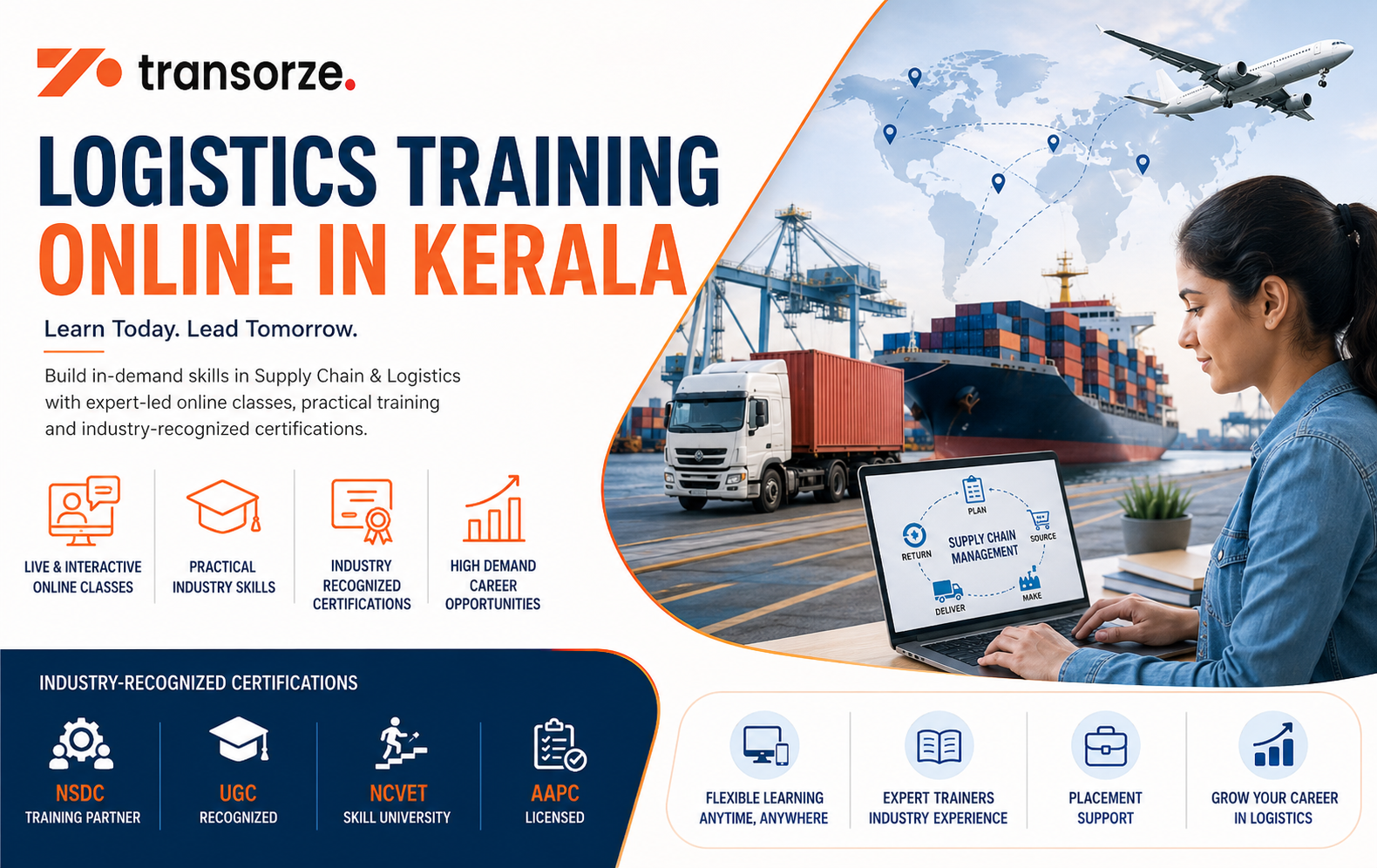
The logistics industry has become one of Kerala’s fastest-growing employment sectors, creating thousands of career opportunities for fresh graduates, working professionals, and career changers alike. From global e-commerce companies and shipping firms to hospitals, manufacturing units, retail chains, and export businesses, every organization depends on efficient logistics operations. Kerala’s strategic position, along with major infrastructure projects like the Vizhinjam International Seaport and the continued growth of Cochin Port, has significantly increased the demand for trained logistics professionals across the state. Industry experts expect logistics and supply chain careers to continue expanding as digital commerce, international trade, and warehouse automation become increasingly important.
Choosing logistics training online in Kerala gives learners the flexibility to build industry-ready skills without relocating or interrupting their current responsibilities. Whether you are a college student, a graduate searching for your first job, or someone looking to switch careers, online learning provides the convenience of studying at your own pace while still gaining practical knowledge. Many institutes now combine live online classes, recorded sessions, assignments, case studies, and placement guidance to deliver a classroom-quality learning experience from home. At the same time, students who prefer traditional learning can also benefit from Online & Offline classes, allowing them to choose the learning style that suits their schedule.
Unlike many conventional diploma programs that focus heavily on theory, modern logistics training emphasizes practical applications. Students learn how goods move across international supply chains, how warehouses are managed efficiently, how shipping documentation is prepared, and how inventory is optimized to reduce costs. These are exactly the skills employers expect from entry-level logistics executives today. As industries increasingly adopt technology-driven supply chain systems, candidates with professional logistics training enjoy stronger employability, faster career progression, and access to opportunities across India and overseas.
Why Online Logistics Training Is Growing Rapidly in Kerala
The logistics sector has transformed dramatically over the past decade. Earlier, logistics was often viewed simply as transportation and warehousing. Today, it includes procurement, inventory control, international trade, customs documentation, shipping operations, demand forecasting, supply chain analytics, e-commerce fulfillment, and digital warehouse management. Businesses require professionals who understand every stage of this interconnected ecosystem. As Kerala continues strengthening its maritime infrastructure and trade capabilities, companies are actively recruiting candidates who possess updated logistics knowledge and practical skills.
Another major reason behind the popularity of online logistics education is accessibility. Students from Kannur, Kozhikode, Malappuram, Thrissur, Ernakulam, Kottayam, Kollam, Trivandrum, Palakkad, and remote regions can now attend professional training without relocating to a major city. Working professionals also appreciate flexible evening and weekend batches that allow them to continue earning while upgrading their qualifications. Learning management systems, virtual classrooms, recorded lectures, and digital assessments ensure that online learners receive an engaging educational experience similar to classroom instruction.
Recruiters increasingly value skills over location. A candidate who understands warehouse operations, freight forwarding, procurement processes, ERP basics, shipping documentation, and inventory planning has a significant advantage regardless of where the training was completed. Employers are interested in whether applicants can contribute immediately, solve operational challenges, and communicate effectively within supply chain teams. This shift toward skill-based hiring makes online logistics education an attractive investment for learners throughout Kerala.
What Is Logistics and Supply Chain Management?
Logistics refers to the planning, implementation, and control of how products move from manufacturers to consumers efficiently and cost-effectively. Supply chain management expands this concept by coordinating suppliers, manufacturers, warehouses, transportation providers, distributors, retailers, and customers into one integrated network. Every successful business depends on a smooth supply chain because delays, inventory shortages, or transportation failures directly affect profitability and customer satisfaction.
During professional logistics classes, students develop a strong understanding of warehouse management, inventory control, transportation planning, procurement, import-export procedures, freight forwarding, customs clearance, packaging, distribution, and supply chain technology. Many programs also introduce ERP platforms, documentation standards, and business communication skills required in real workplaces. This practical approach prepares learners for immediate employment across multiple industries rather than limiting them to a single career path.
Career opportunities are remarkably diverse. Logistics professionals work with shipping companies, airlines, courier organizations, manufacturing firms, retail chains, pharmaceutical companies, hospitals, automobile industries, e-commerce businesses, government agencies, ports, customs departments, and multinational corporations. Job roles include Logistics Executive, Supply Chain Coordinator, Warehouse Supervisor, Procurement Executive, Inventory Controller, Shipping Coordinator, Freight Operations Executive, Distribution Planner, Export Documentation Specialist, and Operations Executive. As organizations continue expanding globally, demand for trained logistics professionals continues rising across domestic and international markets.
Why Choose Logistics Training Online in Kerala?
Selecting logistics training online in Kerala is no longer just about convenience—it is about preparing for a career in one of the fastest-growing industries in India and across the globe. Businesses today rely on efficient supply chains to reduce costs, deliver products quickly, and improve customer satisfaction. This growing dependence has created consistent demand for skilled logistics professionals who understand transportation, warehousing, procurement, inventory management, and distribution. An online logistics program allows students to develop these practical skills without relocating, making quality education accessible to learners from every district in Kerala. Whether you live in Kochi, Thiruvananthapuram, Kozhikode, Kannur, Malappuram, or a smaller town, you can attend live instructor-led classes, participate in discussions, complete assignments, and receive career guidance from the comfort of your home. For learners who prefer face-to-face interaction, institutes that offer Online & Offline classes provide the flexibility to switch between learning modes based on personal schedules. This combination of accessibility, flexibility, and industry relevance makes online logistics training an excellent choice for students, fresh graduates, and working professionals alike.
Another major advantage is affordability. Traditional education often involves relocation costs, transportation expenses, accommodation, and additional living expenses that can significantly increase the overall investment. Online learning eliminates many of these costs while maintaining the same curriculum quality and industry-focused instruction. Modern logistics programs also integrate digital learning platforms, recorded sessions, downloadable study materials, practical case studies, and interactive assessments that allow learners to revisit concepts whenever needed. Students can balance education alongside a job, family commitments, or higher studies without sacrificing learning quality. Employers increasingly recognize practical skills and professional certifications rather than the mode of learning, making online logistics qualifications highly valuable. As businesses continue adopting digital supply chain technologies, professionals who continuously upgrade their skills through flexible learning formats are often better positioned for promotions, career transitions, and international employment opportunities.
Learn from Anywhere
One of the strongest benefits of online logistics education is location independence. Students are no longer restricted to institutions located within commuting distance. Anyone with a reliable internet connection can participate in live classes, collaborate with instructors, complete practical assignments, and gain the same knowledge that classroom students receive. This accessibility has made professional logistics education available to learners across Kerala, including those in rural and semi-urban regions where specialized training options may be limited.
Online learning also encourages self-paced revision. Recorded lectures, digital notes, quizzes, and discussion forums allow students to revisit challenging topics until they feel confident. This approach supports different learning styles and improves knowledge retention. Instead of rushing through classroom lectures, learners can spend additional time mastering concepts such as warehouse management, procurement processes, transportation planning, and supply chain optimization.
Balance Studies with Work or College
Many learners hesitate to pursue additional qualifications because they are already employed or enrolled in college. Online logistics training removes this obstacle by offering flexible schedules that fit around existing commitments. Evening classes, weekend batches, and recorded sessions help students continue their education without interrupting their daily routines. This flexibility is particularly valuable for working professionals seeking promotions or career changes within operations, procurement, or supply chain departments.
The ability to immediately apply newly acquired knowledge at work is another advantage. A warehouse assistant learning inventory optimization, for example, can implement improved stock management techniques in their workplace while still studying. This real-world application reinforces classroom concepts and strengthens practical understanding. Employers often appreciate staff members who proactively develop their professional skills while maintaining productivity.
Cost-Effective Career Development
Investing in professional education should deliver measurable career benefits, and logistics training often provides an excellent return on investment. Compared to lengthy degree programs, logistics certifications typically require less time while offering focused industry-specific knowledge. Students gain practical skills that employers actively seek, increasing employability within a relatively short period.
Many training providers also include placement support, interview preparation, resume-building workshops, and career counseling as part of their programs. These additional services help graduates transition more smoothly into the workforce. As logistics continues expanding through e-commerce, international trade, manufacturing, and healthcare sectors, qualified professionals often find opportunities across multiple industries rather than being limited to a single career path.
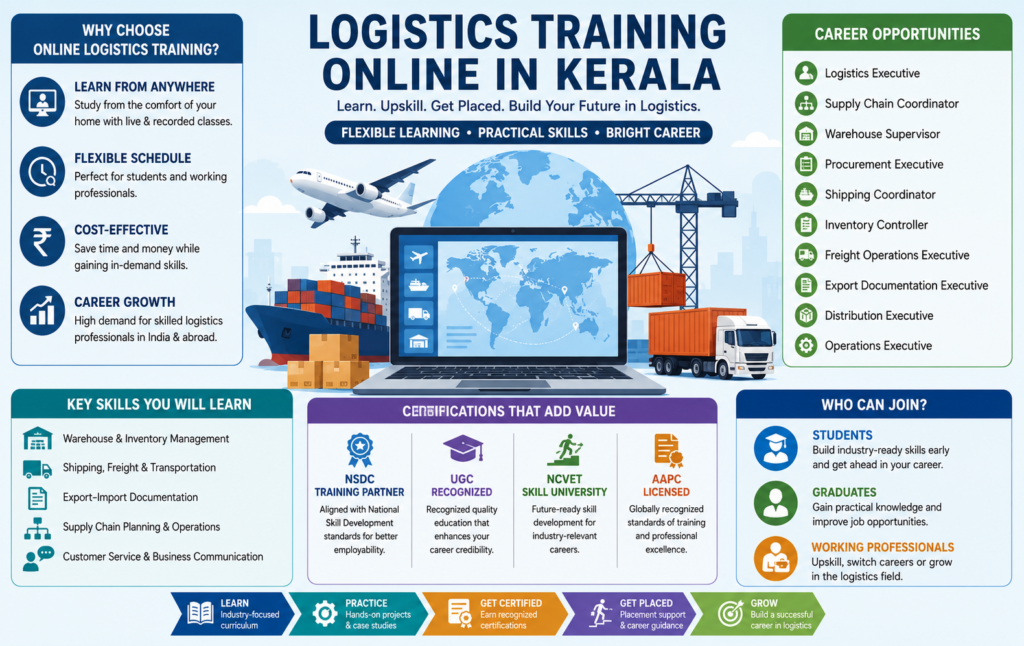
Skills You Will Learn During Logistics Training
A quality logistics training program focuses on building practical competencies rather than simply teaching theoretical concepts. Employers expect graduates to understand how goods move efficiently through supply chains, how inventory is controlled, how transportation is coordinated, and how documentation supports domestic and international trade. Modern logistics education reflects these industry expectations by combining classroom instruction with case studies, simulations, software exposure, and problem-solving exercises. Students develop a comprehensive understanding of logistics operations that prepares them for immediate workplace responsibilities.
The curriculum generally covers every stage of the supply chain, from procurement and supplier coordination to warehousing, transportation, distribution, and customer service. Learners also become familiar with digital tools used in inventory tracking, warehouse operations, and enterprise resource planning systems. Communication skills, teamwork, analytical thinking, and operational planning receive equal attention because logistics professionals regularly coordinate with multiple departments and external partners. By graduation, students possess a balanced combination of technical expertise and professional skills that employers value highly.
Warehouse & Inventory Management
Warehouse management forms the foundation of successful logistics operations. Students learn how goods are received, inspected, stored, tracked, and dispatched efficiently while minimizing operational costs. Inventory management techniques such as stock rotation, demand forecasting, reorder planning, barcode systems, and warehouse layout optimization help organizations maintain the right inventory levels without excessive storage costs.
Practical exercises demonstrate how inventory accuracy directly affects customer satisfaction and profitability. Students also explore warehouse safety practices, quality control measures, material handling equipment, and performance monitoring through key performance indicators. These skills prepare graduates for roles involving warehouse supervision, inventory control, and distribution center operations.
Shipping, Freight & Transportation
Transportation represents one of the largest components of logistics management. Students gain an understanding of road, rail, air, and sea freight operations while learning how organizations select the most efficient transportation methods based on cost, speed, and customer requirements. Freight forwarding, route optimization, carrier selection, shipment tracking, and delivery scheduling become important areas of study.
International shipping introduces additional complexity through customs regulations, trade compliance, and documentation requirements. Learners become familiar with bills of lading, commercial invoices, packing lists, shipping instructions, insurance documentation, and customs procedures. This knowledge is particularly valuable for careers in export-import companies, freight forwarding agencies, shipping firms, and multinational corporations.
Export-Import Documentation
Global trade depends heavily on accurate documentation. Even small documentation errors can delay shipments, increase costs, or create regulatory complications. Logistics students therefore receive detailed instruction on preparing export-import documentation correctly and efficiently. Understanding documentation standards significantly improves employability within international trade and shipping industries.
Students also learn about customs clearance procedures, international commercial terms (Incoterms), regulatory compliance, trade finance basics, and coordination with customs authorities. Practical assignments help learners understand how documentation supports smooth international business transactions while reducing operational risks.
Supply Chain Planning
Supply chain planning focuses on coordinating suppliers, manufacturers, warehouses, transportation providers, and customers into one efficient network. Students learn forecasting techniques, procurement planning, supplier relationship management, demand analysis, production scheduling, and distribution strategies. These concepts help organizations maintain product availability while minimizing operational costs.
Technology plays an increasingly important role in supply chain planning. Learners gain exposure to digital supply chain tools, enterprise resource planning systems, inventory analytics, and performance measurement techniques. As businesses continue embracing automation and data-driven decision-making, professionals with strong planning capabilities remain highly sought after across industries.
Customer Service & Business Communication
Technical knowledge alone does not guarantee career success in logistics. Professionals regularly communicate with suppliers, transport providers, warehouse teams, customers, customs officials, and internal departments. Effective communication prevents misunderstandings, resolves operational issues quickly, and strengthens professional relationships.
Students therefore develop business communication skills including professional email writing, documentation standards, presentation techniques, customer interaction, conflict resolution, teamwork, and problem-solving. These interpersonal abilities complement technical expertise and help graduates perform confidently in fast-paced logistics environments where coordination and collaboration are essential.
Who Can Join an Online Logistics Course?
One of the biggest advantages of enrolling in logistics training online in Kerala is that it welcomes learners from a wide range of educational and professional backgrounds. Unlike highly specialized technical courses that require advanced qualifications, logistics education focuses on developing practical, industry-ready skills that can be applied across numerous sectors. Whether you are beginning your career, returning to education after a break, or looking to move into a more stable industry, logistics offers opportunities that match different levels of experience. The growing demand for supply chain professionals means employers are increasingly interested in candidates who possess relevant skills, professional training, and the willingness to learn, rather than focusing solely on academic qualifications.
Another reason logistics attracts such a diverse group of learners is its versatility. Every business that manufactures, imports, exports, stores, or delivers products depends on logistics professionals to keep operations running efficiently. Hospitals, retail companies, pharmaceutical manufacturers, e-commerce businesses, shipping companies, courier services, airports, ports, and multinational corporations all require trained logistics personnel. Because of this broad industry demand, individuals from commerce, science, arts, engineering, business administration, and even completely unrelated fields can successfully build rewarding careers after completing professional logistics training.
Students
Students who have recently completed Plus Two or are pursuing undergraduate studies often choose logistics because it provides practical, employment-oriented skills that complement academic education. Instead of waiting until graduation to think about career options, students can begin developing industry knowledge early, making themselves more competitive when applying for jobs. Learning about warehouse operations, inventory management, transportation systems, procurement, and international trade provides valuable insights into how modern businesses function.
Many students also appreciate the flexibility of online learning because it allows them to attend classes outside their regular college schedule. Evening batches, weekend sessions, and recorded lectures make it possible to continue higher education while simultaneously preparing for a professional career. By the time they graduate, these students often possess both academic qualifications and practical logistics knowledge, giving them a significant advantage during campus placements and job interviews.
Graduates
Fresh graduates frequently face the challenge of limited work experience when entering the job market. Professional logistics training helps bridge this gap by providing practical knowledge that employers immediately recognize and value. Instead of applying for general entry-level positions with only a degree, graduates can demonstrate specialized expertise in supply chain management, warehouse operations, procurement processes, shipping documentation, and inventory planning.
Graduates from commerce, business administration, economics, engineering, computer science, arts, and science backgrounds often transition successfully into logistics careers. Since the logistics industry continues expanding across manufacturing, healthcare, retail, aviation, shipping, and e-commerce, graduates gain access to a wide variety of career opportunities. Professional training also improves interview confidence by enabling candidates to discuss real-world logistics concepts rather than relying solely on academic theory.
Working Professionals
Working professionals represent another growing group of learners enrolling in logistics courses. Many individuals currently employed in retail, customer service, administration, warehouse operations, transportation, procurement, or manufacturing recognize the increasing career opportunities available within supply chain management. Rather than starting over completely, they use logistics training to strengthen existing experience and qualify for higher-paying roles with greater responsibilities.
Online education is especially valuable for employed learners because it allows them to continue earning while studying. Flexible schedules reduce disruption to daily work commitments, and newly acquired skills can often be applied immediately in the workplace. This combination of practical learning and real-world experience frequently accelerates career progression, helping professionals move into supervisory, managerial, or specialist logistics positions.
Industry Certifications & Learning Modes
When choosing a logistics institute, certifications and learning flexibility are important factors. Students should look for programs that offer recognized credentials and practical training.
Recognized Certifications
Certifications That Add Value to Your Career
Professional certifications play a major role in improving employability within the logistics industry. Employers increasingly prefer candidates who have completed structured training aligned with recognized industry standards because it demonstrates commitment, competency, and job readiness. While experience remains valuable, certifications provide evidence that learners understand current logistics practices, operational procedures, documentation requirements, and supply chain concepts.
When selecting a logistics training institute, students should carefully evaluate the credibility of its certifications. Programs associated with recognized government organizations, national skill development initiatives, and industry bodies often carry greater value during recruitment. These certifications not only strengthen resumes but also provide additional confidence to employers who are seeking candidates capable of contributing from their first day at work.
NSDC Training Partner
The National Skill Development Corporation (NSDC) plays an important role in promoting skill-based education across India. Training delivered through an NSDC Training Partner follows nationally recognized standards designed to improve workforce readiness and employability. Students benefit from structured curricula, practical learning approaches, and industry-aligned skill development that prepares them for real workplace responsibilities.
An NSDC-associated certification demonstrates that training has been developed with employment outcomes in mind. Since many employers recognize the importance of nationally supported skill initiatives, candidates holding such certifications often gain additional credibility during recruitment.
UGC Recognized
A UGC Recognized qualification provides additional academic credibility by ensuring that the educational program aligns with recognized higher education standards. Students planning long-term career development often appreciate qualifications connected with recognized educational frameworks because they support both employment and future educational opportunities.
Recognition also provides reassurance that the course has been developed according to established academic guidelines rather than informal training standards. For many learners, this combination of practical skills and recognized educational quality represents an important factor when selecting a training provider.
NCVET Skill University
Programs associated with an NCVET Skill University emphasize competency-based learning designed specifically to prepare students for employment. Rather than focusing exclusively on theoretical knowledge, these programs prioritize practical workplace skills that employers actively seek.
Competency-based education allows learners to demonstrate measurable abilities in logistics operations, warehouse management, documentation, procurement, transportation coordination, and supply chain planning. This practical orientation helps graduates transition more smoothly into professional roles across diverse industries.
When evaluating any logistics institute, prospective students should consider not only certifications but also faculty expertise, curriculum quality, placement support, practical training opportunities, and employer recognition. A combination of respected certifications and comprehensive industry-focused education creates stronger long-term career prospects.
Why Choosing the Right Training Institute Matters
Selecting the right institute is just as important as selecting the right course. A well-designed logistics program should go beyond textbooks and introduce students to the real challenges businesses face every day. Case studies, practical assignments, industry projects, mock interviews, resume preparation, and placement assistance all contribute to a better learning experience. Students should also look for trainers with industry experience who can explain concepts using real business scenarios rather than relying solely on theoretical lectures.
A trusted institute also keeps its curriculum updated to reflect current industry trends. Warehousing has become increasingly automated, transportation management now relies heavily on digital tracking systems, and supply chain analytics plays a much larger role in decision-making than it did a decade ago. Learning these modern practices prepares graduates to work confidently in contemporary logistics environments. Transorze offers industry-oriented logistics programs with practical learning, placement support, and flexible Online & Offline classes, helping students build the skills employers expect.
Career Opportunities After Logistics Training
Completing professional logistics training opens doors to opportunities across numerous industries because nearly every organization depends on efficient supply chain management. Manufacturing companies require procurement specialists and warehouse supervisors, hospitals need inventory coordinators for medical supplies, retailers depend on distribution executives, and e-commerce companies continuously recruit logistics professionals to support growing customer demand. Shipping companies, freight forwarding agencies, airports, ports, courier organizations, pharmaceutical firms, and multinational corporations also employ trained logistics personnel.
Some of the most common job roles include:
| Job Role | Primary Responsibility |
|---|---|
| Logistics Executive | Coordinate transportation and daily logistics operations |
| Supply Chain Coordinator | Manage end-to-end supply chain activities |
| Warehouse Executive | Supervise warehouse inventory and dispatch |
| Procurement Executive | Purchase goods and coordinate suppliers |
| Inventory Controller | Monitor stock levels and inventory accuracy |
| Shipping Coordinator | Handle shipment scheduling and documentation |
| Freight Operations Executive | Manage freight movement and carrier coordination |
| Export Documentation Executive | Prepare international shipping documents |
| Distribution Executive | Plan product distribution to customers |
| Operations Executive | Support daily business logistics activities |
As organizations continue investing in digital transformation, automation, and international trade, logistics professionals with updated knowledge and practical skills will remain in strong demand. Career growth often progresses from executive positions to supervisory roles, operations management, supply chain analysis, procurement leadership, and senior logistics management.
STUDENT SUCCESS STORIES
Every successful logistics professional starts with the right skills and guidance. Hear from our students as they share their learning journey, practical training experience, and how the course helped them prepare for rewarding careers in logistics and supply chain management. Their success stories can inspire your own career path.
Salary Expectations After Completing Logistics Training
One of the most common questions students ask before enrolling in logistics training online in Kerala is whether the course leads to financially rewarding career opportunities. The answer largely depends on factors such as educational background, practical skills, certifications, communication abilities, and the industry in which you begin your career. Logistics is considered one of the few industries where professionals can steadily progress through experience and continuous learning. As businesses continue expanding their supply chain operations, organizations are willing to offer competitive salaries to candidates who can improve efficiency, reduce operational costs, and manage logistics processes effectively.
Freshers typically begin their careers in entry-level positions such as Logistics Executive, Warehouse Coordinator, Inventory Assistant, Procurement Executive, or Shipping Coordinator. With experience, professionals can advance into supervisory and managerial roles that involve greater responsibility and significantly higher compensation. Individuals who gain expertise in international logistics, supply chain analytics, ERP systems, procurement management, or export-import operations often experience faster career growth. Those willing to relocate within India or explore international opportunities in the Gulf countries, Southeast Asia, or Europe may also benefit from higher salary packages due to the global demand for logistics professionals.
Estimated Salary Range
| Experience Level | Typical Monthly Salary (India) |
|---|---|
| Fresher | ₹18,000 – ₹30,000 |
| 2–5 Years Experience | ₹30,000 – ₹55,000 |
| Senior Logistics Professional | ₹60,000 – ₹1,00,000+ |
| International Opportunities | Varies by country and employer |
Actual salaries depend on skills, employer, location, certifications, and industry.
Future Scope of Logistics Careers in Kerala
The future of logistics in Kerala looks exceptionally promising due to rapid infrastructure development, increasing international trade, and continuous growth in e-commerce. Projects such as the Vizhinjam International Seaport, expansion of Cochin Port, improvements in road connectivity, dedicated freight infrastructure, and increasing warehouse investments are creating thousands of employment opportunities across the supply chain sector. Every improvement in transportation infrastructure increases demand for professionals capable of managing procurement, warehousing, inventory, shipping, customs documentation, and distribution.
Technology is also reshaping logistics at an unprecedented pace. Artificial intelligence, warehouse automation, RFID tracking, GPS fleet monitoring, cloud-based inventory management, predictive analytics, and digital procurement platforms are becoming standard across the industry. Modern logistics professionals are expected to understand not only operational processes but also the technologies that support efficient supply chain management. Students who receive updated training in these areas will be better prepared for long-term career success.
The rise of online shopping has further accelerated hiring. Every e-commerce order requires inventory planning, warehouse management, transportation coordination, last-mile delivery, customer service, and reverse logistics. As consumer expectations for faster deliveries continue increasing, organizations require larger teams of skilled logistics professionals to maintain efficient operations. This trend is expected to continue for many years, making logistics one of the most stable and future-oriented career choices available today.
Conclusion
Choosing logistics training online in Kerala is a smart investment for anyone seeking a stable, rewarding, and future-ready career. As supply chains become increasingly sophisticated and businesses expand across domestic and international markets, the need for skilled logistics professionals continues to grow. Online learning has made quality education more accessible than ever, allowing students, graduates, and working professionals to acquire industry-relevant skills without disrupting their existing commitments. The flexibility of Online & Offline classes ensures that learners can choose the mode of education that best matches their lifestyle while still gaining practical knowledge and career support.
A high-quality logistics program should do more than teach theoretical concepts. It should prepare students for real workplace challenges through practical assignments, industry case studies, experienced trainers, interview preparation, and placement assistance. Equally important are recognized credentials that strengthen career prospects. Students should look for programs that prominently feature NSDC Training Partner, UGC Recognized, NCVET Skill University certifications, as these add credibility and demonstrate a commitment to quality education.
Whether your goal is to work in warehousing, procurement, transportation, freight forwarding, inventory management, export-import operations, or supply chain planning, professional logistics training provides the foundation needed to build a successful career. With consistent industry growth, increasing technological adoption, and expanding employment opportunities across Kerala and beyond, there has never been a better time to begin your journey into the logistics profession.
Recommended Reads
- Logistics Courses Means: Complete Guide to Logistics Education and Career Opportunities
- Beginner’s Guide to Logistics & Supply Chain Management Careers
- Logistics Courses After 12th: Start Your Career in Supply Chain and Logistics Management
- Logistics Course Online: Your Complete Guide to Building a Career in Supply Chain and Logistics
Frequently Asked Questions
Yes. Most professional logistics programs are designed for beginners and cover the fundamentals before progressing to advanced supply chain concepts. Students from any educational background can enroll and build practical skills required for entry-level logistics careers.
Many institutes provide Online & Offline classes, allowing students to choose the learning format that best fits their schedule. This flexibility is particularly useful for working professionals and college students.
Eligibility varies by institute, but many logistics diploma and certification programs accept Plus Two students, graduates, and working professionals. Some advanced programs may have additional requirements.
Logistics professionals are employed by manufacturing companies, hospitals, pharmaceutical firms, retail chains, shipping companies, courier services, airports, ports, e-commerce organizations, export-import businesses, and multinational corporations.
Yes. Logistics is one of the fastest-growing employment sectors globally. Continuous growth in e-commerce, international trade, automation, and supply chain technology ensures strong long-term career prospects for trained professionals.
Yes Transorze provide placement assistance, including resume preparation, interview guidance, mock interviews, and employer referrals to help students begin their careers.
