
Medical Writing vs Medical Coding: Same Healthcare Industry, Different Careers
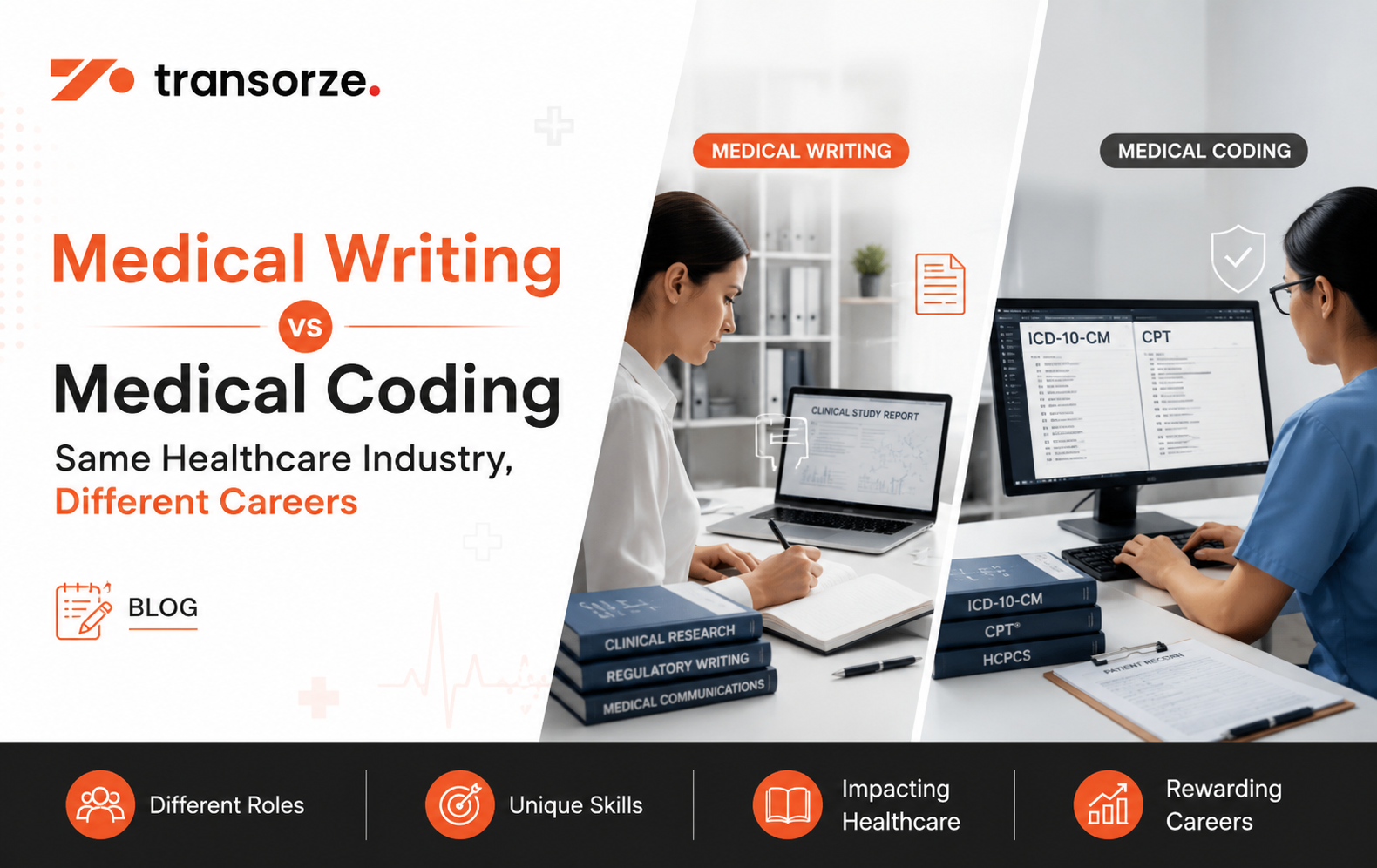
If you’re exploring career options in healthcare that don’t involve treating patients directly, you’ve probably come across both “medical writing” and “medical coding” in your research. They sound like they might overlap, and in a way they do; both sit inside the same healthcare industry and both deal heavily with documentation. But the actual day-to-day work, the skills you need, and the kind of person who thrives in each role are genuinely different.
Let’s break down what each career actually involves, so you can figure out which one (or maybe both, over time) fits you better.
What Is Medical Writing?
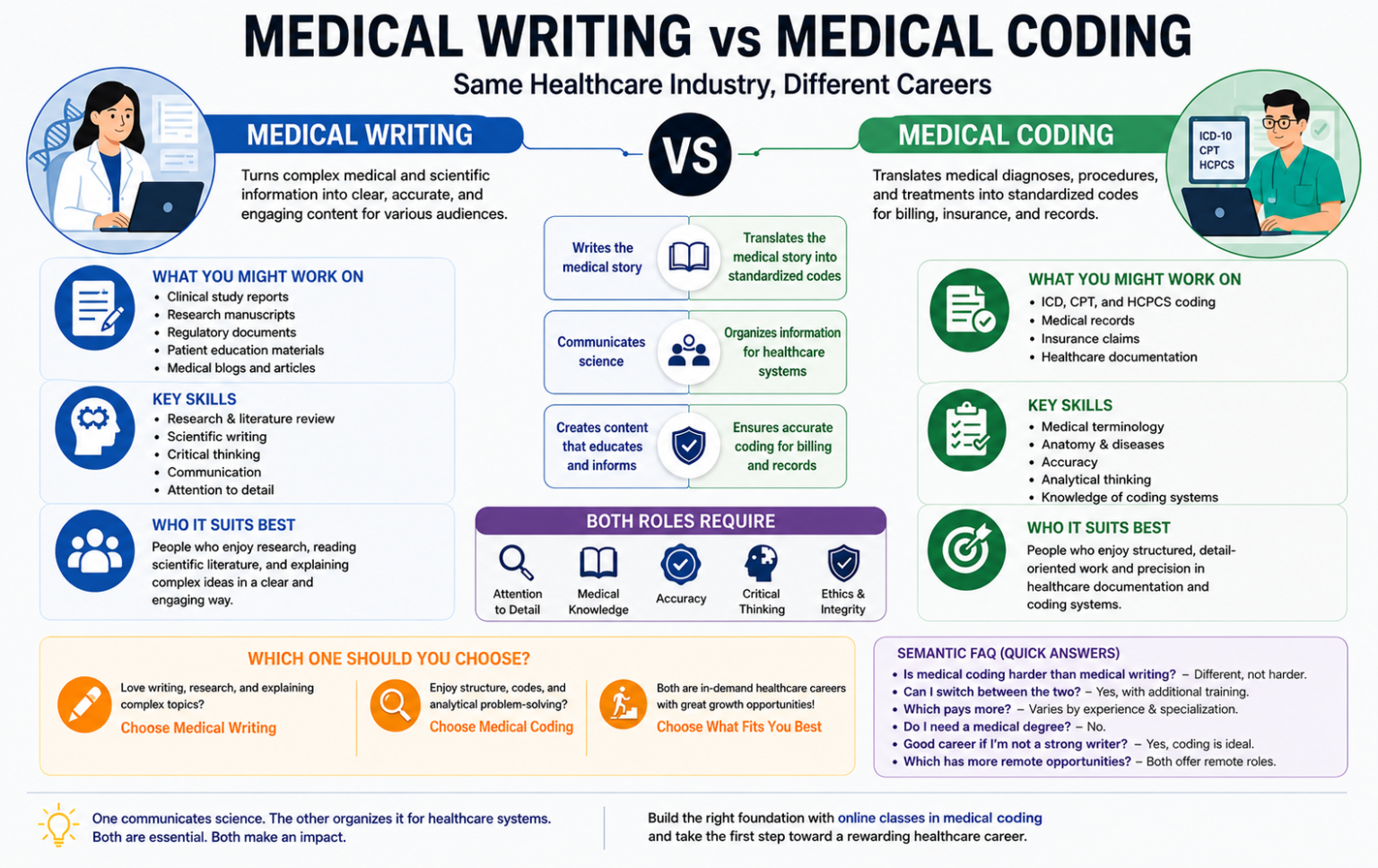
Medical writing turns complex medical and scientific information into clear, accurate, and engaging content. Think of a medical writer as a translator between dense clinical research and the people who need to actually use or understand that information, whether that’s other researchers, regulators, or patients.
What a Medical Writer Might Work On
- Clinical study reports
- Research manuscripts
- Regulatory documents
- Patient education materials
- Medical blogs and articles
Medical writing turns complex medical and scientific information into clear, accurate, and engaging content. Think of a medical writer as a translator between dense clinical research and the people who need to actually use or understand that information, whether that’s other researchers, regulators, or patients.
What a Medical Writer Might Work On
- Clinical study reports
- Research manuscripts
- Regulatory documents
- Patient education materials
- Medical blogs and articles
Key Skills for Medical Writing
- Research and literature review
- Scientific writing
- Critical thinking
- Communication
- Attention to detail
Who Medical Writing Suits Best
People who enjoy research, reading scientific literature, and writing tend to do well here. If you’re the type who actually enjoys digging through a study’s methodology section, or you like explaining a complicated topic in a way that makes it click for someone else, medical writing plays to those strengths.
What Is Medical Coding?
Medical coding translates medical diagnoses, procedures, and treatments into standardized codes (ICD-10, CPT, HCPCS) for billing, insurance, and healthcare records. Instead of writing prose, a medical coder is essentially converting a physician’s documentation into a precise, structured language that insurance systems and healthcare records can process.
What a Medical Coder Might Work On
- ICD, CPT, and HCPCS coding
- Medical records
- Insurance claims
- Healthcare documentation
Key Skills for Medical Coding
- Medical terminology
- Anatomy and diseases
- Accuracy
- Analytical thinking
- Knowledge of coding systems
Who Medical Coding Suits Best
People who enjoy structured, detail-oriented work and healthcare documentation tend to thrive in coding. If you like the idea of a job with clear rules, defined codes, and a satisfying sense of “getting it exactly right,” coding is a strong match.
The Difference at a Glance
Here’s the simplest way to think about it:
- Medical Writer – Writes the medical story.
- Medical Coder – Translates the medical story into standardized codes.
Put another way: one communicates science, and the other organizes it for healthcare systems. A medical writer turns research into readable content. A medical coder turns clinical documentation into billable, trackable data. Both roles depend on accuracy, but they express that accuracy very differently, one through language, the other through structured codes.
Which One Should You Choose?
This isn’t really a question of which career is “better,” because neither is. It genuinely comes down to your own interests and strengths.
Ask yourself:
- Do you enjoy reading research papers and explaining complex ideas in your own words, or do you prefer working with defined systems, codes, and structured rules?
- Are you more energized by writing and storytelling, or by precision, patterns, and analytical problem-solving?
- Would you rather build content that educates people, or maintain the documentation and coding accuracy that keeps a healthcare practice’s revenue cycle running?
There’s no wrong answer here. Some people even move between the two over the course of a career, since a strong grounding in medical terminology and healthcare documentation benefits both paths.
STUDENTS SUCCESS STORIES
Semantic FAQ: Medical Writing vs Medical Coding
Not necessarily harder, just different. Medical coding demands precision with structured rules and codes, while medical writing demands strong research and writing skills to communicate complex science clearly. Difficulty really depends on which skill set comes more naturally to you.
Yes, it’s possible, since both fields share a foundation in medical terminology and healthcare documentation. Moving between them usually requires additional training specific to the new role, like ICD-10-CM and CPT coursework for someone shifting into coding.
Pay varies by experience, specialization, region, and employer in both fields, so there’s no universal answer. Medical writing can pay well for specialized regulatory or scientific writing, while coding offers strong, steady demand across hospitals, clinics, and insurance companies.
No. Neither medical writing nor medical coding requires a medical degree. Both fields do require specialized training, medical writing typically benefits from strong scientific literacy, and medical coding requires certification-focused training in coding systems and medical terminology.
Yes. Medical coding relies far more on analytical thinking, attention to detail, and knowledge of coding systems than on writing ability, which makes it a great fit for detail-oriented people who don’t necessarily enjoy long-form writing.
Both fields commonly offer remote roles, since coding and documentation work can typically be done from anywhere with the right systems access, and much medical writing work is similarly location-independent.
Building the Right Foundation, Whichever Path You Choose
Whether you’re drawn to the storytelling side of medical writing or the structured precision of medical coding, the starting point is the same: a solid grounding in medical terminology, anatomy, and how healthcare documentation actually works.
If the coding side of this comparison feels like the better fit for you, Transorze offers structured online classes in medical coding that build exactly this foundation, from terminology and anatomy through ICD-10-CM, CPT, and HCPCS coding practice, so you’re genuinely prepared to step into the role, not just aware of what it involves.
