
Medical Billing & Coding Certification for High-Demand Jobs
The healthcare industry has become one of the fastest-growing employment sectors worldwide, creating an enormous demand for professionals who can accurately manage patient records, insurance claims, and healthcare documentation. Among the most sought-after career options today is Medical Billing & Coding Certification, a qualification that prepares individuals to work in hospitals, clinics, insurance companies, healthcare BPOs, and medical coding organizations. As healthcare systems continue to digitize patient records and adopt standardized coding systems, certified professionals are increasingly becoming essential to ensure accurate reimbursement, compliance, and quality patient care. Whether you’re a fresh graduate, a life science student, or someone looking for a career change, earning a recognized certification can open doors to stable employment, excellent salary packages, and long-term career growth in India and abroad.
The demand for certified professionals is growing due to increasing healthcare documentation requirements, insurance regulations, and expanding medical services worldwide. Healthcare organizations prefer candidates who possess formal certification because it demonstrates professional competence and practical knowledge of coding guidelines, medical terminology, anatomy, and billing procedures. Employers also value candidates who understand ICD, CPT, and HCPCS coding systems while maintaining high standards of compliance and accuracy. With advancements in artificial intelligence, certified coders are now expected to work alongside AI-powered coding tools, making human expertise even more valuable for quality assurance and complex case reviews. This makes certification an investment that continues to deliver career benefits for years to come.
What is Medical Billing & Coding Certification?
A Medical Billing & Coding Certification is a professional credential that validates an individual’s ability to accurately convert medical diagnoses, procedures, and treatments into standardized codes used for insurance claims and healthcare documentation. Medical coders analyze patient records and assign appropriate ICD, CPT, and HCPCS codes, while medical billers ensure healthcare providers receive timely reimbursement from insurance companies. Together, these professionals play a vital role in maintaining the financial health of hospitals and clinics while ensuring compliance with healthcare regulations. Certification proves that a candidate has mastered the knowledge and practical skills required to perform these responsibilities efficiently, reducing errors and improving revenue cycle management.
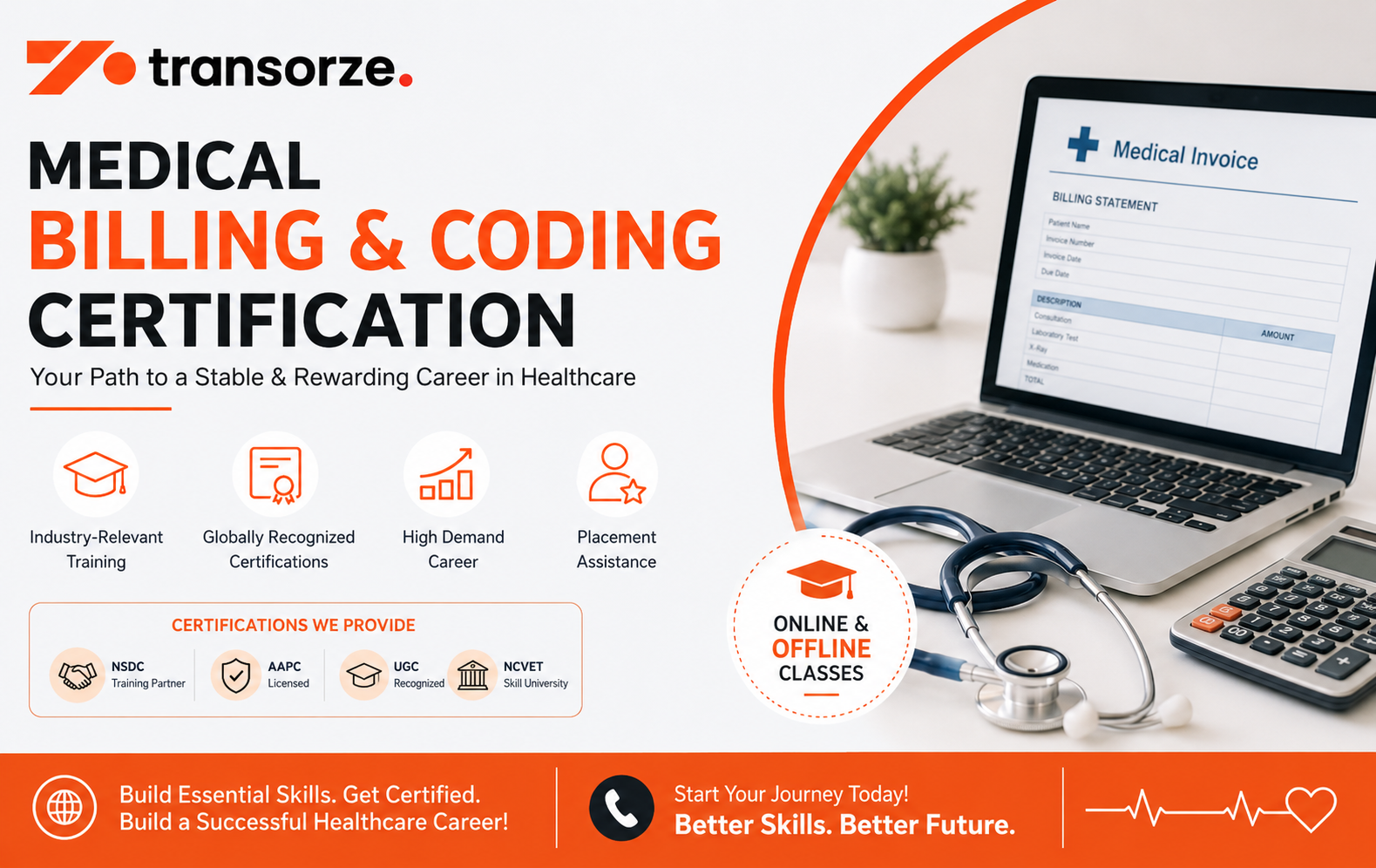
Healthcare employers increasingly prioritize certified candidates because they require less onboarding and demonstrate a stronger understanding of industry standards. Professional certification also helps candidates stand out in a competitive job market by showcasing commitment to quality and continuous learning. Many organizations now prefer applicants who have undergone structured training with practical exposure, mock coding exercises, and placement support. A comprehensive certification program not only teaches coding systems but also covers anatomy, physiology, medical terminology, reimbursement methodologies, HIPAA compliance, and healthcare documentation practices. These foundational skills prepare graduates to confidently handle real-world coding scenarios from day one. According to current program information, Transorze provides both Online & Offline classes with industry-oriented practical training and recognized certifications through partnerships including NSDC Training Partner, AAPC Licensed, and UGC recognized NCVET Skill University.
Medical Billing vs Medical Coding
Although the terms are often used together, medical billing and medical coding represent two distinct yet interconnected functions within the healthcare revenue cycle. Medical coders focus on translating physician documentation into universally accepted medical codes using coding systems such as ICD-10-CM, CPT, and HCPCS. Accuracy is critical because these codes directly influence insurance reimbursements, healthcare reporting, and compliance with regulatory standards. Even a small coding error can result in claim denials, delayed payments, or compliance issues. Coders therefore require strong analytical skills, attention to detail, and a solid understanding of medical terminology and anatomy.
Medical billers, in contrast, use the coded information to prepare insurance claims, verify patient information, communicate with insurance providers, resolve denied claims, and ensure healthcare organizations receive proper reimbursement. Billers often interact with insurance companies, patients, and healthcare providers to resolve payment issues efficiently. While coding focuses primarily on documentation accuracy, billing centers on financial processes and claim management. Professionals who understand both functions enjoy greater employment opportunities because many employers seek candidates capable of handling the complete revenue cycle. Comprehensive training programs integrate both disciplines, allowing graduates to become versatile healthcare professionals prepared for multiple job roles across hospitals, medical coding companies, insurance firms, and international healthcare organizations.
Benefits of Medical Billing & Coding Certification
Choosing to pursue a medical billing & coding training is more than earning a certificate—it is an investment in a long-term healthcare career. The healthcare industry continues to expand globally, creating consistent demand for skilled professionals who can accurately process medical records and insurance claims. Certified professionals are often given preference during recruitment because employers recognize that they have received structured training in medical terminology, anatomy, coding guidelines, reimbursement processes, and compliance standards. This reduces training time for employers while improving productivity and coding accuracy from the beginning.
Another significant advantage is career flexibility. Medical billing and coding professionals can work in hospitals, specialty clinics, diagnostic centers, insurance companies, medical coding firms, healthcare BPOs, and telehealth organizations. With the increasing adoption of digital healthcare systems, remote and hybrid work opportunities are also becoming more common. Certification provides confidence to employers that a candidate understands industry standards and can contribute effectively in various healthcare environments. As technology continues to reshape healthcare documentation, certified professionals who stay updated with coding standards remain highly valuable in the job market.
Better Salary and Career Growth
One of the biggest motivations for earning certification is the potential for improved earning opportunities. Organizations are generally willing to pay higher salaries to certified professionals because accurate coding directly impacts revenue generation and regulatory compliance. Skilled coders help healthcare providers reduce claim denials, improve reimbursement rates, and maintain documentation quality, making them valuable assets to any healthcare organization.
Career progression is another important benefit. Many professionals begin as junior medical coders or billing executives and gradually move into senior coding, auditing, quality assurance, team leadership, compliance management, or training roles. Some even specialize in fields such as radiology, cardiology, orthopedics, emergency medicine, or outpatient coding. Continuous learning and professional certifications can accelerate career advancement and increase long-term earning potential.
Skills Required for Medical Billing & Coding
Success in medical billing and coding requires a balanced combination of technical expertise and professional skills. While coding software and AI-assisted tools can automate certain repetitive tasks, human expertise remains essential for interpreting complex clinical documentation and ensuring coding accuracy. Employers therefore seek candidates who possess both technical knowledge and analytical thinking.
Some of the most important technical skills include understanding ICD-10-CM, CPT, and HCPCS coding systems, medical terminology, anatomy, physiology, healthcare documentation, insurance claim processing, and reimbursement methodologies. Professionals should also be comfortable using electronic health record (EHR) systems and coding software. Since coding standards are updated regularly, a commitment to continuous learning is essential.
Equally important are soft skills. Attention to detail, critical thinking, communication, time management, confidentiality, and ethical decision-making all contribute to success in this profession. Coders frequently review detailed physician documentation where even a small mistake can affect claim approval or patient records. Strong organizational skills and the ability to work under deadlines help professionals maintain both accuracy and productivity.
Certifications That Employers Value
Healthcare employers increasingly prefer candidates with recognized certifications because these credentials demonstrate competency and adherence to industry standards. Selecting a training institute that offers nationally and internationally recognized certifications can significantly improve employability.
AAPC Licensed Training
The AAPC Licensed curriculum is recognized globally and prepares students for professional medical coding careers. AAPC certification is respected by healthcare organizations because it emphasizes practical coding knowledge, compliance, and coding accuracy. Students trained using licensed material gain exposure to real-world coding scenarios that align with current industry practices.
NSDC Training Partner
Programs offered through an NSDC Training Partner focus on developing industry-ready skills aligned with national workforce development initiatives. This recognition adds credibility to the certification and assures employers that the training follows structured skill development standards.
UGC Recognized NCVET Skill University
A certification associated with a UGC recognized NCVET Skill University provides additional academic value while ensuring that students receive structured education designed to meet evolving industry requirements. Such recognition enhances the credibility of the qualification and supports career opportunities across various healthcare sectors.
How to Choose the Right Medical Billing & Coding Institute
Selecting the right Medical Billing & Coding institute can significantly influence your career success. While many organizations offer training programs, not all provide the same level of curriculum quality, faculty expertise, practical exposure, or placement support. Before enrolling, prospective students should evaluate several important factors rather than focusing solely on course fees.
An ideal training institute should offer updated curriculum aligned with current coding guidelines, experienced instructors, hands-on practical sessions, live case studies, interview preparation, certification guidance, and placement assistance. Students should also verify whether the institute provides recognized certifications and maintains connections with healthcare employers. Practical learning through coding exercises and real-world documentation significantly improves job readiness compared to purely theoretical training.
Another important consideration is learning flexibility. Many students and working professionals prefer the convenience of online learning, while others perform better in classroom environments. Choosing an institute that offers both options allows learners to select the format that best suits their schedule and learning style.
Online vs Offline Classes
Modern learners have different educational needs, making flexibility an important factor when selecting a medical billing and coding course. Online medical billing and coding classes provide convenience, allowing students to learn from home while balancing work, studies, or family responsibilities. Live interactive sessions, recorded lectures, digital assessments, and online mentoring have made virtual learning highly effective for many students.
Offline classroom training, on the other hand, offers face-to-face interaction with instructors, immediate doubt clarification, collaborative learning, and structured classroom discipline. Many students appreciate the opportunity to participate in practical coding exercises alongside peers and receive direct feedback from experienced trainers.
Providing both Online & Offline classes enables students to choose the learning method that aligns with their preferences and circumstances. This flexibility ensures that quality education remains accessible to a wider range of learners without compromising practical skill development.
Career Opportunities After Medical Billing & Coding Certification
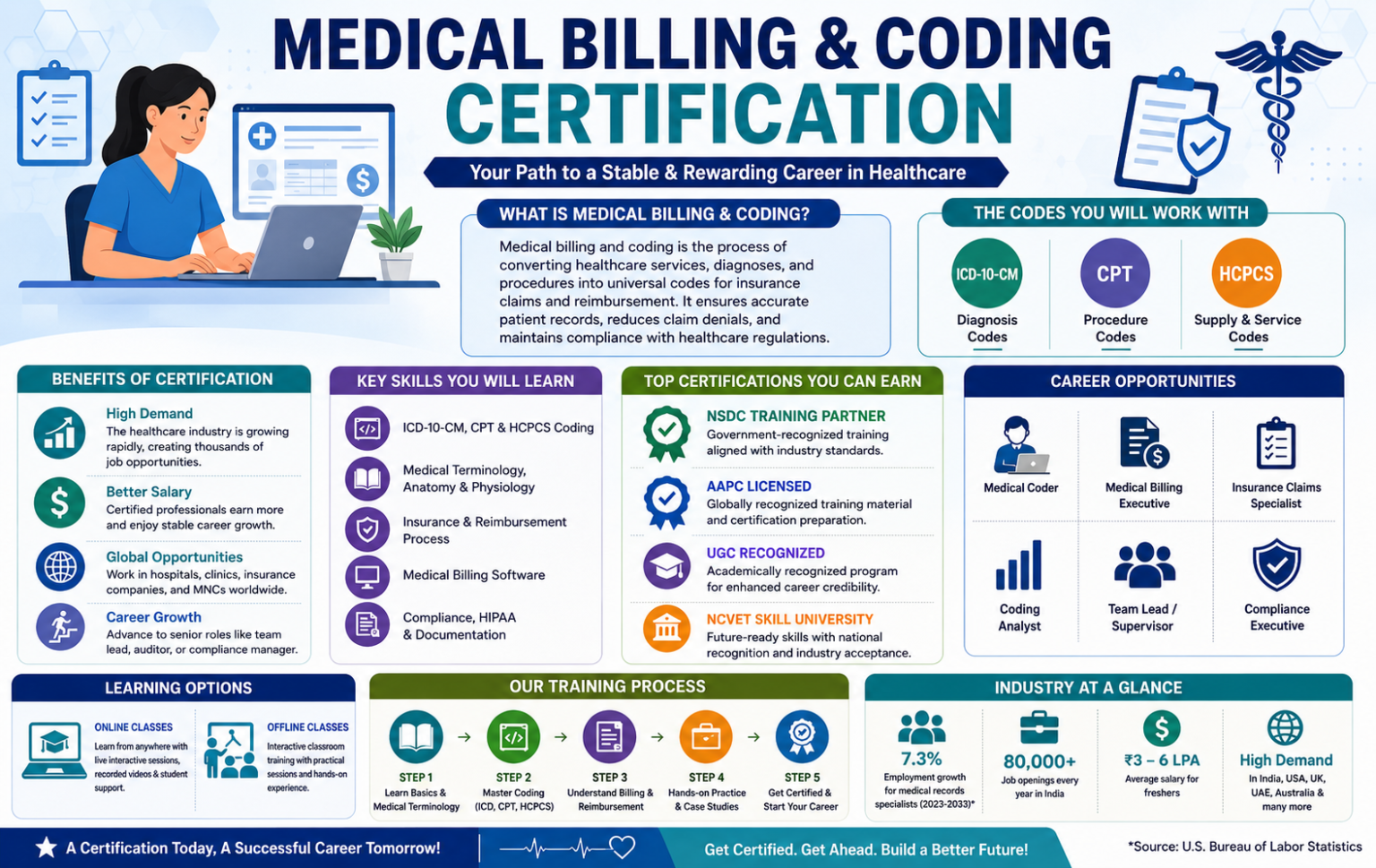
Completing a Medical Billing & Coding Certification opens the door to a wide range of career opportunities in the healthcare industry. As hospitals, clinics, insurance companies, and healthcare outsourcing firms continue to digitize their operations, the demand for professionals who can accurately manage medical documentation and insurance claims continues to grow. Certified professionals are employed by multispecialty hospitals, physician practices, diagnostic laboratories, pharmaceutical companies, healthcare consulting firms, and revenue cycle management organizations. Many international healthcare companies also recruit skilled coders to support their global operations, creating opportunities for candidates who want to build careers with multinational organizations.
Some of the common job roles include Medical Coder, Medical Billing Executive, Coding Analyst, Insurance Claims Specialist, Revenue Cycle Associate, Medical Records Technician, Coding Auditor, Compliance Executive, and Quality Analyst. With experience, professionals can advance into leadership positions such as Coding Team Lead, Coding Manager, Training Specialist, Clinical Documentation Improvement (CDI) Specialist, or Healthcare Compliance Manager. Since healthcare services operate around the clock, skilled professionals enjoy stable employment and continuous career progression. The combination of specialized knowledge, recognized certification, and practical training significantly improves employability in both domestic and international healthcare markets.
Future Demand for Medical Billing & Coding Professionals
Healthcare remains one of the fastest-growing industries worldwide, and the need for accurate medical documentation continues to increase every year. The expansion of health insurance coverage, electronic health records (EHRs), telemedicine, and value-based healthcare models has made medical coding more important than ever. While artificial intelligence is helping automate repetitive coding tasks, it cannot fully replace trained professionals who understand clinical documentation, coding regulations, payer guidelines, and compliance requirements. Human expertise remains essential for reviewing complex medical cases, resolving claim denials, conducting quality audits, and ensuring coding accuracy.
The future also brings new opportunities in AI-assisted coding, healthcare analytics, clinical documentation improvement, and medical auditing. Professionals who continuously update their skills and stay informed about evolving coding guidelines will remain highly competitive. Employers increasingly seek candidates who can work effectively alongside AI-powered coding platforms, ensuring quality assurance and compliance rather than relying solely on automation. This evolving landscape makes certification not just valuable today but also a strong investment for long-term career growth.
STUDENTS SUCCESS STORIES
Why Choose Transorze for Medical Billing & Coding Certification?
Selecting the right training provider is one of the most important decisions in your career journey. A quality training institute should offer more than classroom instruction—it should prepare students for real-world employment through practical exposure, industry-recognized certifications, and career support. A comprehensive curriculum should cover anatomy, physiology, medical terminology, ICD, CPT, HCPCS coding systems, insurance processes, revenue cycle management, mock interviews, resume preparation, and hands-on coding practice using real-life scenarios.
Students also benefit from learning flexibility. Whether you prefer attending regular classroom sessions or studying remotely, having access to Online & Offline classes allows you to learn at your own pace while maintaining the same academic standards. Industry-recognized credentials such as NSDC Training Partner, AAPC Licensed, and UGC recognized NCVET Skill University certifications add credibility to your profile and increase employer confidence during recruitment. Combined with experienced faculty, practical assignments, interview guidance, and placement assistance, these advantages help students transition smoothly from training to professional employment.
Conclusion
A Medical Billing & Coding Certification is one of the most practical career choices for individuals seeking stability, professional growth, and opportunities in the rapidly expanding healthcare sector. As healthcare organizations continue to adopt digital technologies and standardized documentation systems, the demand for trained coding and billing professionals remains strong across hospitals, insurance companies, healthcare BPOs, and multinational organizations. Certification demonstrates your technical expertise, commitment to quality, and readiness to contribute effectively in real-world healthcare environments.
Choosing a training program that combines comprehensive education, practical experience, recognized certifications, and flexible learning options gives you a significant advantage in today’s competitive job market. Whether you are a fresh graduate, a life science student, or a working professional looking for a career transition, the right certification can help you build a rewarding future. With continuous learning and industry-recognized credentials, you can establish a successful long-term career in one of the world’s most resilient and growing industries.
Recommended Reads
- Courses for Medical Coding: Complete Career Guide for Aspiring Healthcare Professionals
- Unlock Your Career: Essential Medical Coding Classes to Enroll
- Medical Coding and Billing Certificate: Your Complete Guide to a Rewarding Healthcare Career
- Online Course Medical Coding: A Complete Guide to Building a Career in Healthcare
Frequently Asked Questions
A Medical Billing & Coding course Certification is a professional qualification that validates your knowledge of medical coding systems, billing procedures, healthcare documentation, and insurance claim processing. It helps improve employability and demonstrates industry-ready skills.
Yes. The healthcare outsourcing industry continues to expand, creating strong demand for certified medical coding and billing professionals. Graduates can find opportunities in hospitals, insurance companies, healthcare BPOs, and multinational organizations.
Yes. Transorze now offer Online & Offline classes, allowing students to choose the learning format that best suits their schedule while receiving the same curriculum and certification support.
Employers often value programs that include recognized credentials such as AAPC Licensed, NSDC Training Partner, and UGC recognized NCVET Skill University certifications because they reflect industry-relevant training and practical knowledge.
Eligibility varies by institute, but many programs are suitable for graduates, life science students, pharmacy graduates, nursing professionals, allied healthcare graduates, and individuals seeking a career change into the healthcare industry.
